-
Sheep Life
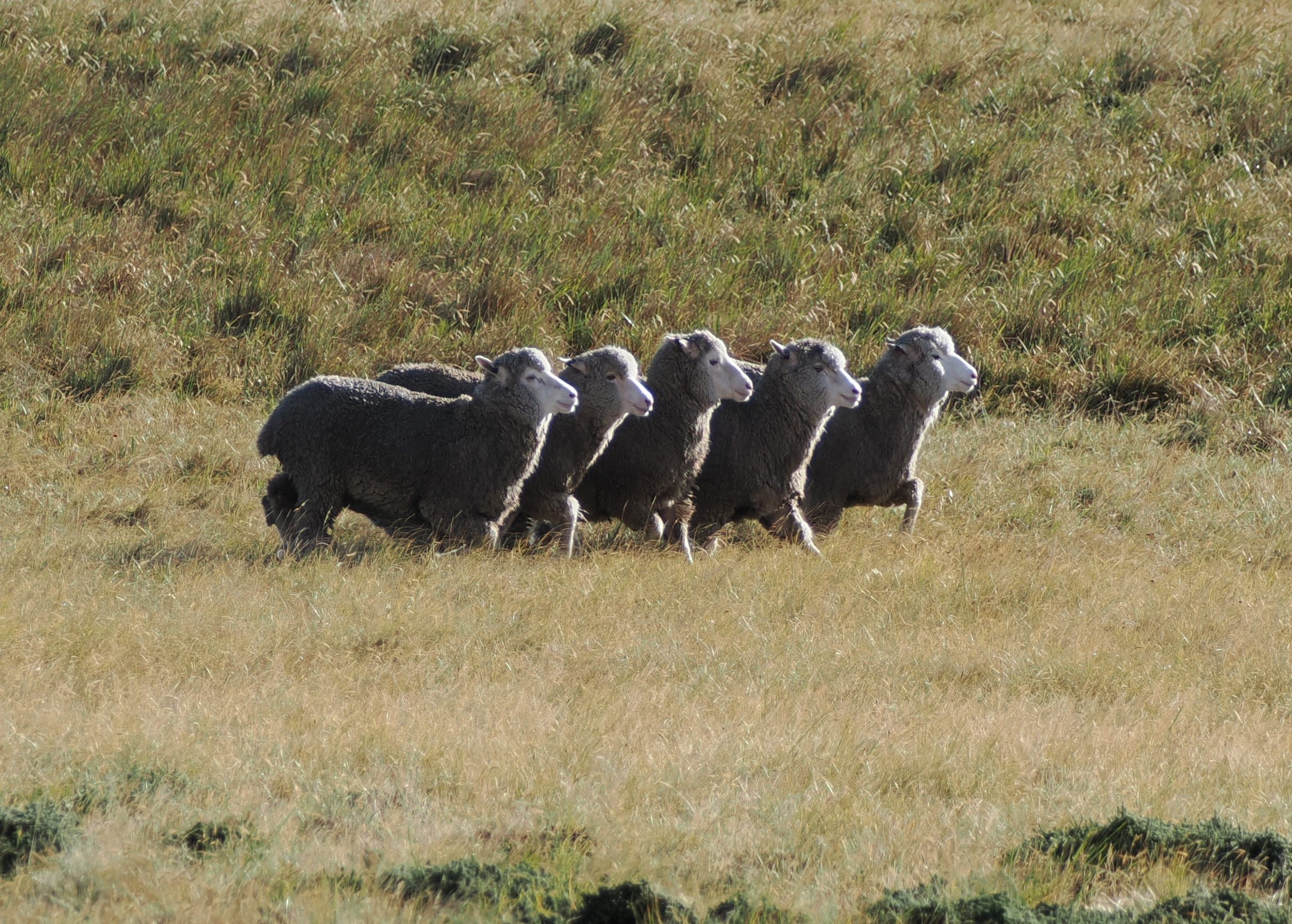
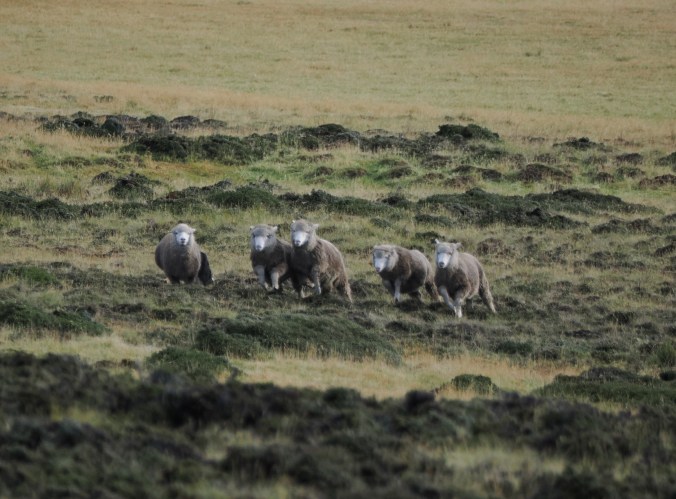
Sheep are the farm animal which is synonymous with the Falkland Islands, there are about 500,000 of them across the Islands. However, when you get to the Islands it may take you a while to see them. Partly this is because they have a lot of land to roam in (about 1 sheep per 10 acres) and partly because their fleeces are dull grey on the surface which makes them blend into the landscape.
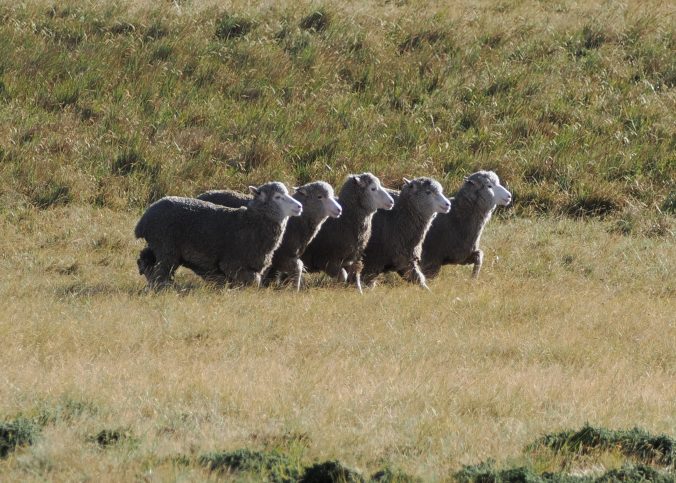
The other reason they are hard to see is their flightiness. What do I mean? Well in the UK, if you’re out walking and see sheep, they will probably ignore you or at most lift their heads and have a look at you. In the Falklands, the first moment that a sheep sees you, it’s off running as hard as it can. Most of the time your view of a Falklands’ sheep is it disappearing into the distance.
It doesn’t matter whether you are on foot, in a vehicle or a plane – once the sheep spot you, they’re off.
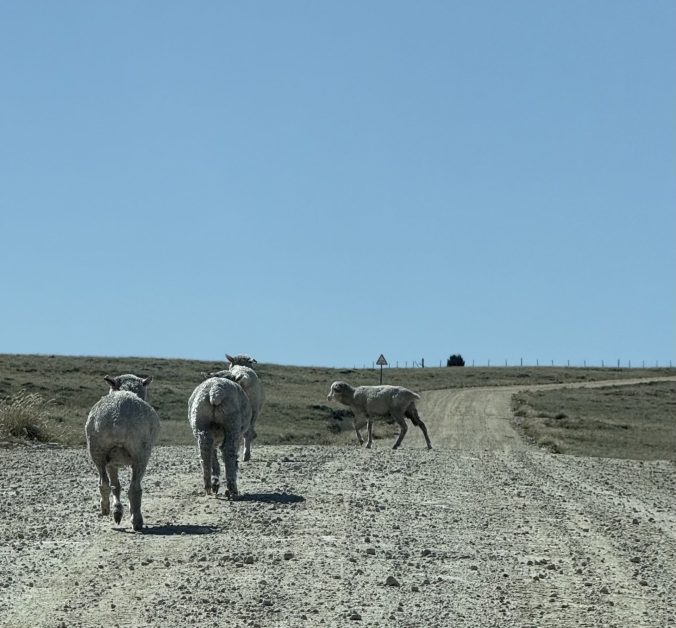
Inadvertently herding sheep up.a road My theory on this is that sheep in the Falkland Islands live such free-range and wild lives that they don’t see people from one week to the next. They fend for themselves – they lamb on their own, they survive (or not) the weather on their own. The only time they see people is when they are gathered (brought together and moved) for major events in their lives, such as:
- annual shearing of their fleeces
- lamb marking – when lambs are vaccinated, given ear tags, tails are docked and male lambs are castrated
- lambs being weaned from their mothers
- moved from one enormous pasture to another
So, clearly the right thing to do when seeing a human, is run. Unless of course it’s a pet sheep but that’s a whole different post.
The independent life of a Falkland Islands sheep means that they are cautious of people and this makes them hard work for the working dogs. I saw this at a sheep dog trials recently – the experienced dogs gained control of their sheep and were able to move them, more or less where they wanted – even if it did take quite a lot staring them down….
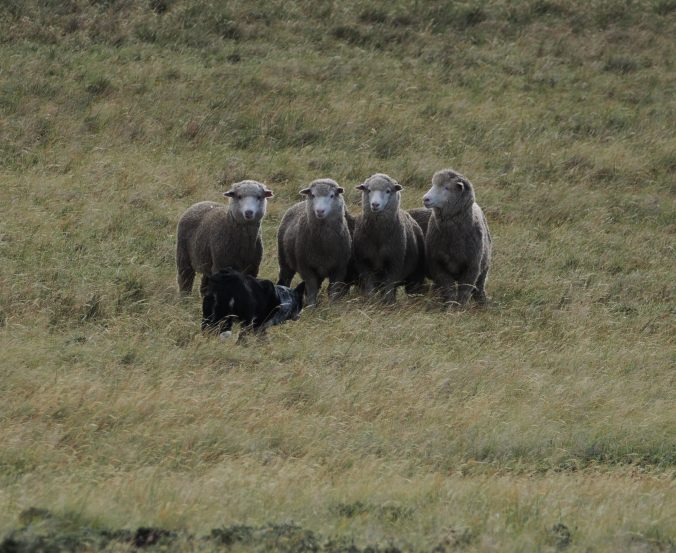
But this did not always work, which could result in a lot of flat out running to try and catch up with them and control them. For one young dog, it went so wrong – or for the sheep, so right – that the dog ended up driving the sheep in completely the opposite direction of what was required and it was only solved by the shepherd getting in a car to catch up and retrieve the dog. 1 – 0 to the sheep.
-
First impressions of São Paulo
After 3 years in South America, I’ve had my first experience of Brazil, as I went to an education conference in São Paolo in October.
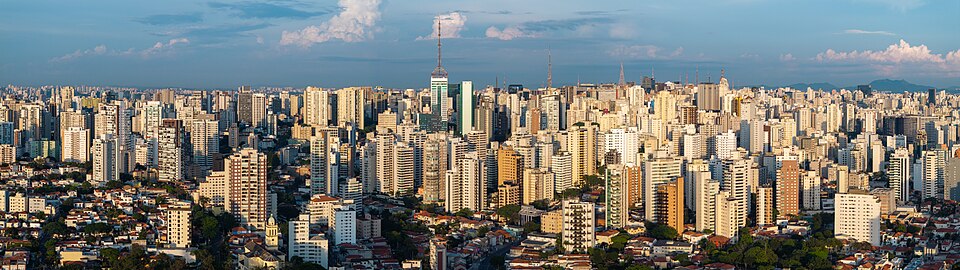
São Paolo is a mega city, the largest city in Latin America with over 30 million people in the macro-metropolis area. It is absolutely vast and the car is the favoured way to travel. The traffic is correspondingly awful and huge motorway-width roads carve through the city, certainly everywhere we travelled. We were advised that we should allow two hours to travel between the airport and our hotel, which was only a distance of 33 kilometres.
From what we experienced of the city, it is densely built with tower blocks everywhere and residential and offices mixed into together. There are some neighbourhoods called Jardim (garden) which are a bit greener, but not that much.
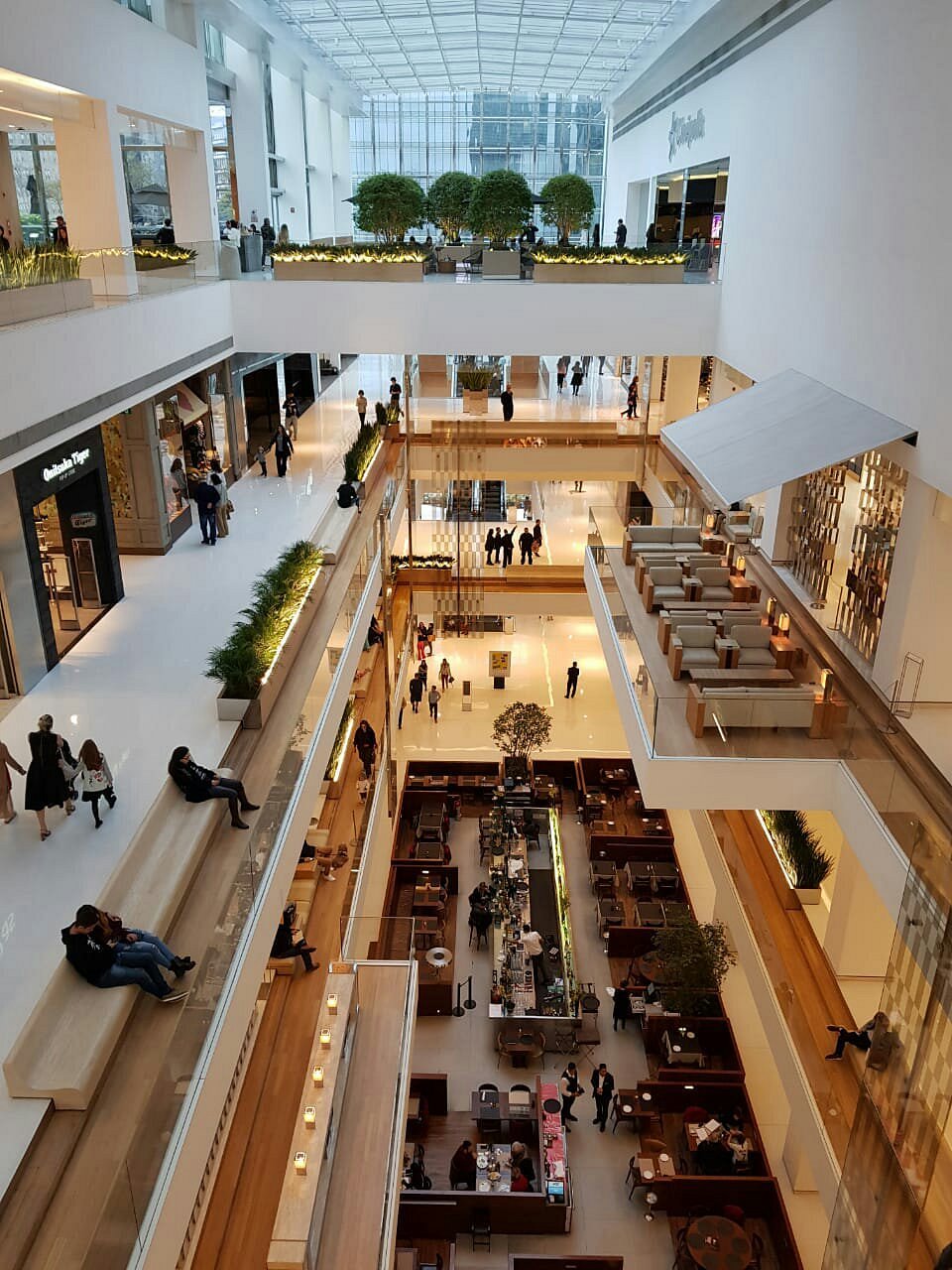
Malls seemed to be a popular way of shopping and the students we had taken with us were very keen to experience them. The first one we visited was a temple to luxury with the shiniest floors and walls I’ve seen and home to Cartier, Gucci, Prada et al. We did a 5 minute gawp at all the things we couldn’t afford and didn’t need and then went to a more normal, but still mega-sized mall, where the students shopped and we had a good Italian meal, in a restaurant named after a sheep (something for the Falklands’ restauranteurs to consider!)
I had been told that São Paulo is the foodie capital of Brazil and we ate very well. The different migrant communities brought their food with them, so as well as traditional Brazilian food there is an excellent range of Italian and Asian restaurants. Apparently São Paulo has the largest Japanese community outside Japan and just round the corner from our hotel was a Japanese restaurant, which we really enjoyed.
Due to our conference commitments we didn’t get a chance to explore but I did have one great cultural experience. At tne end of a conference day there was an hour for a Brazilian experience – I chose Batucada, which is a style of Samba carnival percussion. A group of 4 talented, energetic, patient and smiley musicians, took a slightly weary group of middle-aged British school leaders and shared their joy of the music with us. It was huge fun and at the end we too were smiley and relaxed. I just need to find a Batucada session in the Falklands!
-
A spring break in San Pedro de Atacama
In October I spent some time in San Pedro de Atacama, for a spring break – although I’m not sure that spring is really a concept in a desert. However, being spring meant that it was a moderate temperature, both at night (not freezing) and during the day (not incredibly hot, merely high 20s in the afternoon). Arriving at Calama airport and driving over to San Pedro, my first impressions were featureless desert, dotted with mines, wind farms and solar panels.
However, as we neared San Pedro, gently climbing all the time and going over a pass of over 3,000m (the town sits at 2,400m), the landscape became more interesting. Rocks sculpted by moisture and wind; perfect volcanoes punctuating the skyline; pinpricks of green showing where rivers ran and water provided life. The small town of San Pedro benefits from being located where two rivers join together – the eponymous Rio San Pedro and Rio Vilama. Ancient peoples settled this area around 12,000 years ago and their descendants, the Atacameños or Licanantay, survived incorporation into the Inca Empire in the 1500s and then the Spanish Conquest and still live in communities across the area. Gradually Chile is recognising the rights of its indigenous groups and in this area it means that many of the natural reserves are managed with the local communities and their beliefs are respected more frequently.
I settled happily into the lovely Hotel Terrantai, a cool, calm oasis, in the very centre of town, notable for the exemplary customer service of the staff and the way that “ayni”, a local custom of reciprocity, was woven into the hotel’s care for its customers. My favourite example was nightly “wine-tasting”, when from 7pm to 9pm several wines were on offer, accompanied by delicious olives, cheeses, breads and dips; a fire and an encouragement by the staff for to guests to talk to each other. A very calm, relaxing end to each day.
I spent 5 nights in San Pedro and at first I was a little underwhelmed by the small town, made of adobe and sand blowing through the streets. I was overwhelmed by the concentration of tour vendors, tourist restaurants and shops with everything a tourist might want. It is without doubt a tourism hotspot and I had the sense that somewhere else the real life of the town was going on. Not my preferred type of travel but a necessary evil for this particular location.
I had chosen to leave buying tours until I got to San Pedro in the belief that I would be able to make a better choice of what to do once I was there. However on my first afternoon I was confused by the cacophony of offers and didn’t want to commit to anything! In the end I settled for buying a tour to the Valley of the Moon for the following afternoon and then went back to the hotel and did some serious online research. The following morning I was ready to book the rest of my tours for the week.
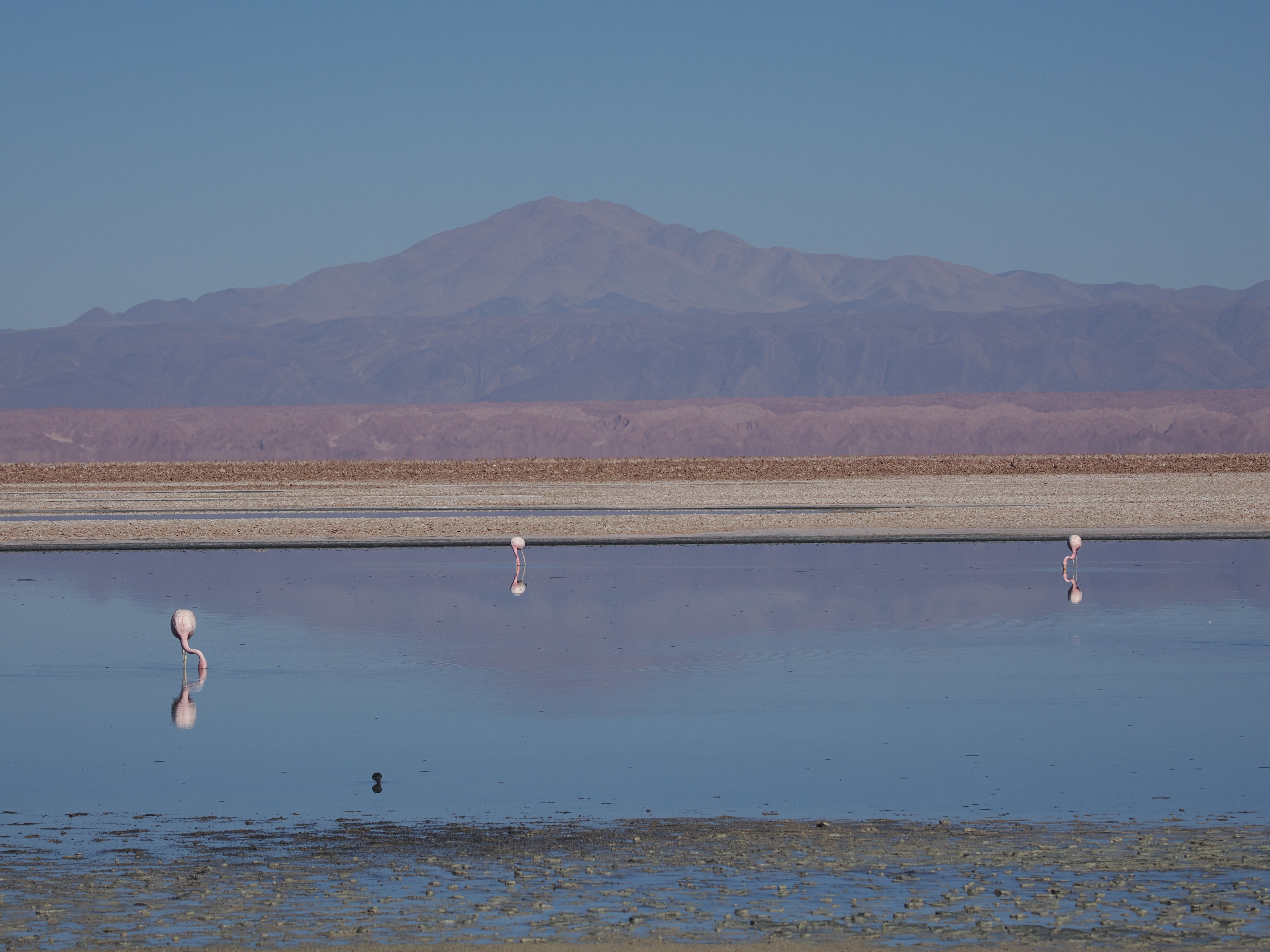
Despite my dislike of the town and the circus of tour sales, once I started travelling in the area I began to appreciate what all the fuss is about. Around San Pedro, the combination of wind, water, minerals and rocks combine to produce memorable, vast landscapes. The Valley of the Moon has been sculpted over time by the wind to produce extraordinary shapes and sand dunes. Unexpectedly there are salt covered slopes where the salt crystals expand and contract in response to changes in temperature and you can listen in silence to the sounds of cracking, like tiny glacier noises in the desert. In the National Flamingoes Reserve, I visited Laguna Chaxa, a lake open to tourists to see flamingoes, beautifully managed to control the impact visitors have on the birds.
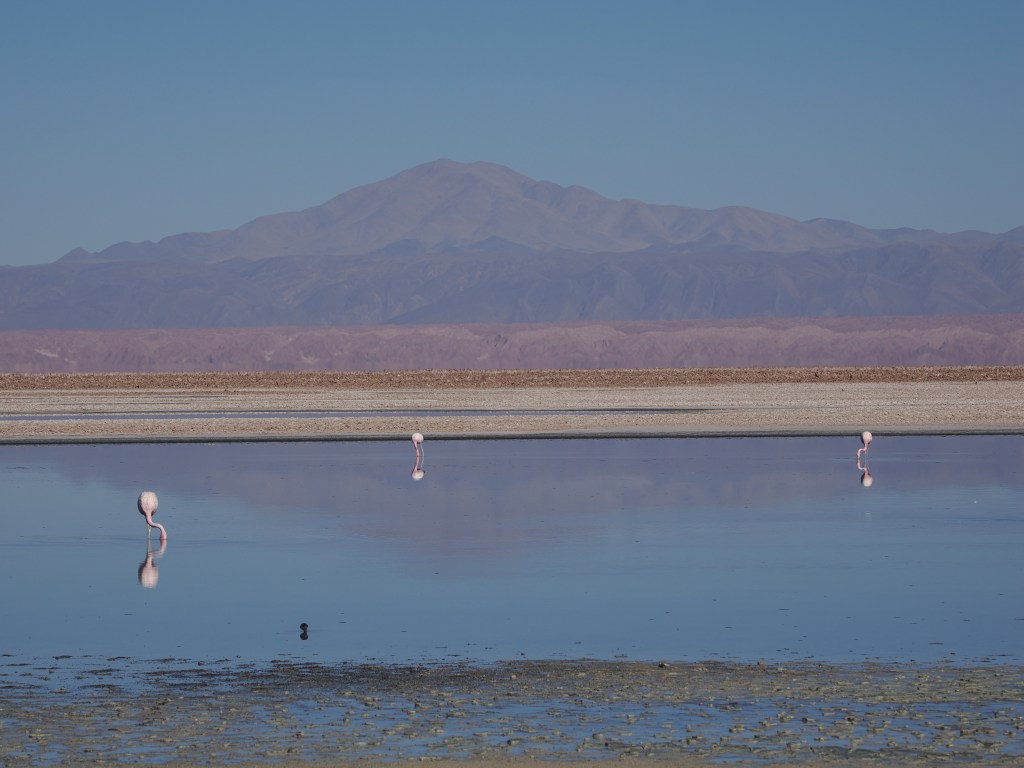
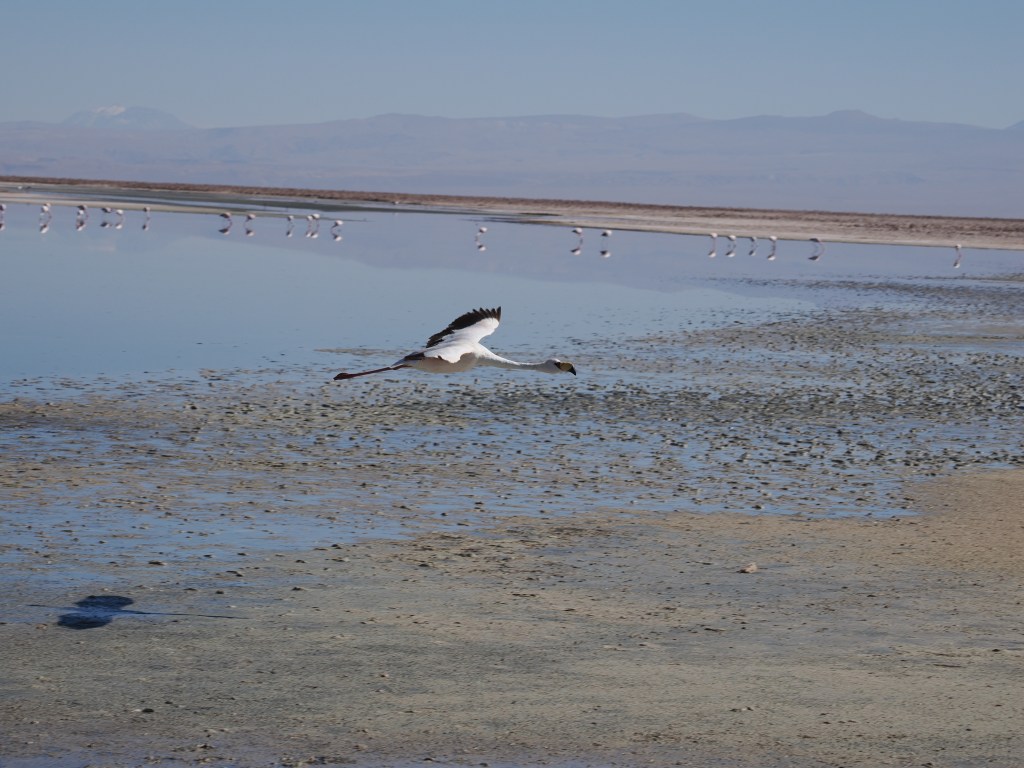
It’s also possible to go up the Altiplano and visit pristine lakes. As we climbed up towards 4,000m I found myself grinning from ear to ear. I love being in high mountains, there’s something about the blue of the sky, the yellower grass, the peaks of the mountains with smudges of snow and the clarity of the lakes. It never fails to make me happy and to feel at peace.
On my last day, I went to the Geysers del Tatio. I was picked up at 5am and the minibus drove through the dark, at first on a standard road and then on unpaved roads that reminded me of the Falklands. Driving these was not for the faint-hearted, particularly as the professional drivers, who knew exactly where they were going and how their vehicles handled, drove them at speed. The point of the early start was to arrive at the geyser field in the pre-dawn twilight, when the field is most active and the steam can be seen really clearly. It was a fascinating visit and our guide’s explanations were excellent. High quality guiding is something I’ve been really impressed with in Chile, both here and elsewhere. The guides in national parks all seem to have high level qualifications, an industry accreditation and take their jobs seriously. I loved the enthusiasm of my guide to the petroglyphs – she had specialised in them during her tourism degree and her passion and energy was infectious.
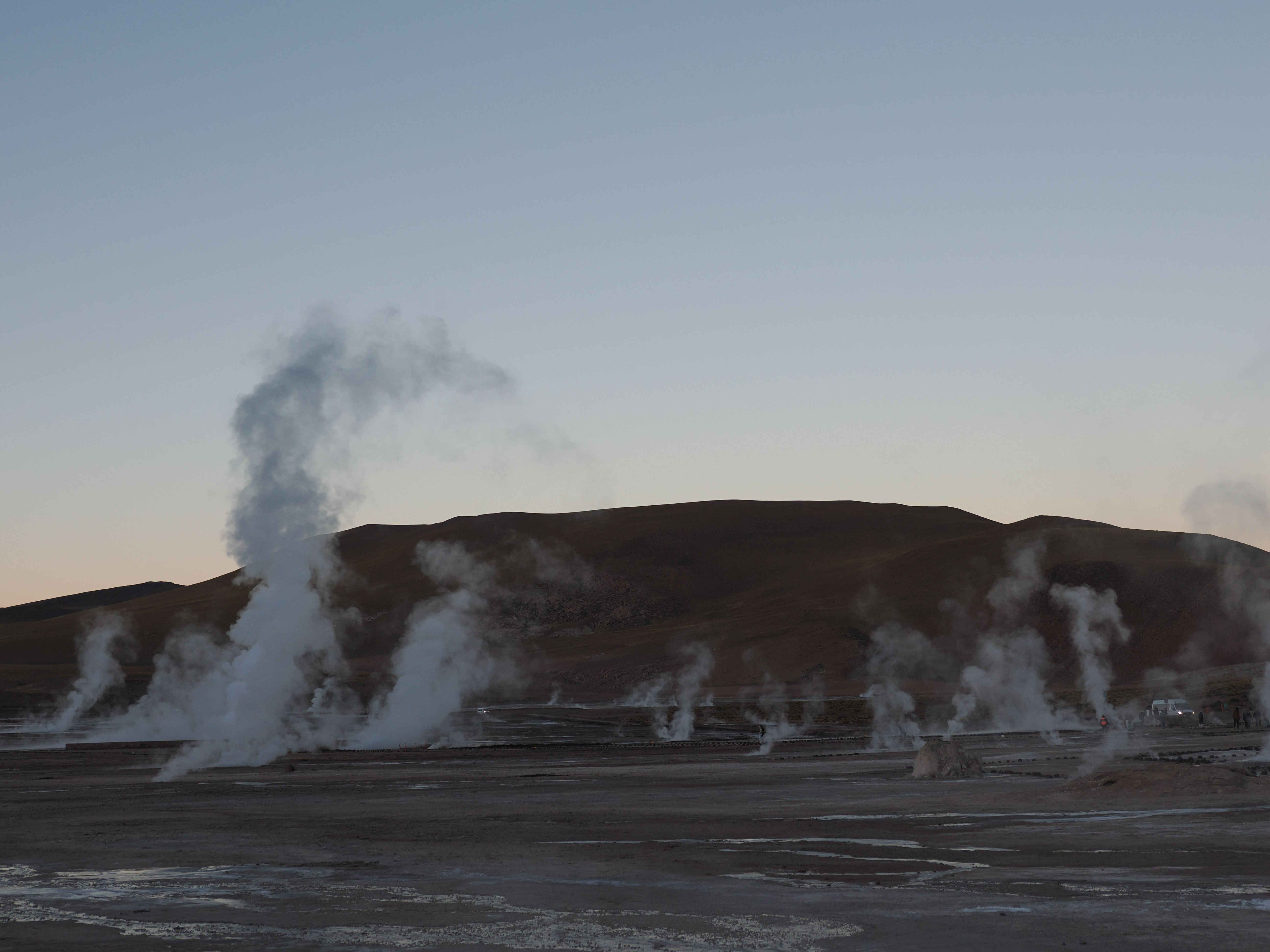
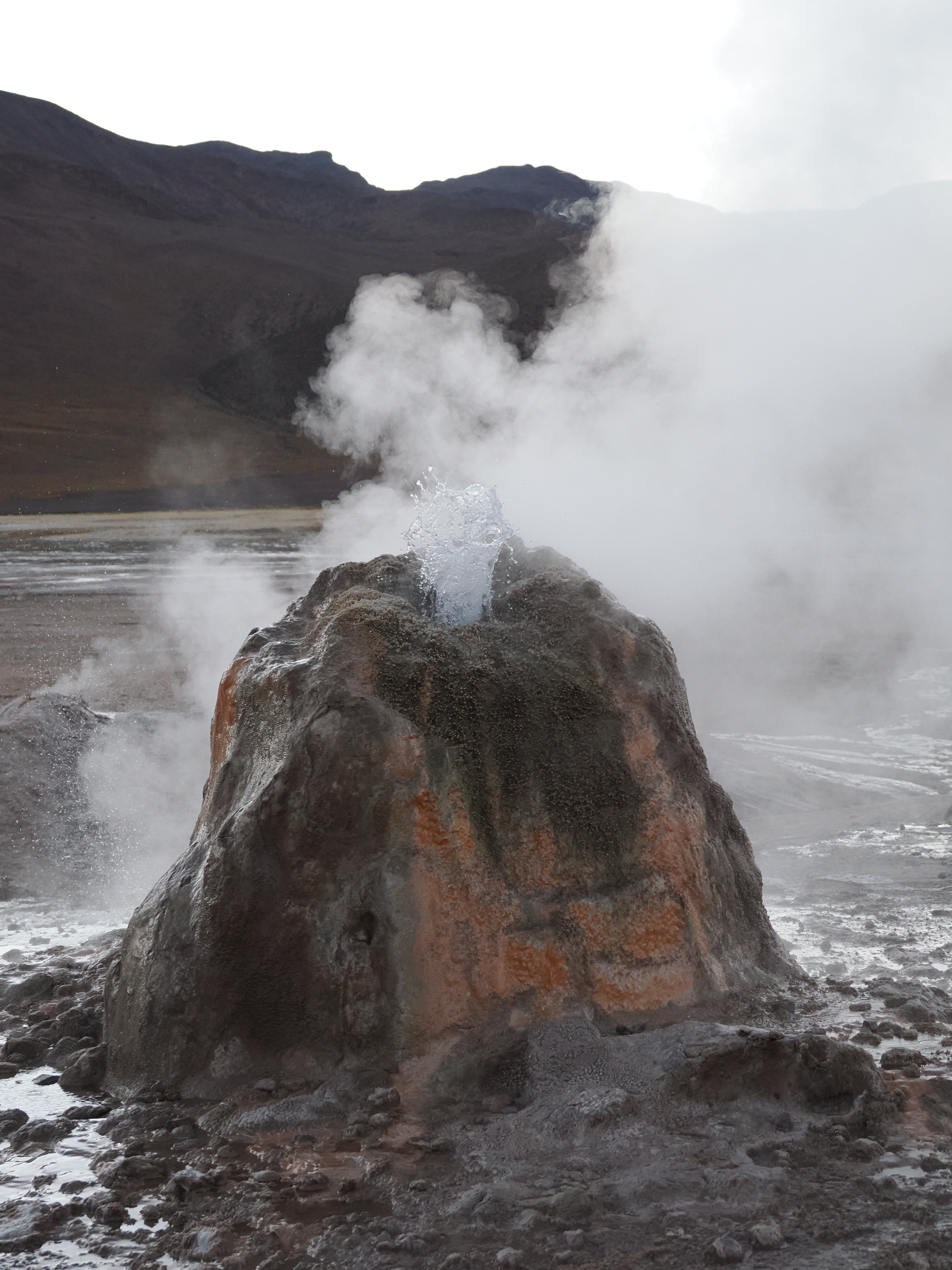
As I travelled back across the desert to Calama, I saw the landscape with different eyes from those I had arrived with, more attuned to the variety and beauty that this seemingly harsh area offers and wondering whether I should come back. This area has definitely got under my skin, not something that I expected and proof yet again, that nothing beats experiencing places in person.
-
Ode to a Library

Fear not, despite the title I am not going to channel my inner Keats and force a poem on anyone. None of us deserve that.
I am, however, going to share my appreciation of my local library, and I realise that a more correct literary title would be a “Paeon of Praise” but it´s autumn (well it was when I first thought about this post) and all our recent mists have made me think of Keats and Odes, though truthfully autumn in the Falklands has little in common with the “mellow fruitfulness” of Keats’ England.
One of the jewels of life in Stanley is the Christie Community Library – perched on a hill just to the west of the city centre, sharing a building with Falkland College. It has the advantage of being modern, having a great view across the harbour and beingwell decorated and laid out. It has an excellent selection of modern fiction for all ages, reference books and a good collection of Falkland Islands history. It’s cheering to see a community invested in the importance of its library and ensuing that it has the funds to keep its collection fresh and importantly that it is free to use and works hard to support the whole community.
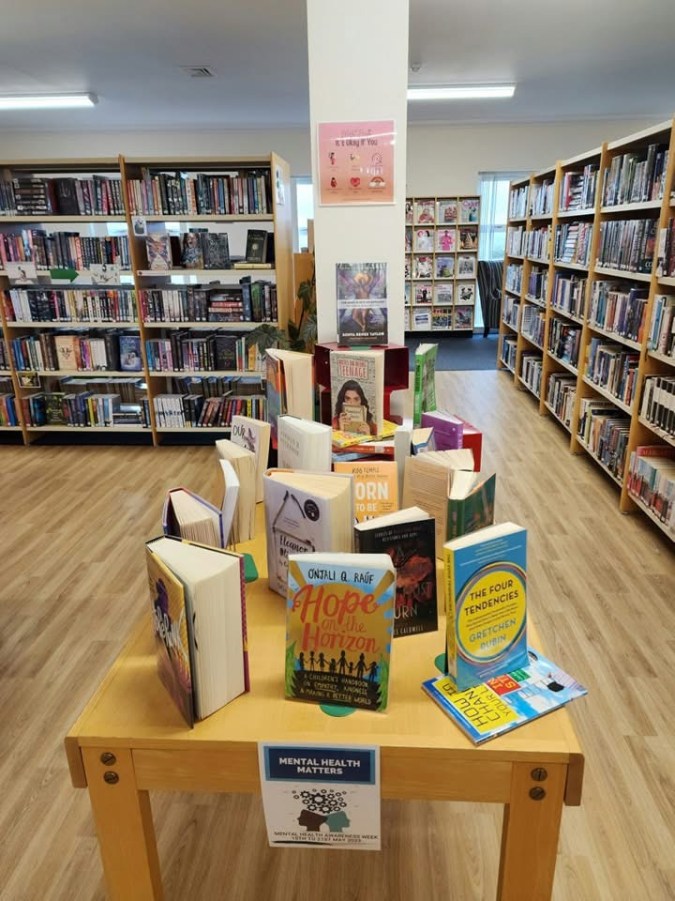
The librarians are passionate about encouraging pleasure in reading and go to great lengths to ensure that everyone benefits, helping their readers choose books and thinking up monthly themes and annual challenges that nudge people to explore authors they don’t normally read.
The library runs many community activities from those for babies and their parents to sessions for older residents. My particular favourite is Book Chatter – a not book group! Book groups generally all read the same book and then talk about it. This is a challenge for us in finding enough copies of the same book to read – the library tends to only have 1 copy of anything at a time and there is no book shop in Stanley. The solution to this is to meet once a month and talk about whatever we’ve read. This is rather wonderful, as it introduces us to new authors, genres and themes and it is a pleasure to spend an hour a month with others who love reading.
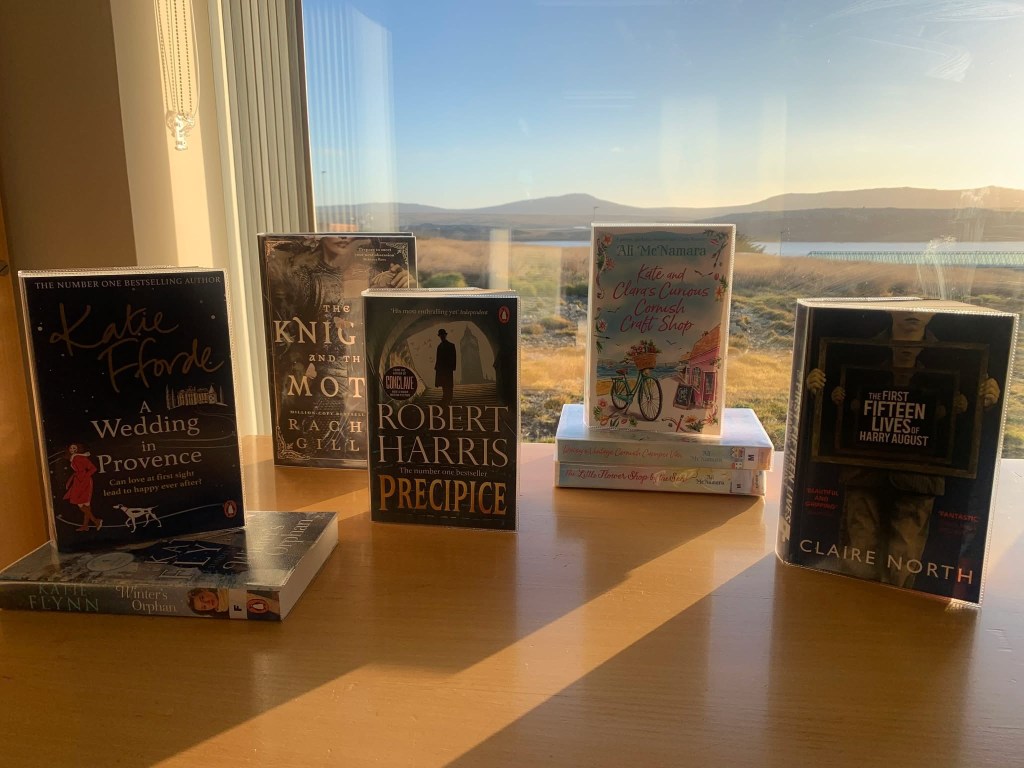
The library works really well for those who can travel into Stanley but what about more remote readers? Never fear, I recently learned that the librarians send book parcels to regular Camp readers with FIGAS. More surprisingly they explained that generally they have to choose the books for these readers, as the library’s book collection is not yet available online, so each arriving parcel is full of mystery books! Yet another example of resourcefulness at its best in the Falklands.
-
A long, thin country
Lots of people know that Chile is a very long country and one way of understanding this is to unfold a standard size country road map. Most countries fit fairly nicely onto the map, or can be put easily onto two sides – not so Chile. When you unfold the map for Chile you find it consists of a series of long, thin slices which take a little while to get your head around.
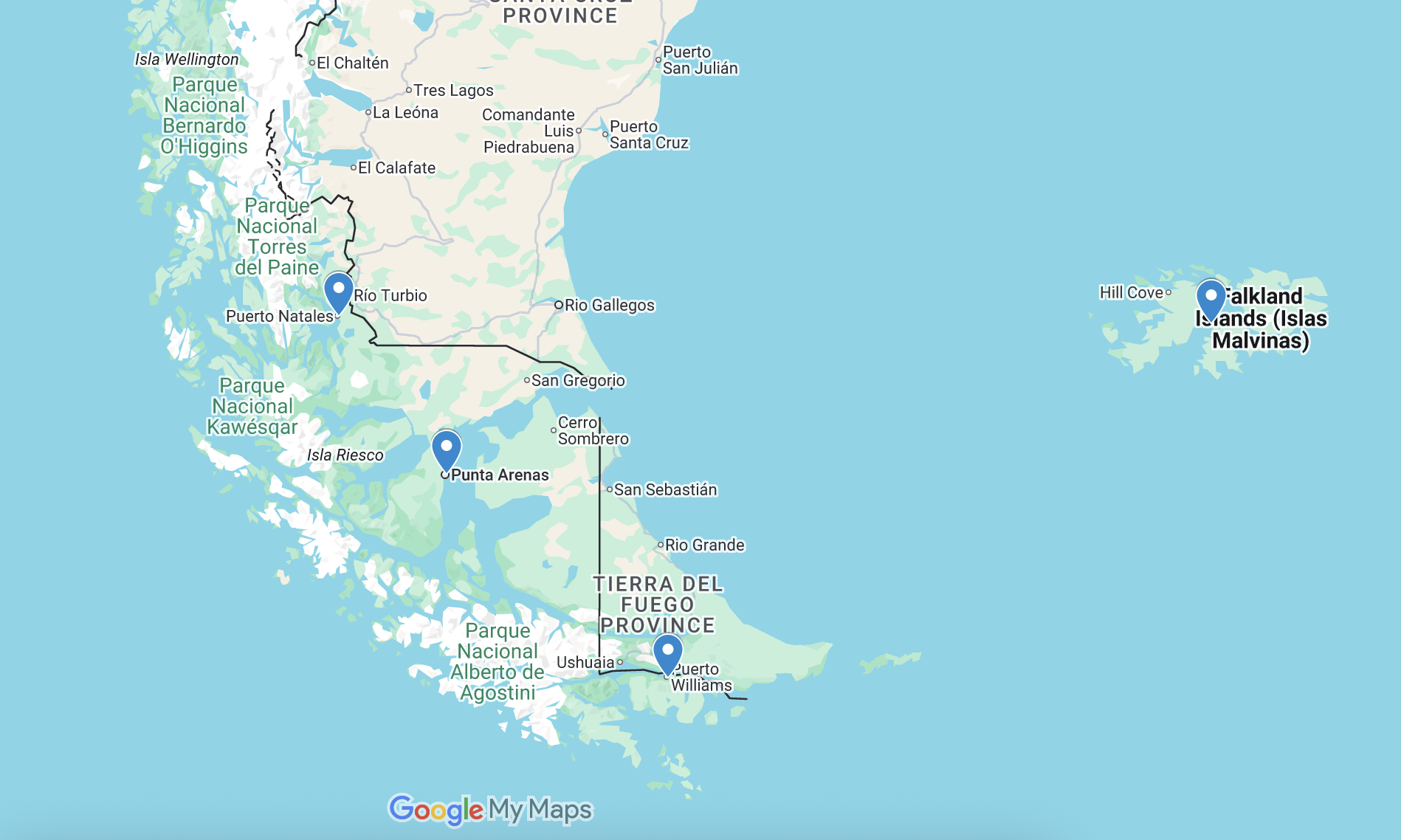
A different way of understanding is to travel from one end of Chile to the other. Living, as I do, in the Falklands, my point of entry to Chile is Punta Arenas, which is pretty far south but not quite the most southerly city in Chile – that honour goes to Puerto Williams, a further 186 miles away on the island of Navarino.

If you started your journey from Puerto Williams and flew north to Arica, the final city in northern Chile, you would be flying for 7 hours to cover 2,579 miles and you’d have to change planes twice – in Punta Arenas and in Santiago. That’s a lot of flying and a lot of distance. As a comparison, if you left the UK from Heathrow and flew south, the same flight distance would get you to Ouagadougou in Burkina Faso.
Chile is a very long country.
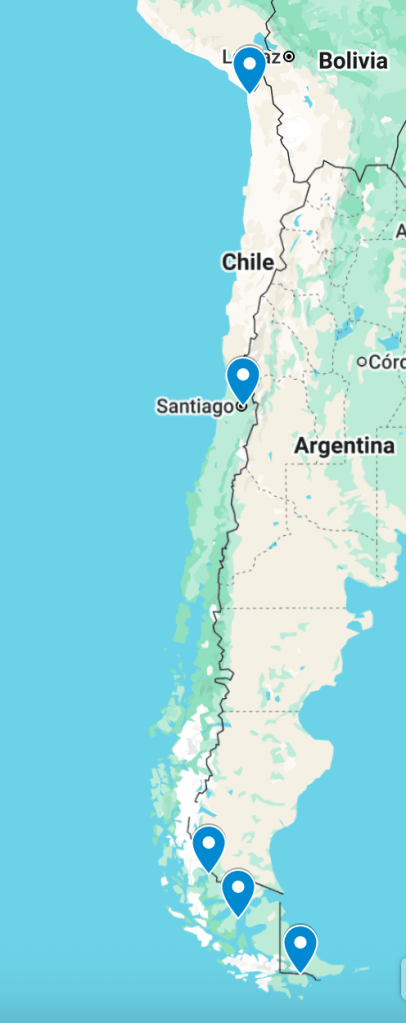
It’s also a very, very thin country – at its narrowest point near Puerto Natales in the South, it is only about 10 miles wide, if you measure from the sea to the frontier with Argentina. At its very widest (near Antofagasta in the north) it is around 200 miles wide – or Southampton to Leeds. Not very wide at all…. The reason it’s so thin is the Andes mountain range, which is a substantial eastern border naturally limiting the width of the country.
Chile’s shape has changed a little since it became an independent state, the main effect has been to make it longer. The War of the Pacific in 1879 to 1884 between Peru, Bolivia and Chile resulted in Chile gaining substantial territory in the north, full of rich mineral resources. Bolivia lost its Pacific coastline and became landlocked. This loss is still raw in Bolivia – they maintain a navy (on Lake Titicaca) and across Bolivia you see slogans on buildings claiming “Mar para Bolivia” (Sea for Bolivia), asserting their right to their old coastline. In reality there seems little chance of the current borders changing.
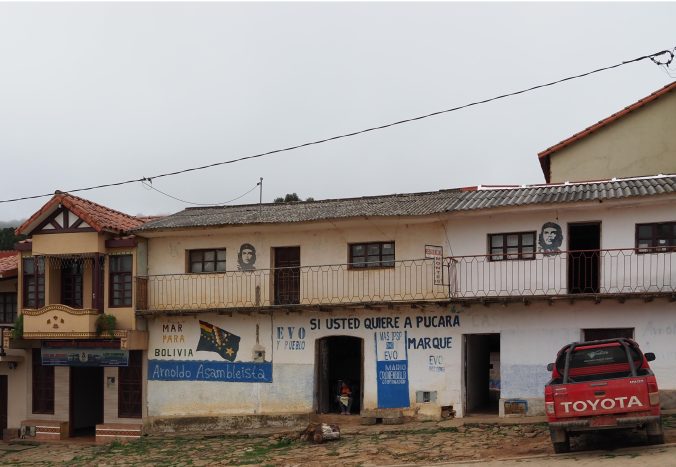
The major effect of all that length for Chile is some very different climates and eco-systems, but that’s a post for another day.
-
Easy Like Sunday Morning
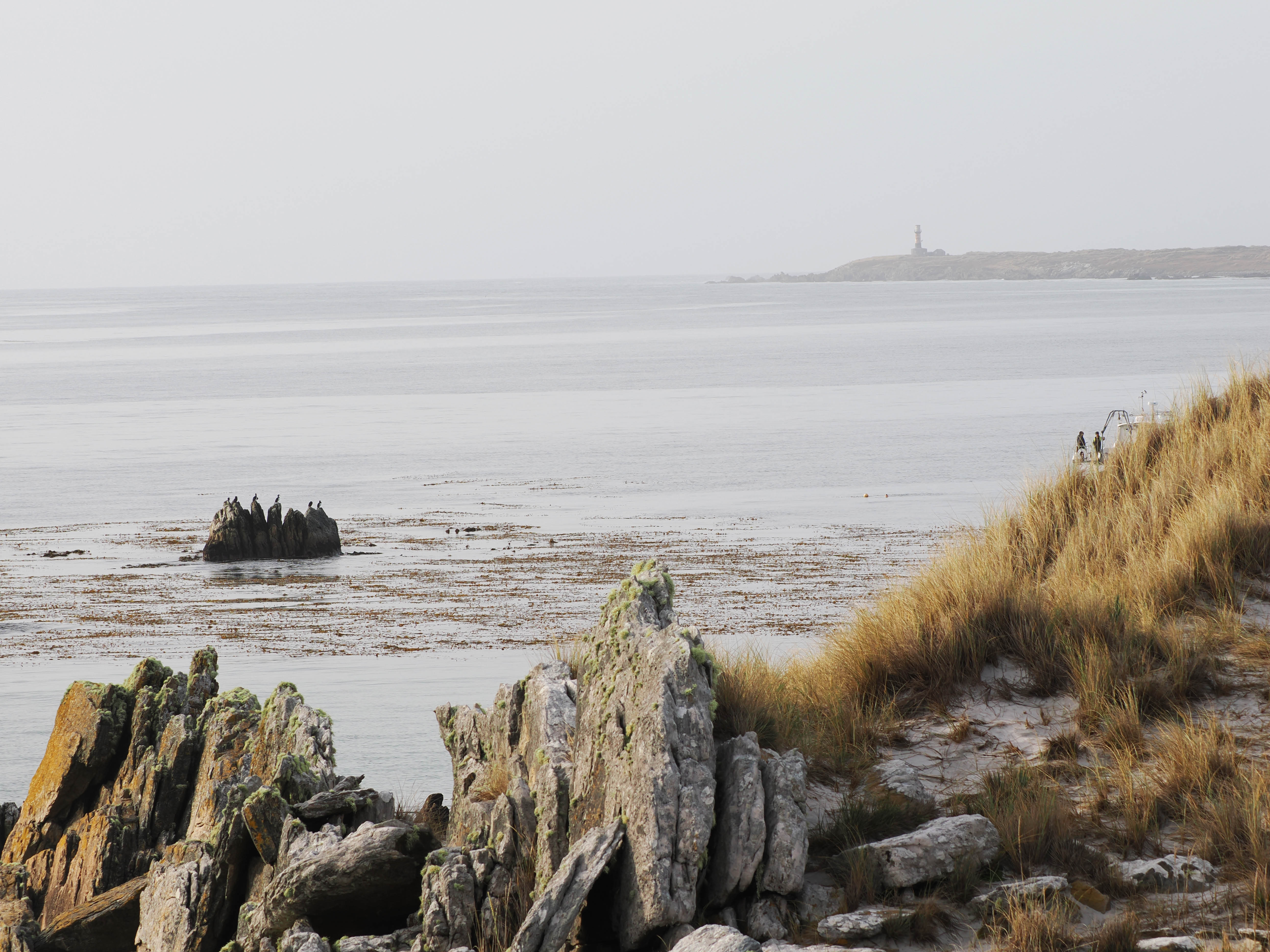
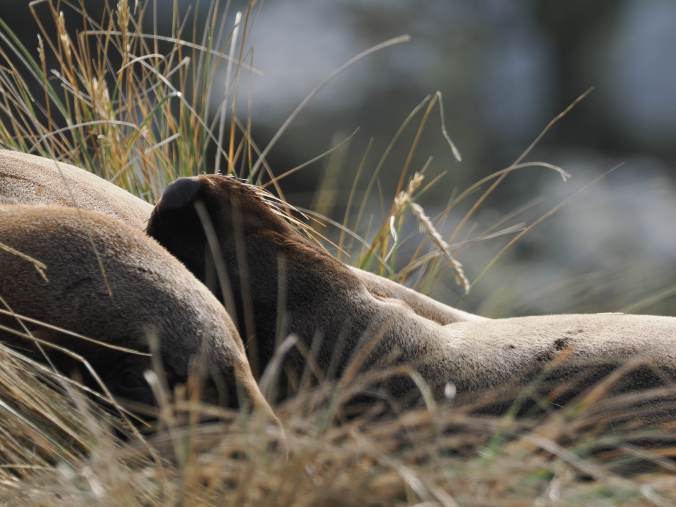
The Falkland Islands are famous for being windy but sometimes we get a beautiful calm day, with mirror like seas, unruffled birds and sunbathing sealions. That’s always a good time to walk the coastline in perfect peace.
-
Dogs with jobs
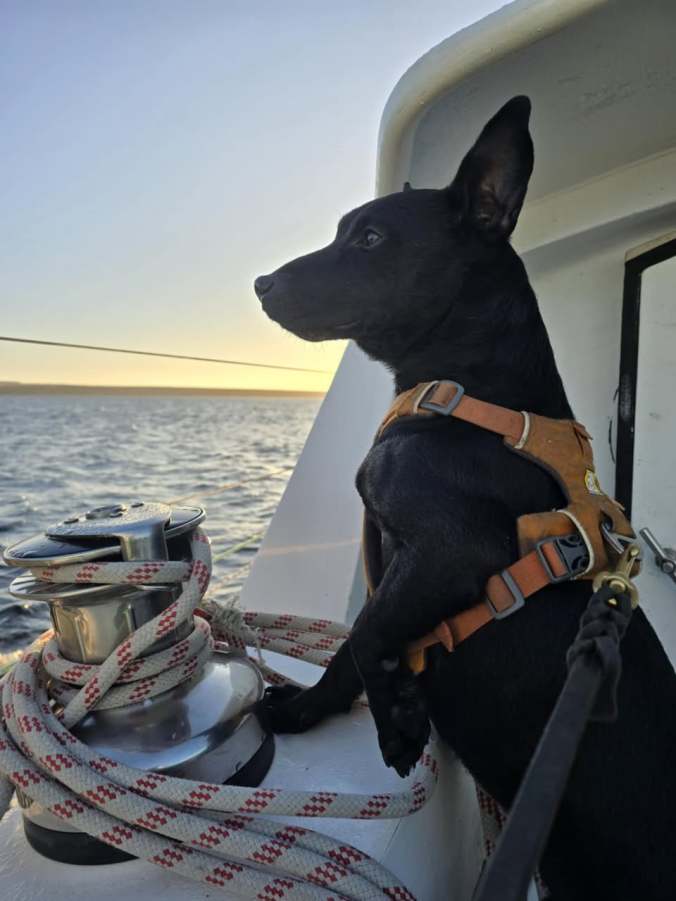
Unsurprisingly, as a rural country the Falkland Islands has lots of working dogs – Collies (England) are commonly used for farm work, as are Kelpies (Australia) and Huntaways (New Zealand). Then there are the military dogs doing security checks at the airport and round the military base. So far, so normal.
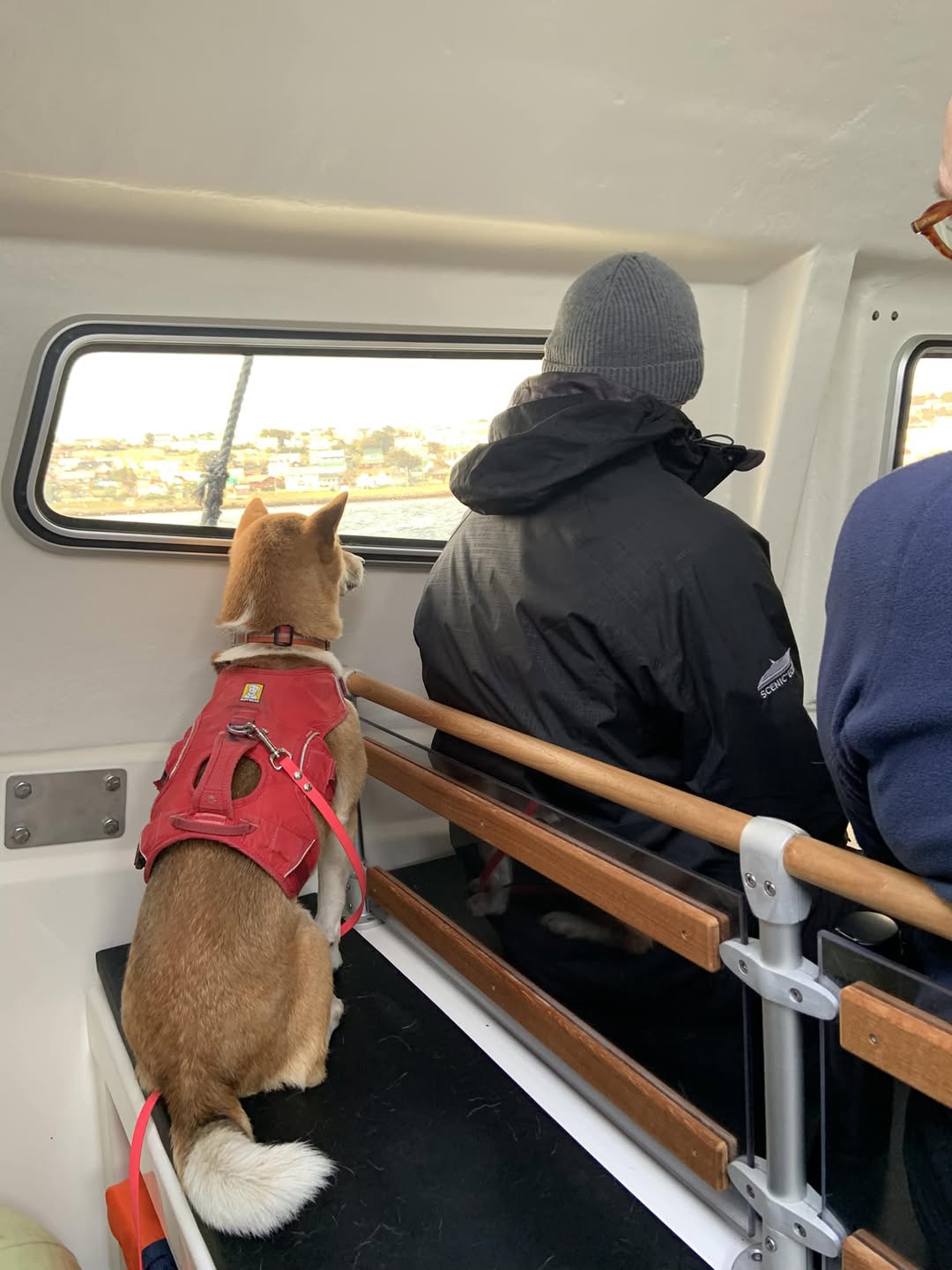
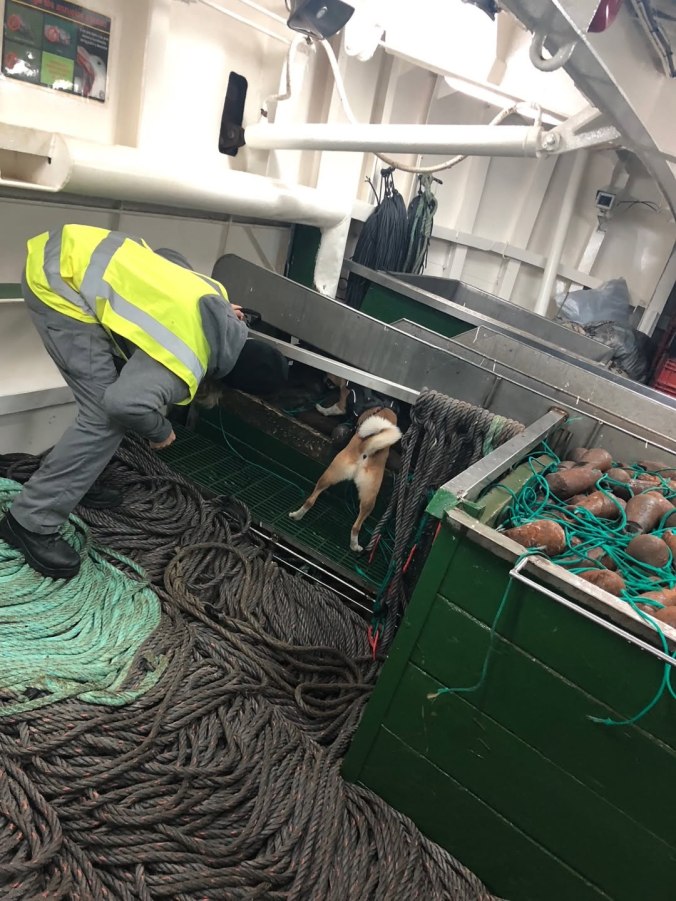
Living here I have met a category of working dog new to me; bio-security dogs, who along with their handlers work on conservation and environment tasks. A key job is to check vessels that are travelling to South Georgia, to ensure that no fishing vessel, research ship, yacht or cruise ship is inadvertently taking any rats that could get ashore on arrival. South Georgia was painstakingly cleared of rats through a multi-year campaign and declared rat free in 2018 and keeping it that way is taken very seriously. Specialist, carefully trained dogs are used to do the vessel checks and you can follow Sammy’s and King’s exploits on South Atlantic Detection Dogs’s Instagram
As well as the full-time working dogs, there are pet dogs that have been talent spotted and trained to help out. Some of these dogs I know well as they belong to friends and it’s clear that they really enjoy the opportunity to work.

Photo: Amanda Curry Brown Missy is a very pretty collie, who melts the hearts of all who meet her. Like most collies she is happiest when she’s out and about, whether that’s walking or working. She has been trained to help with counting birds who nest in burrows, such as prions. She works by scent and will point at burrows that have an occupant, significantly speeding up the counting process.
Poppy is a labrador and her talent is her greed! Her ability to find food with her extremely sensitive nose is now put to good use, checking incoming luggage at the airport for undeclared food. There are strict rules about which foods can be brought into the Falkland Islands, to ensure that no invasive creatures or diseases get in. Sadly not every visitor is that aware of the rules and Poppy’s proud boast is that she has found food in luggage every time she’s been on duty!
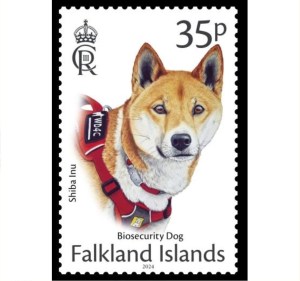
It’s fair to say that working dogs and part-time working dogs are an essential part of Falkland Islands life and it’s been fun getting to know what they do and see how much they enjoy their jobs. Their role is so important that in 2024 they were recognised with their own set of stamps!
-
Locked Up
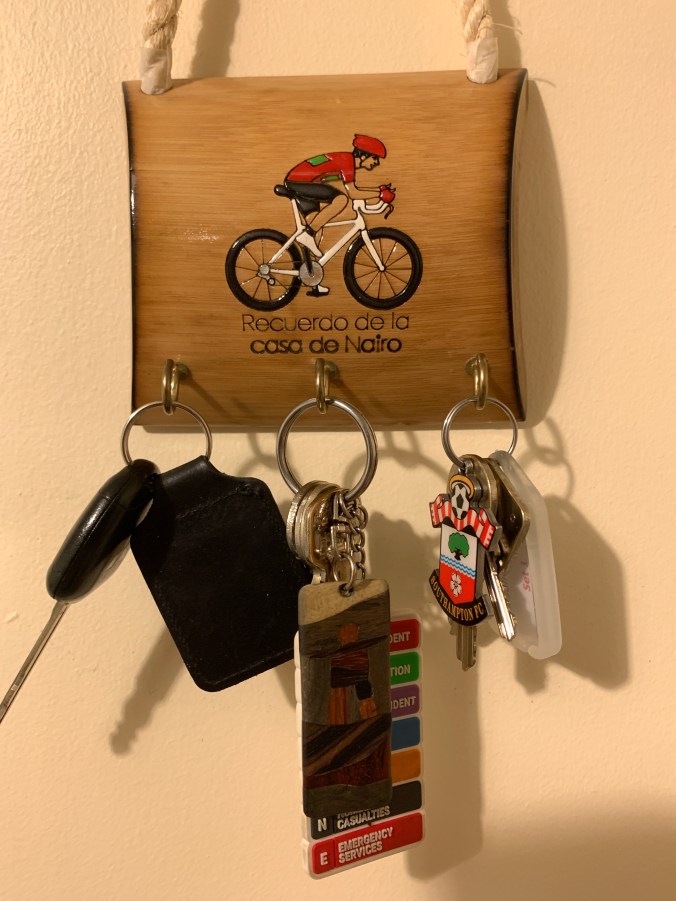
As I got out of my car this morning and walked across the car park to the office, it occurred to me that I hadn’t locked the car. The thought floated across my mind and I dismissed it, it really wasn’t necessary to go back.
As someone moving from UK city centre living to the Falklands I brought with me, my habits of locking everything all the time and checking carefully and repeatedly that I had locked my house or car. I know that I still lock my house and car much more frequently than local residents and I sub-consciously expect others to do the same, until I remember that they don’t. Last weekend I stood patiently at the door of a friend´s car, which we’d returned to after a two hour walk, waiting for her to unlock it and let me in. Then it occurred to me that of course it wasn’t locked and I opened the door and got in.
Early on in my time here I was returning something to a friend and when I got to his house he wasn’t in. He’d told me that might be the case and had said just go in and leave it on the side in the kitchen. Of course I knocked on the outside door and waited, although there were no lights on and it was pretty clear he was out. Then feeling like a burglar I opened the door, let myself in and opened the kitchen door to leave the item on the counter. It felt deeply wrong and I really had to force myself to do it.
I’m still not able to intentionally leave my house unlocked when I go out but there are definitely signs of change. I clearly do not check comprehensively that the doors to the outside are locked when I think they should be (at night and when I go out). The other day I found to my vague surprise that the seaward door (officially always the front door in Stanley) was unlocked. I had no idea when I had last used it and not locked it, it could have been days previously. I found it interesting that my response was limited, I did not immediately feel unsafe and have to repetitively check everything was locked several times each night before I went to bed. I mentally shrugged, locked the door and went on with my unruffled day.
I’m not sure that I will ever start leaving my house and car unlocked all the time, which some do. Even in a place with a very low crime rate, where robbery is almost unheard of, insurers still frown on claims where houses/cars are unlocked at the time of the crime. Occasionally one hears via the court reports of cars being “borrowed” late at night, when the pubs have closed, so best not to leave your car unlocked in Stanley central at the weekends. Depending on your friends, you might need to lock your house when you are on your own and having a shower, or you might emerge clean and shiny, as of a friend of mine did, to find that other friends had been in and borrowed her dining chairs while she was otherwise occupied!
I suspect the longer I am here the more relaxed I will be about locks, how far along the spectrum will I be when I leave?
-
Wild Goose Chases
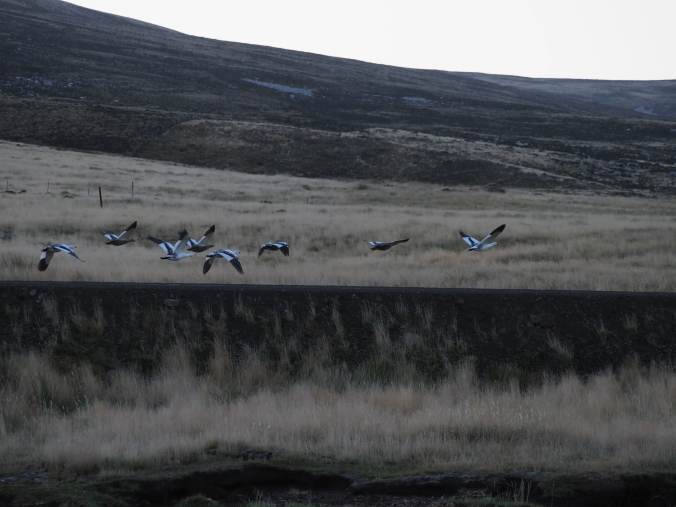
My first night at the Beach Hut through the fury of the wind and rain beating on the cabin, I could hear geese calling to each other. The next morning, in the blue pre-dawn light, I could see the creek edges were alive with geese, ducks and the occasional swan. I made a cup of tea and wondered if they were just there that night because of the storm. As the sun rose they started to disappear and by the time I went out mid-morning, there were no geese to be seen. Was the creek a safe haven for a stormy night, or would they come back that evening? I had my answer later in the day, as the sun disappeared behind the hills I could hear their calls again.
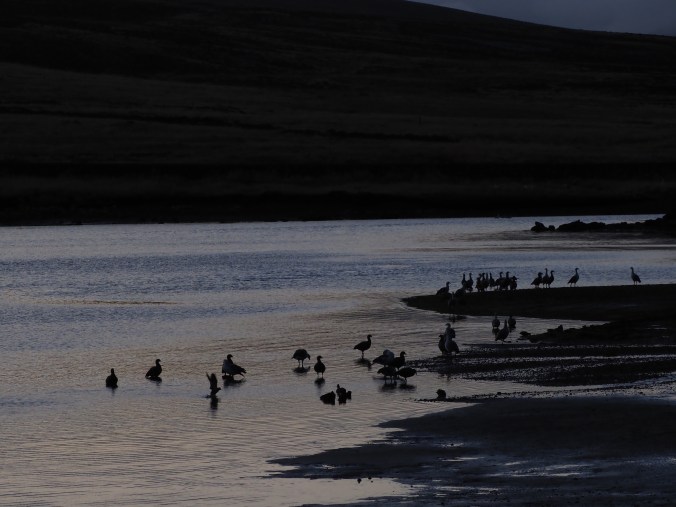
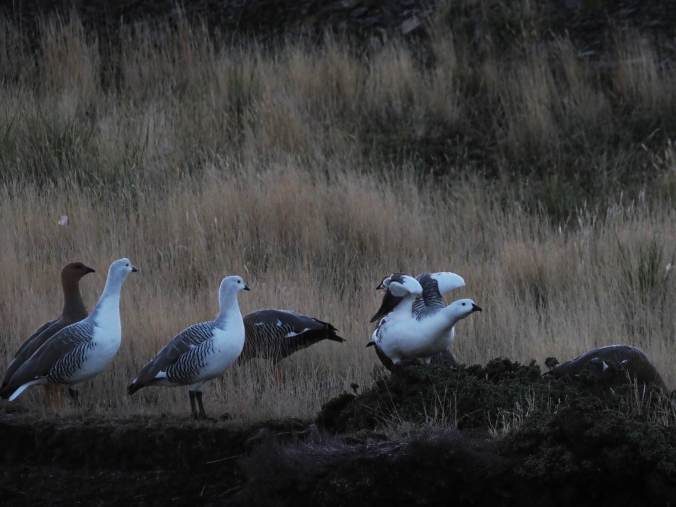
The next morning I bundled up against the pre-dawn cold and went outside to watch the asnerine rituals more closely. In the twilight the geese took to the water, after spending the night on the creek edge. I realised watching them that they were in family groups, sometimes quite large, I counted one with 11 individuals. I knew that Upland Geese adults pair for life but hadn’t really thought about how look each year’s brood would stay with them. Watching these groups, clearly the young adults stay for a considerable time – perhaps until next year’s breeding season.

Upland Goose family Each family seemed to follow a similar pattern, take to the water, swim up the creek away from the sea. There was a little bit of feeding and constant, low, quiet sounds to check in with the rest of the family. Then higher up the creek they’d leave the water and might do some wing stretching or just wait. They might get back in the water again, swim a bit further and then out, or not.
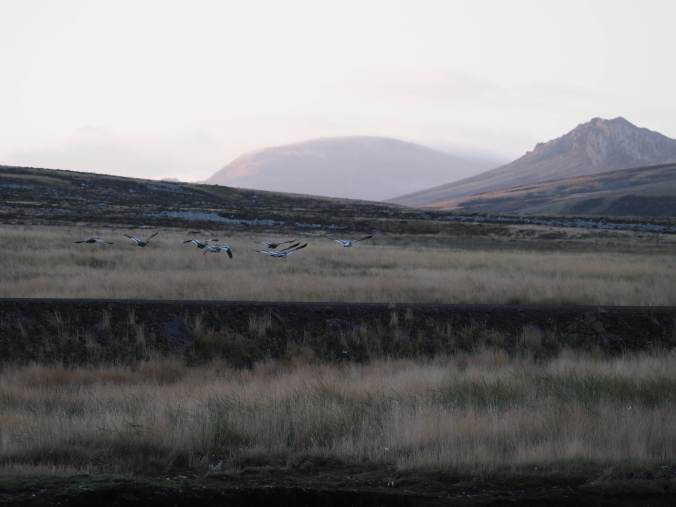
And then for no apparent reason, there would be loud urgent honking from the leader, repeated by all the geese in the group and they would take off at pace, leave the river and disappear towards the grasslands for the day.
By the time the sun was properly up, they were all gone, to come back in the evening for the whole cycle to repeat.
-
A weekend retreat

Most of my weekends away in the Falklands have been to outer, smaller islands, drawn there by the attraction of seeing some of the spectacular wildlife. However, there are other weekend options on East and West Falkland where farms have created self-catering properties and new income sources. Often self-catering units are existing houses that are no longer lived in or in some cases purpose built. The latter is what I’m staying in this weekend – the charming Beach Hut.
To get here, you drive west from Stanley for 45 minutes on the tarmac road to Mount Pleasant (MPC) – home of the international airport and the armed forces. The tarmac road is unique here, as it is the only tarmaced road outside Stanley and MPC and it is very recently finished, in the sense that there is now unbroken tarmac all the way (road markings are bit patchy still). This road is pretty well travelled and there was a steady flow of people driving past me towards the bright, weekend lights of Stanley, while I headed the other way.
At MPC you turn on to a graded gravel road and keep going west towards Goose Green. It’s a two vehicle width road but in reality most people drive in the middle unless they’re passing someone else. It has a bit of reputation for being slidey in places, with the gravel piling up on each side, this can be treacherous and occasionally people do lose control and in the worst cases roll their cars. I hadn’t seen anyone else for a while when I noticed three 4WDs coming up quite quickly behind me and a Discovery overtook the other two and in overtaking skidded, which the driver recovered but made the whole car lean alarmingly. I was very happy to let him go past me and then a bit later the other two. They all shot off into the distance, while I continued at the speed limit…
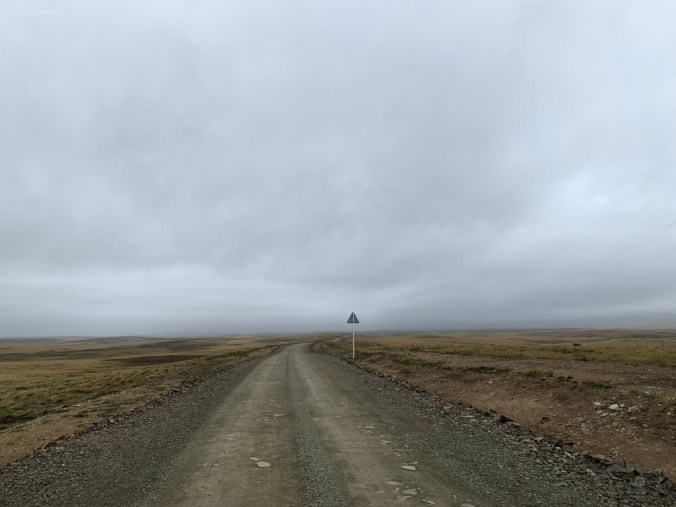
About half an hour from leaving MPC, just before arriving at Darwin, you turn right onto the North Camp road, which loops all the way around the top of East Falkland before coming right round back to Stanley. This is a one and a bit vehicle wide road, which is predominantly clay, definitely slidey in the wet. My instructions for finding the Beach Hut were – drive towards San Carlos and there’s a sign on the left . I knew this was true because mid-summer I’d driven some friends round the North Camp road and seen it. So I felt I knew how long it would take me to get there. Of course, the reality of driving at dusk in poor visibility, when you’re not entirely sure where you’re going makes it a different experience. I went across the cattle grids, with a sign occasionally telling me which farm I was passing through – Goose Green, Port Sussex, Head of the Bay. I had gone past a few signs and wondered if I had missed mine. The road went up and into the cloud, which was very low and wet. I really felt I had gone too far, the road wound down and I could see green grass around a bay and I then I saw the sign to the Beach Hut and all was well.
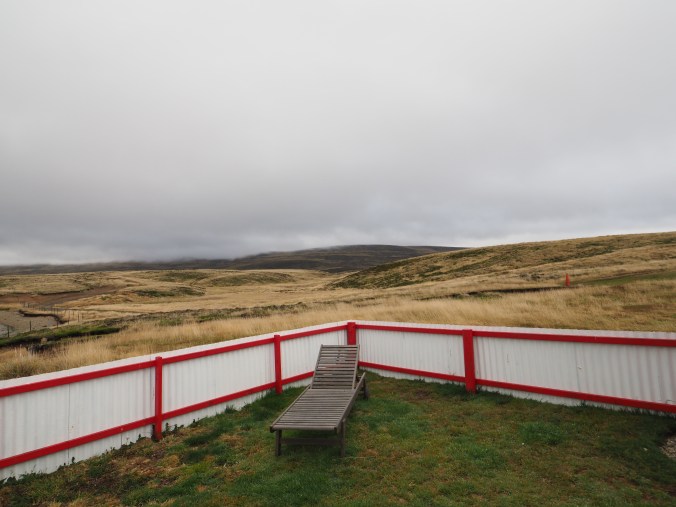
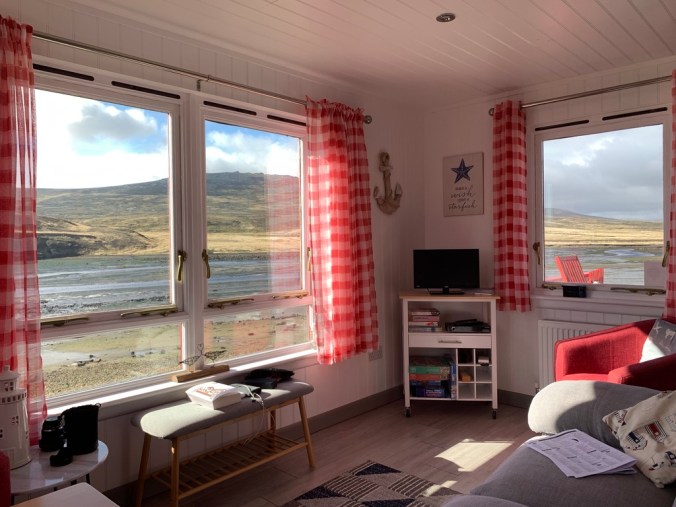
I bumped down the grass track towards the houses and as I drew up, the owners came to meet me, showed me everything I needed to know about the house and then left me in peace. The Beach Hut is considerably bigger than a traditional British seaside hut, not least as it has two bedrooms, a bathroom and a living room/kitchen, but it is much smaller than a normal house. It is purpose built and has everything you need on a miniature scale. In contrast the landscape round it and the views are great big sweeping vistas and joyfully can be seen through every window.
I have fallen in love with the views. Every time you look out you are looking at an amazing scene. Look up the river towards the hills, and follow them rolling into the distance. Look down the creek and see the river shimmering as it merges into the sea. Look out at breakfast at the grey, lowering clouds, enveloping the hills in their misty folds. Look out again and see the sun breaking through, brilliant blue patches of sky, huge, fluffy, white clouds and all the colours of the hillsides vivid in the sunshine.
The area around the houses is full of birds. At first light, in the blue-grey distance, all along the creek were pairs and family groups of geese, ducks and possibly in the distance a pair of black-necked swans. The geese had arrived in the evening twilight. As the sun rose (not very visibly as it was somewhere behind the grey cloud layer) the geese and swans took off for a day of grazing elsewhere. The ducks stayed, dabbling in the falling tide, grazing on seaweed.
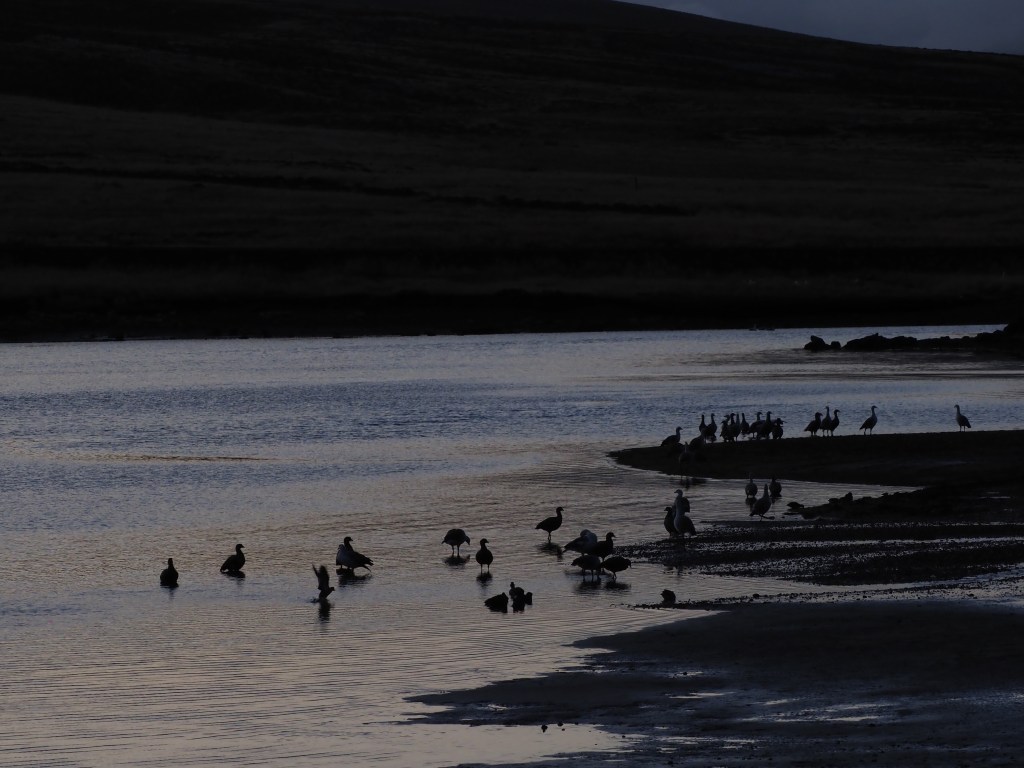
The tide fell steadily, the water retreating into small channels between the silted edges. Inevitably it turned, the creek filled and as night fell, the sound of incoming goose honks could be heard.
It really is a perfect spot to decompress, escape the tyranny of weekend chores and totally relax. I think I might be back!






-
Subscribe
Subscribed
Already have a WordPress.com account? Log in now.
 Where is Sarah?