-
Advanced Shopping Skills

When I first arrived one of my earliest posts was about the idiosyncrasies of shopping for food here – Food Shopping 101. Since then I have honed my shopping skills. There are more options what can be bought locally in the shops or on Chebay (as the Facebook Bring and Buy group is known).
An obvious one is online shopping with firms that will ship to the Falklands – this is a limited group and sometimes shipping costs are prohibitive. It’s always a joy when one finds a UK company that does ship to the Falklands and even better if they send it by post rather than DHL. In August I ordered some clothes from Adini and also from Seasalt. Astonishingly the Adini parcel by post (via the Airbridge) arrived in 7 days. The Seasalt parcel with DHL took a month. The post is not normally so speedy but it is still quicker than DHL (a month is standard) as DHL goes to Santiago fast and then has to wait to be put on the once a week Latam flight to the Falklands. Or not, if the plane is full of passengers and luggage.
A less speedy but really reliable way of getting orders to the Falklands is to have them shipped by sea. It’s also quite a lot cheaper than post. A firm called Richard James International provide shipping services to the British South Atlantic Islands – Ascension, Falklands, St Helena and Tristan da Cunha.
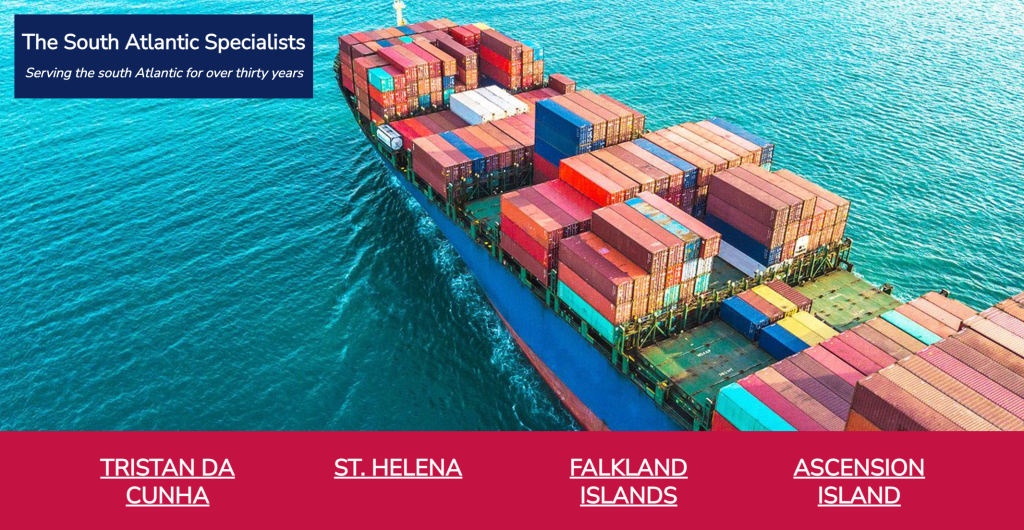
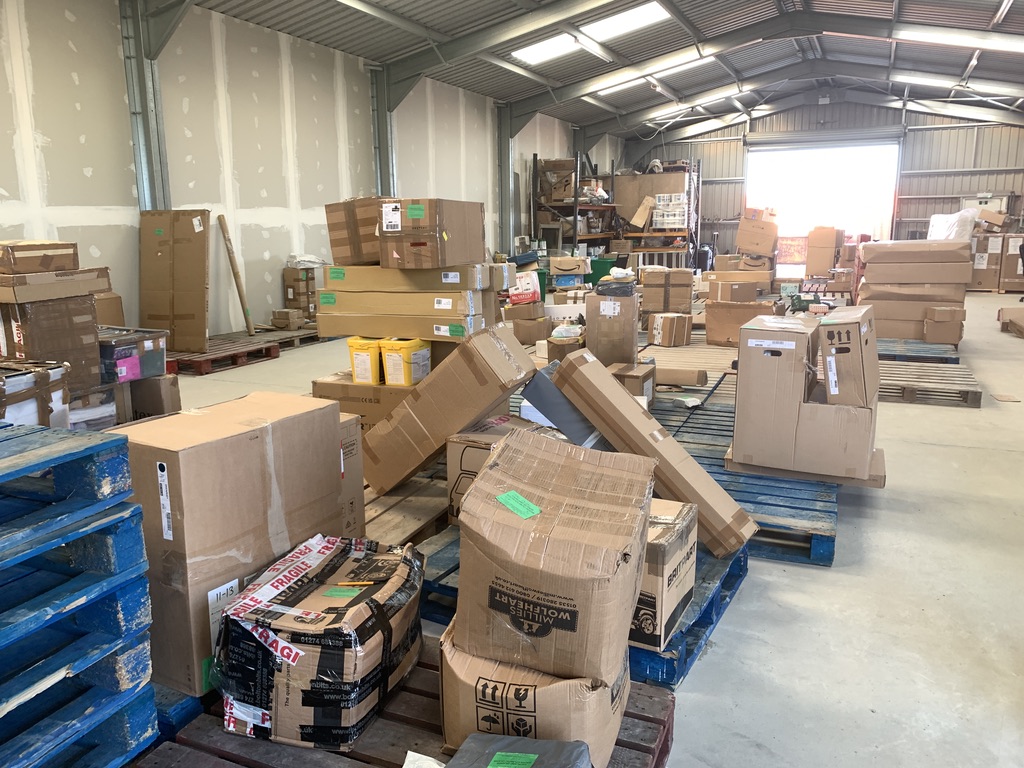
One of their services is receiving individual orders that are delivered to them; consolidating these orders into containers and shipping the containters. The service includes being able to order food from supermarkets (of those items one can’t live without – Lady Grey tea anyone) and they will pack it securely into boxes and send it down. Or you can ask them to buy items for you from certain stores like Ikea and they manage it all.
The containers travel to Montevideo and are then transhipped onto the MV Unispirit which shuttles backwards and forwards between Montevideo and the Falklands, bringing us supplies and taking away fish and squid for export.
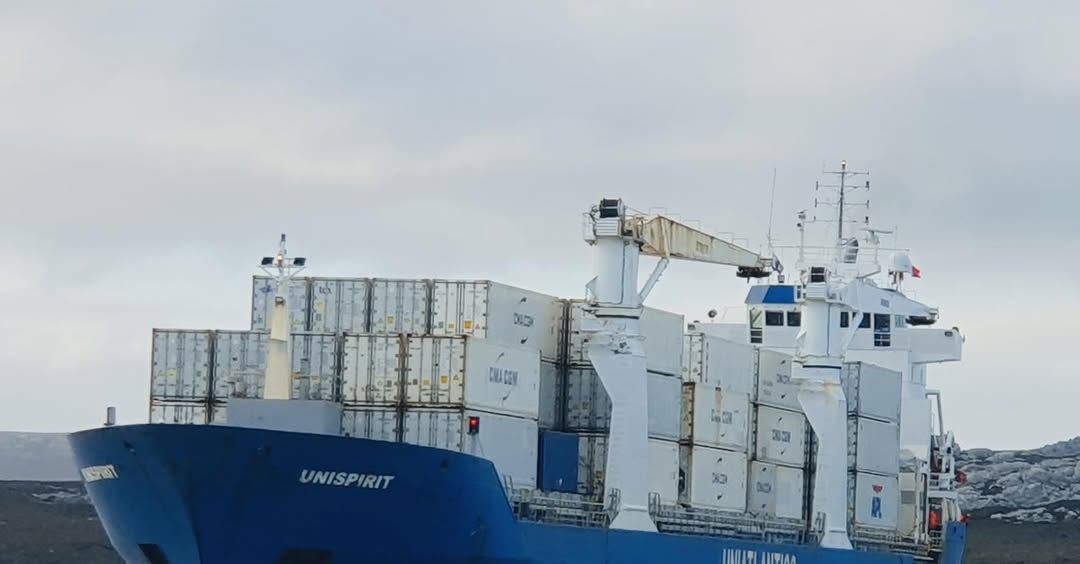
Once a month the Unispirit arrives full of goodies and when the containers are unloaded, the call goes out to go and collect your order. Sometimes it’s a box of presents that have been lovingly chosen and sent, more often (for me) it’s food. Either things that are not sold here or that run out regularly.


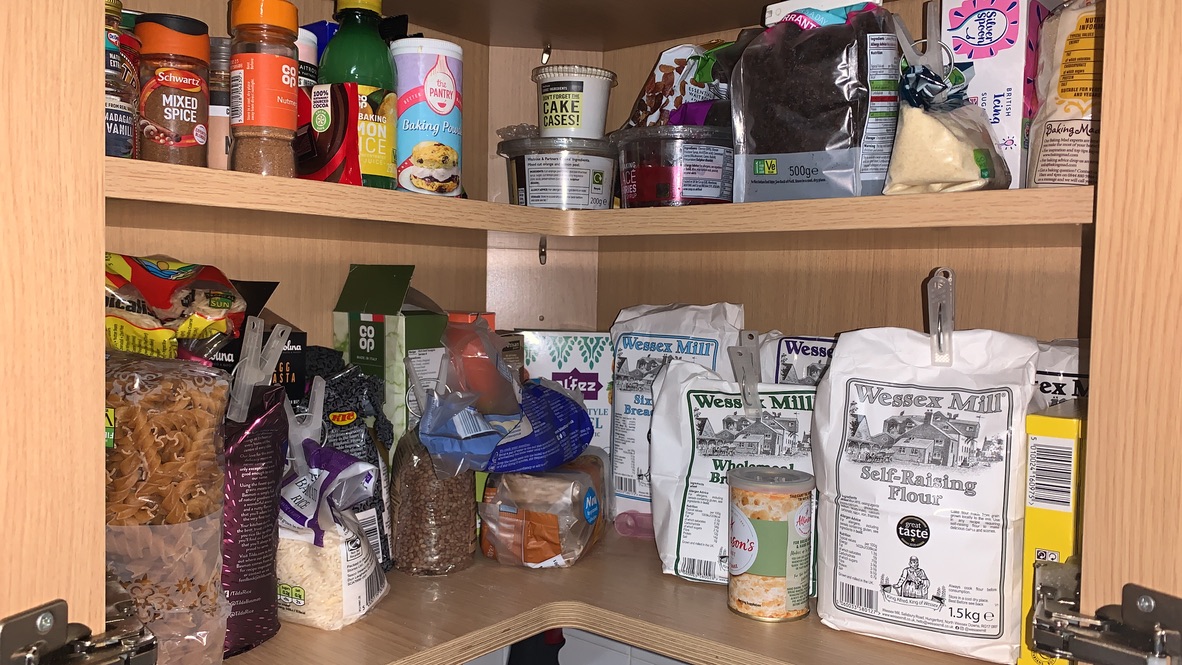
Although online shopping works, it is in no way instant. The consequence of the time things take to get here (2/3 months) is that you need think ahead and order in larger quantities. This means that if you come to my house you will find that drawers and cupboards are holding a surprising amount of supplies.
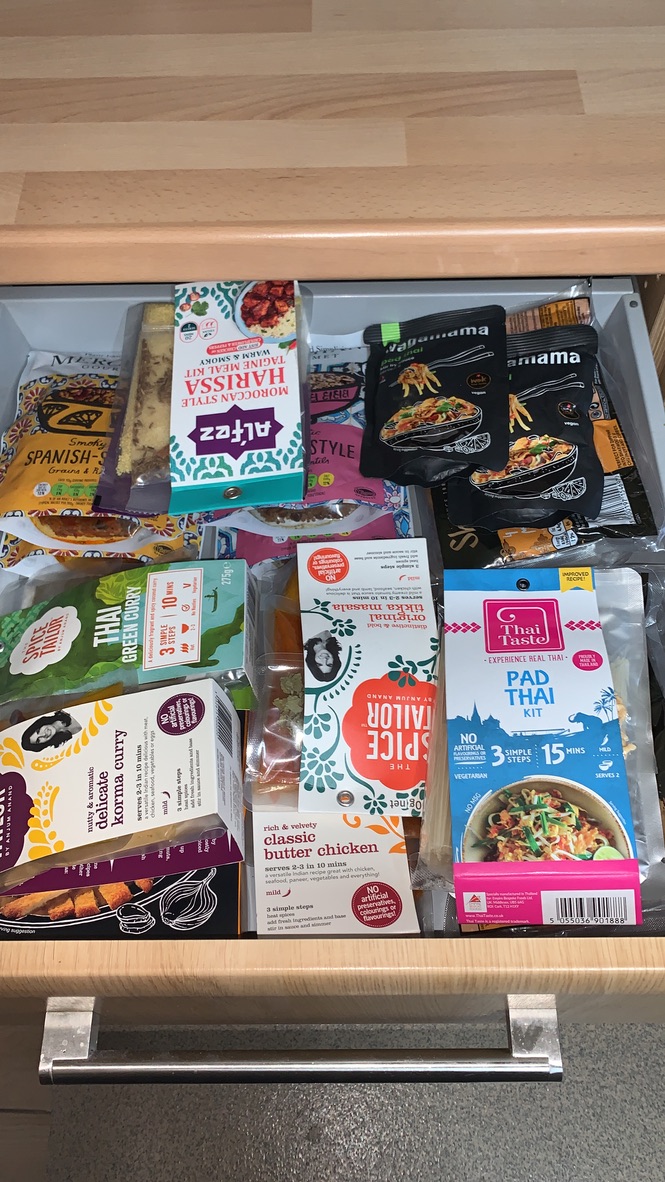
To put this in context, my stores are nothing compared to some of the walk-in store rooms I’ve seen in West Falkland and the outer islands, where you can easily add another month or two to having anything delivered. Their deliveries are transferred from the Unispirit onto the Concordia Bay, which is both the ferry between East and West Falkland and the supply ship for the outer settlements. I think some people have enough stores for six months or longer. I think outer islands inhabitants really do have Advanced Shopping skills and I can reasonably claim Intermediate status!
-
Resourcefulness
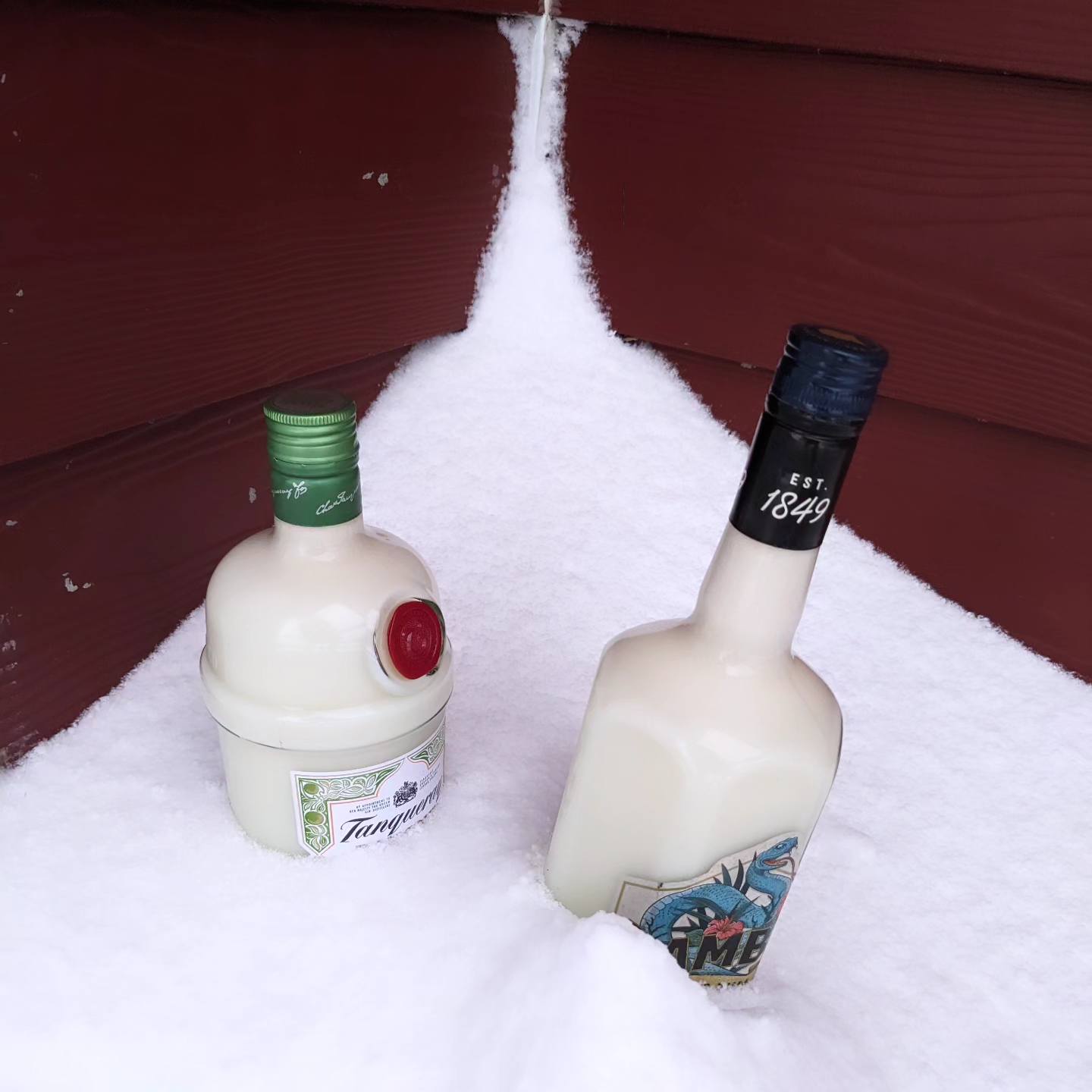
One facet of Falkland life which is distinctly different to much of the UK, is what people do with items they no longer want or that are a bit broken or worn. They do not go straight in the bin, recycling or to the tip. Partly that’s because there isn’t much opportunity for recycling in the UK sense – tins are collected, and go back to the UK on the military supply ship; glass is collected and is crushed and used in roads and pavements, but that’s all the formal recycling there is. So what happens to everything else?
The longer you live here, the more you see. Milk is sold by a local farm, they don’t have a supply of standard milk bottles so instead milk is delivered in used spirits bottles. If you see several empty spirits bottles outside someone’s front door, it probably just means they’ve left their empty milk bottles to be collected. Lots of families have hens and sell eggs, which means that people are very appreciative if you give them surplus egg cartons, they’ll be used over and over again.
Milk delivered to your door and sometimes refrigerated naturally (Photo: Becky Clark) Vehicles are all imported and most of them are used when they arrive – my trusty Pajero is a 2010 model and seen as pretty new. There is an annual road worthiness check that you need if you want comprehensive insurance, but you don’t have to have it and cars are kept and used until they are really old and completely dead. Even then they have value and will be stripped down for parts that can be used elsewhere.
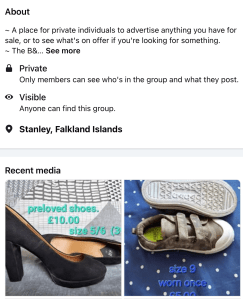
Part of the incentive to reuse items is that it’s hard to get them here. There’s no such thing as fast fashion. Very limited amounts of new clothes are for sale on the Islands but most clothing is mail order or bought when people are abroad. This means that clothes are well used before they’re disposed of and that there’s a healthy market in secondhand clothes. Enter the Bring and Buy group on Facebook, aka Chebay – where you can sell your surplus items such as clothes, DVD box sets, used tyres, children’s clothes, furniture, hoovers. You name it, it’s probably been for sale at some point. And if you don’t want to sell an item, you can put it on Free Falklands and let people know that you have old doors or a bath or metal panels, free to whoever collects. Or you could donate it to the Charity Shop.
All of this means that what has to go to the tip is far less than in the UK and that seems to me like a very good thing.
-
Crafting – a personal journey

I am, in my personal view, once of the least crafty people I know. I have sad memories of attempting to learn to sew at school and being run away with by the sewing machine, with stitches in all sorts of places they shouldn’t have been. I never got to grips with the sewing machine and it left me with an abiding dislike of sewing and an appreciation of others ability to bend it to their will.
So here I am in living in a place where craft skills are present everywhere you look and they are appreciated and encouraged. There are the professionals such as Alice Clarke who makes beautiful jewellery which sells in the Falklands, New York and London; Hairy Daisy who make pewter jewellery inspired by the landscape; Julie Halliday who fills her shop Studio 52 with beautiful designs and keeps learning new skills to add her to her considerable bow. Alongside them, a considerable number of the population use their artistic and craft skills to produce greetings cards, prints, model buildings, silver and ceramic jewellery, all things woollen such as bags, gloves, hats, and much much more which are bought by locals and tourists alike.
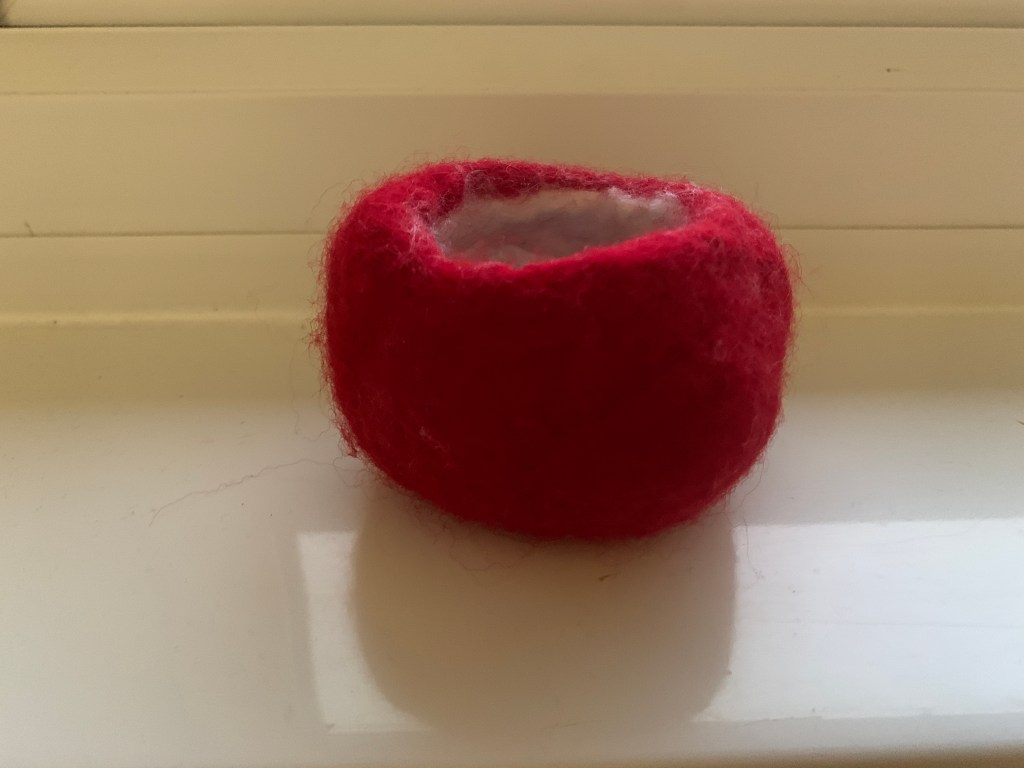
Despite my low expectations of my innate ability to be any good at any craft, in such a place it’s natural to have a go at new things and see if one of them might reveal a previously unknown talent. My very first weekend I was invited to a wine and felting evening, during which Jo showed a bunch of novices how to felt. Results included a beautiful beach scene, lots of bowls and my misshapen red object… although I do use it to keep coins in. Felting was clearly not the craft I was looking for.
After the annual spring Craft Exhibition and Show last October, I was inspired to have a go at teaching myself to knit with the aid of Youtube. I enjoyed it and managed to make a scarf for my sister for Christmas, which she gallantly put on and declared herself to be very pleased.
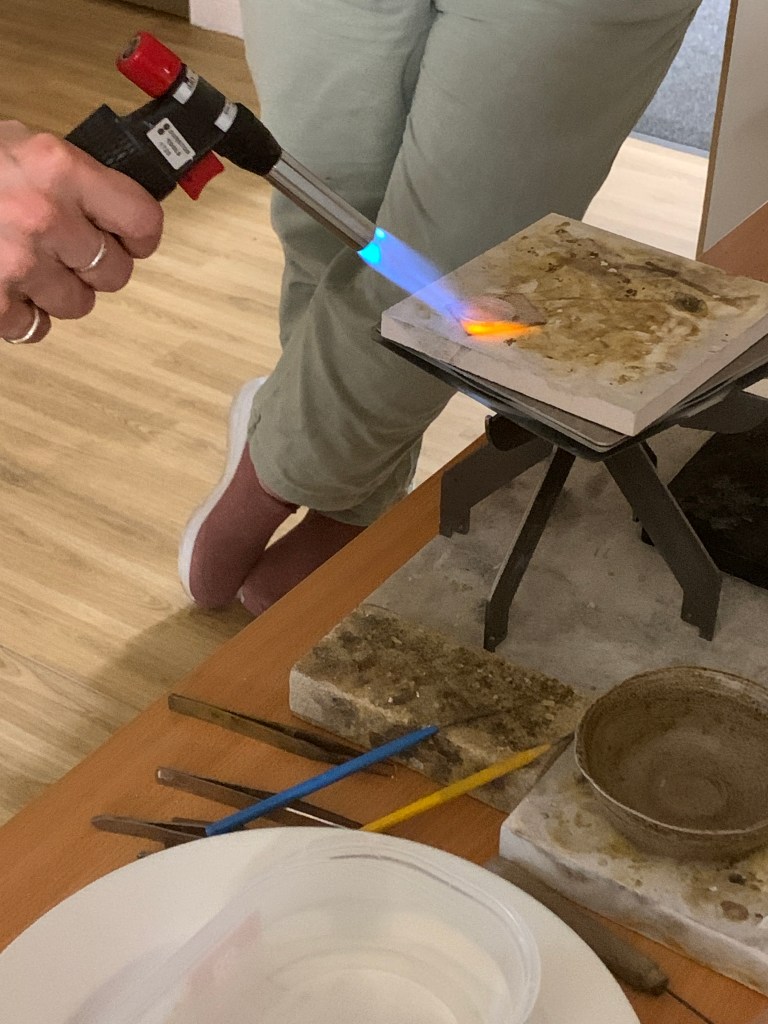
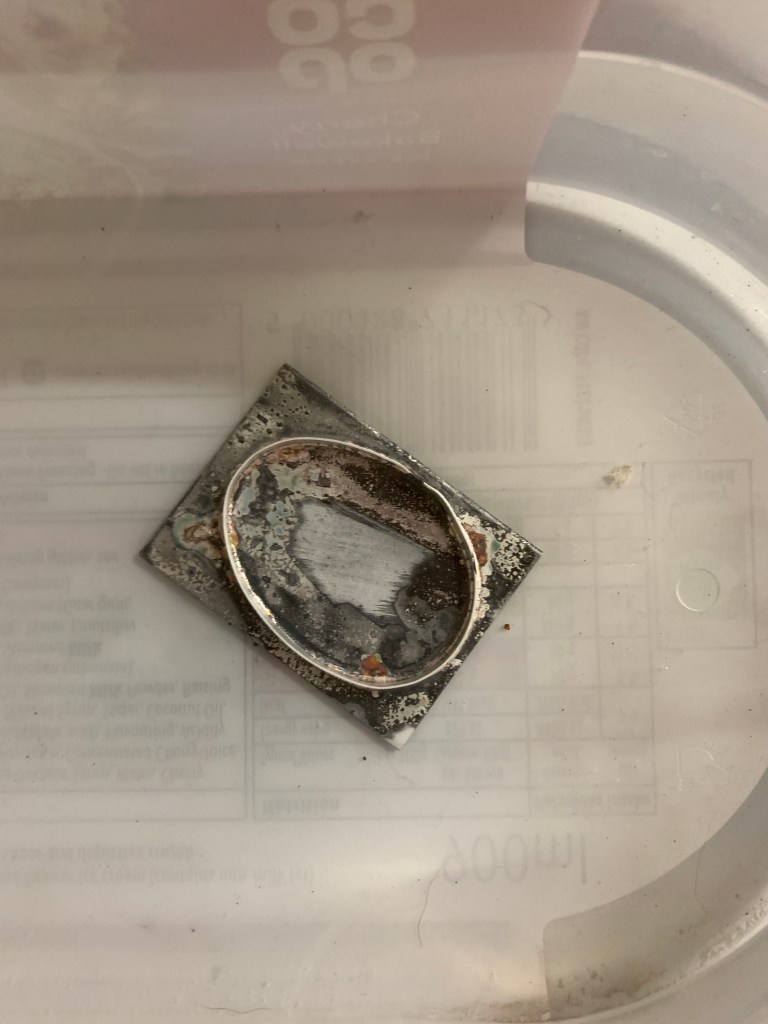
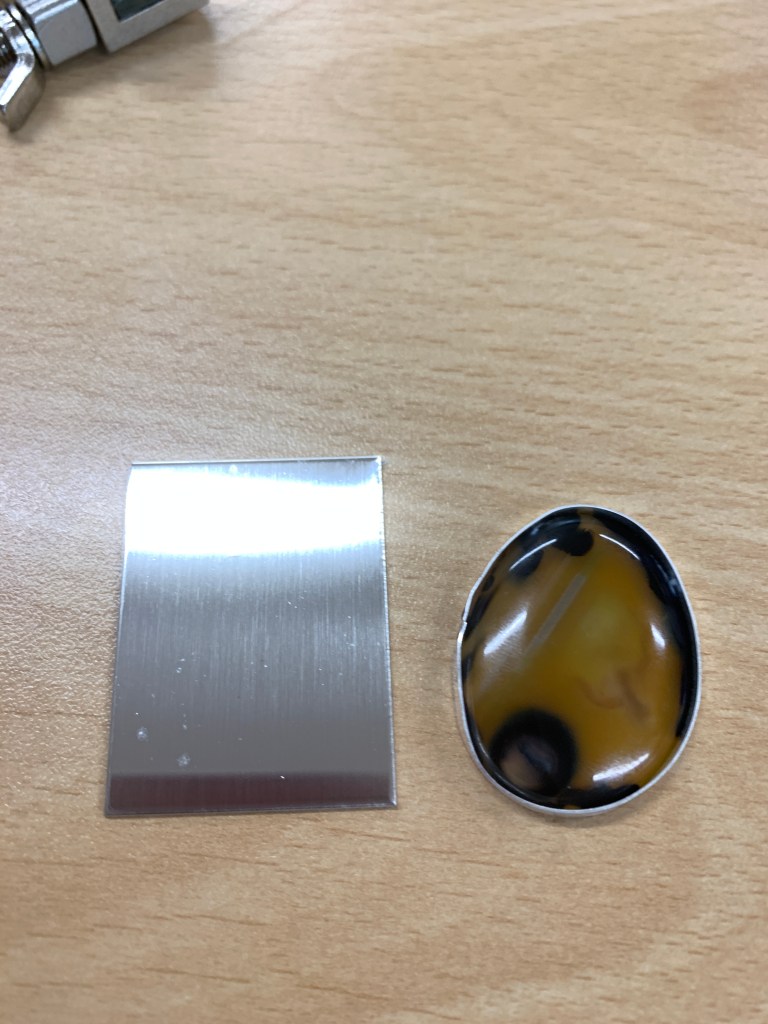
This winter I have had a go in a class at Falkland College in making a piece of silver jewellery using local stones, which have been cut and polished to bring out their natural colours. This was a lot of fun and it was great to spend time with others learning how to choose stones, polish them and then set them in silver. I wouldn’t say that I fell in love with the making process, it needs a great deal of patience and I think an affinity for it, which I didn’t feel. However, it was a great weekend with a lovely group of people and a skilled teacher and I am now the owner of a pendant that I am very proud to wear and am planning to enter for the spring show….


-
The great milk crisis of 2024
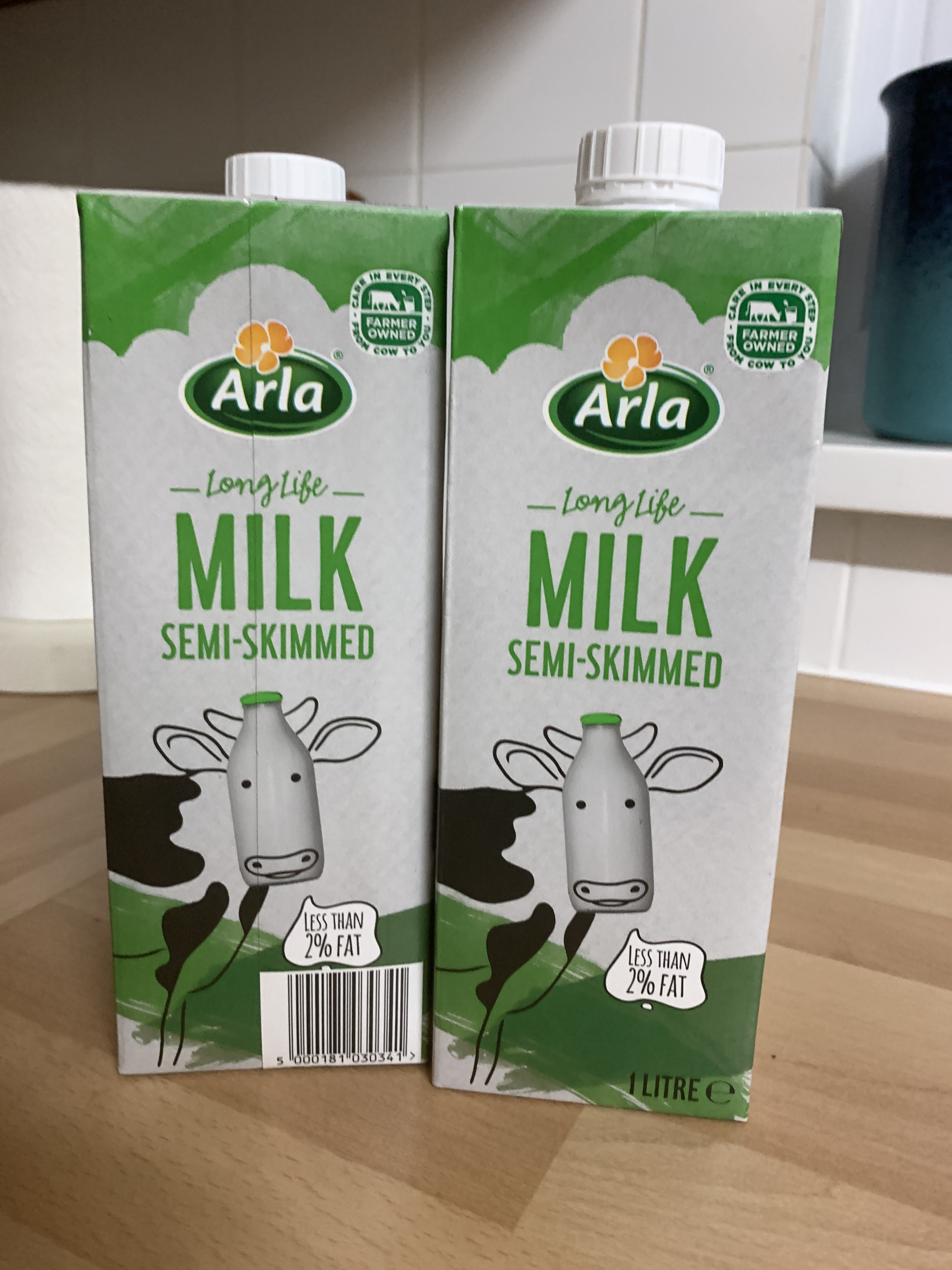
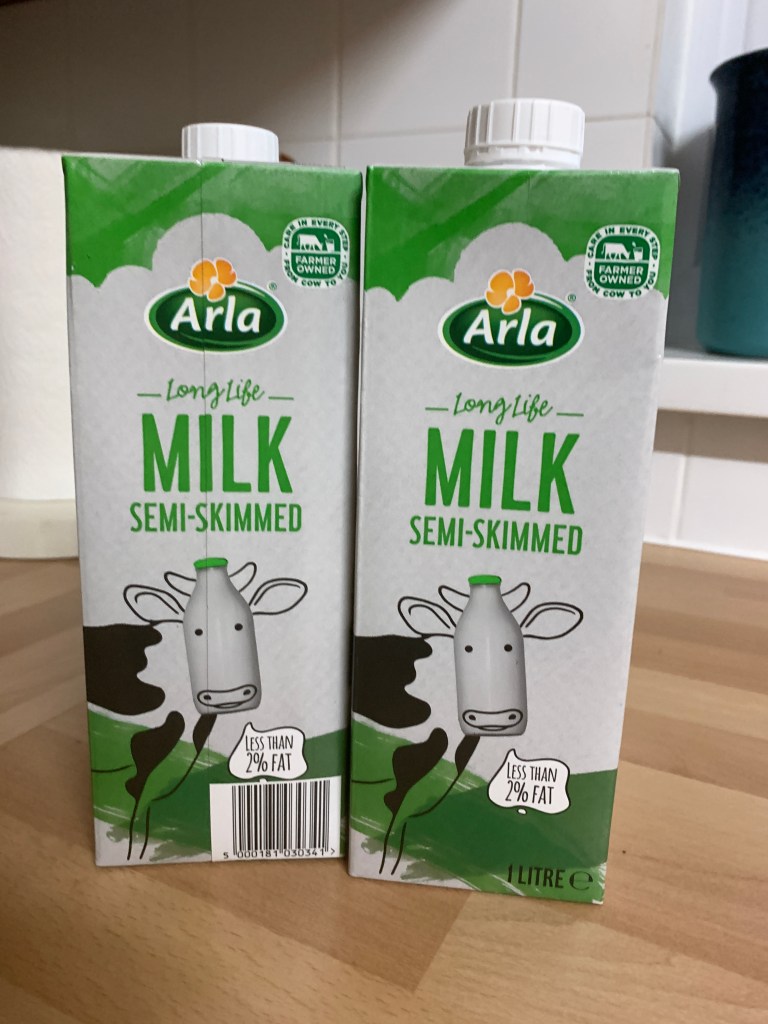
Our story begins in March 2024, when rumours began to circulate that there was no milk. It was said that one of the supermarkets had sold a lot of milk to a cruise ship and was now very short of supplies. To begin with there was some milk in some shops and there was also some speciality milk like oat and soy. One of the supermarkets did seem to have run out, however because all the milk sold in the shops is longlife most people had several cartons at home. Inevitably the rumour made people nervous and some went and bought what there was and then there was none for sale. Really though as a friend remarked at this point – “We don’t have a milk shortage, we have a milk location problem”.
All would be well though as once a month the supply ship arrives and it was due at the end of March, so no matter, there would be milk again. Except there wasn’t for very long. The supply ship arrived, the supermarkets received their orders (which were placed about 2 months in advance and weren’t intended to overcome a complete lack of milk). No restrictions were put on how much you could buy. Some people might have bought a lot. Then there was no milk again.
Most people got through April ok, using their stores and at the end of April the next supply ship arrived. This time there were controls on how much people could buy and it lasted a bit longer. However, it’s said that one of the supermarkets managed to buy a contaminated amount of milk which had to be thrown away. Whatever had happened there was no milk on the shelves for most of May and people have struggled. Some milk was flown in from Uruguay and it was £3.25 a litre! People grumbled a lot but it was all sold.
So here we are at the end of May, hoping that the milk shortage might now be over…the supermarkets have said that their deliveries should be enough to restore normality as these orders were placed after the shortage began, so are higher than normal.
People were waiting anxiously for the supply ship – on Wednesday it arrived and then couldn’t dock until Thursday (because of WEATHER). Thursday evening, everyone went to the shops where the milk seemed to have been the first item unloaded, sensibly they still have limits on how much you can buy in place so no one can bathe in it yet. I am now the proud possessor of 2 litres of milk and hopefully the great milk crisis has ended and goes into the history books alongside the yeast shortage of 2023 and the flour shortage of 2022. Time will tell.
-
The times they are a’changing

The coming of autumn in England is easy to see and experience – summer flowers fade; trees burst into flame, covered in reds and oranges and the days shorten.
Last year, experiencing my first autumn in the Falklands I found it difficult to feel autumnal, because I was missing those visual clues. The few trees we have are evergreen pines, so no colour changes there. The landscape doesn’t change colour dramatically, it’s consistently green, brown, sandy, blue and grey. Our days are shortening, but we don’t change our clocks, so there is no autumnal leap into late afternoon darkness to really mark the change. I felt a bit adrift, attuned to a set of seasonal clues that are irrelevant in the Falklands.
A year on, it all seems more natural and clearly the season has changed to autumn/winter. How do I know? The first change is that the cruise ship season finished at the end of March. No more opening my curtains to see which ship is anchored in the entrance to the Narrows, no more popping out at lunchtime and having to navigate a sea of people who have forgotten normal rules of road and pavement usage. Although tourism is a vital economic sector for the Falklands you can feel the collective sigh of relief that the summer season is over and a season of peace and quiet has arrived.
Another clear sign is the change in wildlife. Rockhopper and Magellanic penguins have finished moulting and left for the winter, we’ll next see them in the spring when they come back to breed again. The Elephant Seals are off to different seas and beaches and the Albatross chicks are fledging and will be gone soon. Although there are still King Penguin chicks and some adults onshore, it’s harder to go and see them. The track to the major colony at Volunteer Point closed at the end of March and won’t reopen until the spring. Track is a strong word for the off road driving experience to VP. It is a track, in the sense that repeated driving across the land has created a track but in the depths of winter with wetter ground, it is a route that would see anyone bogged repeatedly, destroying the terrain and vehicles, so best left alone.
The most visible sign of reduced daylight is sunrise becoming later and later – the first hints of the sun in the East are now just visible as I leave for work just before 8am. However, dark combined with a run of grey skies and rain, it’s fairly consistently “dreich” weather at the moment. We have had our first frost and sometimes the rain looks very like snow…
In fact I think what I’ve come to understand over the last year is that really there are two seasons in the Falklands not four and the change from one to the other is gradual and mostly clearly seen in animal behaviour and the farming cycle. My response is to change from my summer coat (long, green, waterproof) to my winter coat (long, green, highly padded) and to ensure that my hat, scarf, glove box is stocked up and ready for use.

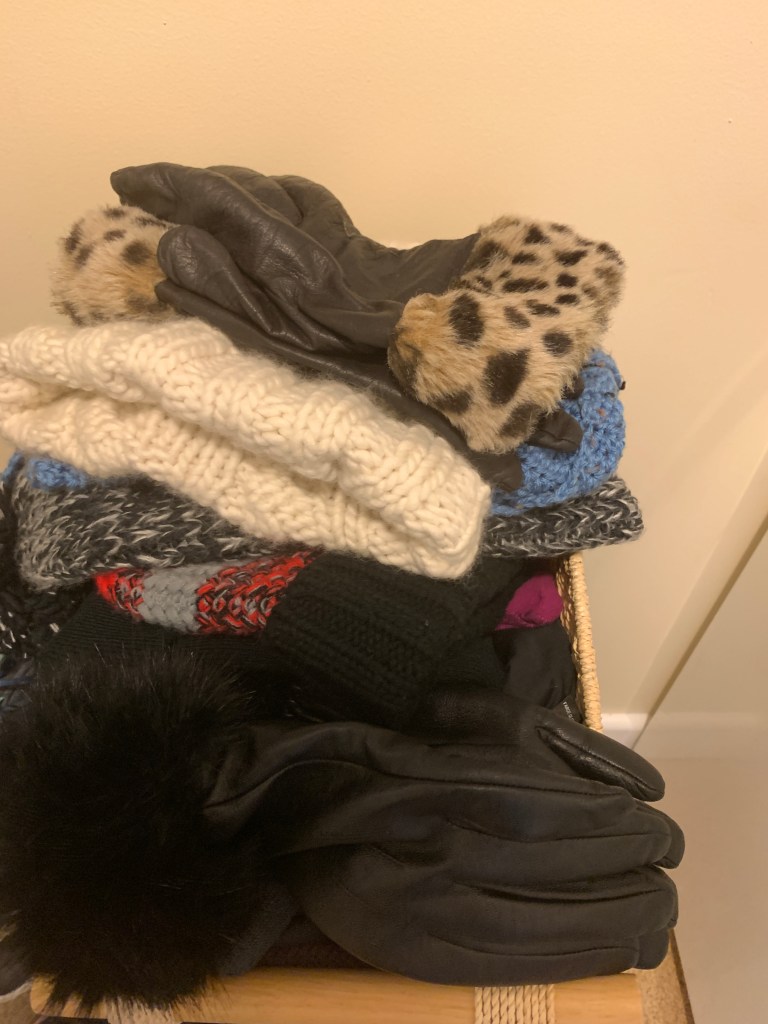
Without doubt we are moving into winter – if nothing else had told me, I would know because the sheep chill factor as announced during the weather forecast is now frequently described as “hazardous to newly shorn sheep”.
-
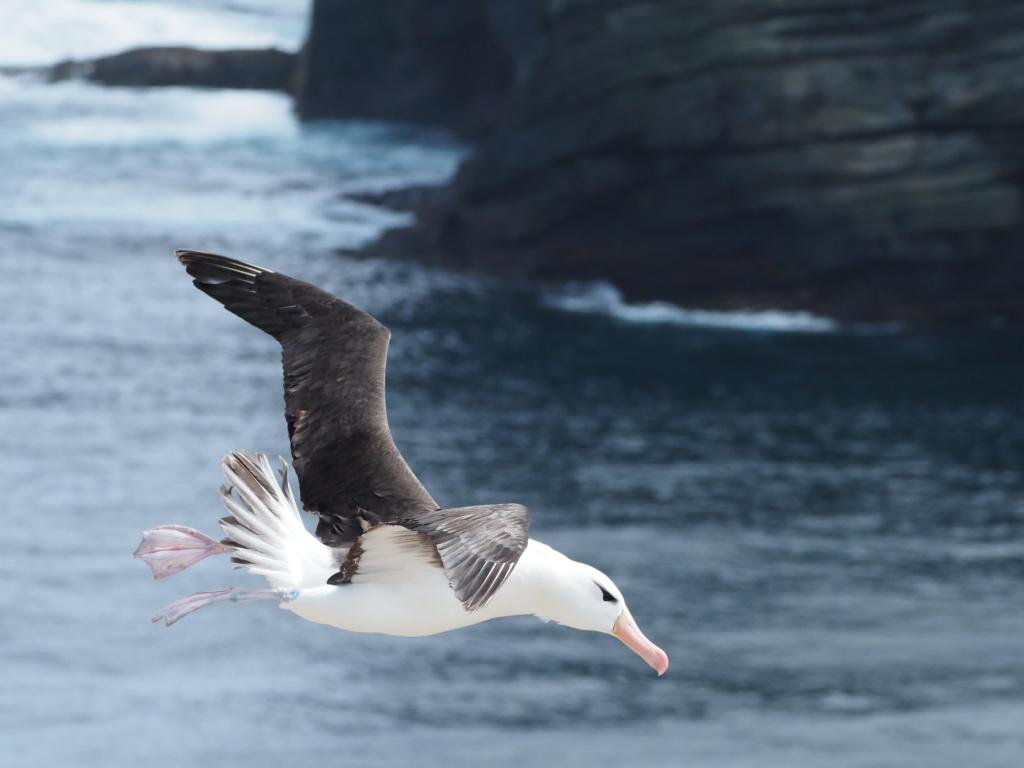
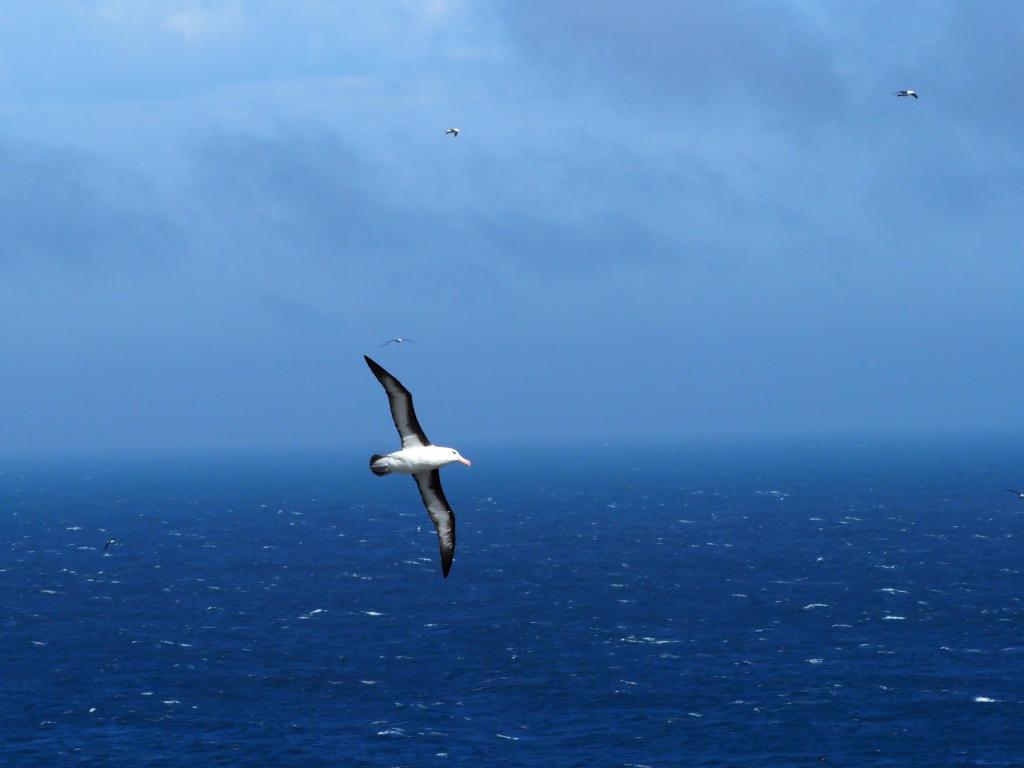
Black Browed Albatross
Day 2 at New Island and I was off to see the rookery nearest the settlement – about a 15 minute walk. The big draw here was to see Black Browed Albatross which would be my first time. I got buzzed by another pair of caracara. I’ve regularly met curious caracara but not experienced pairs circling over my head in the way they did here. I’m assuming it’s a territorial thing and the right thing is to ignore them and move on, but it’s a bit unnerving when they get lower and lower.
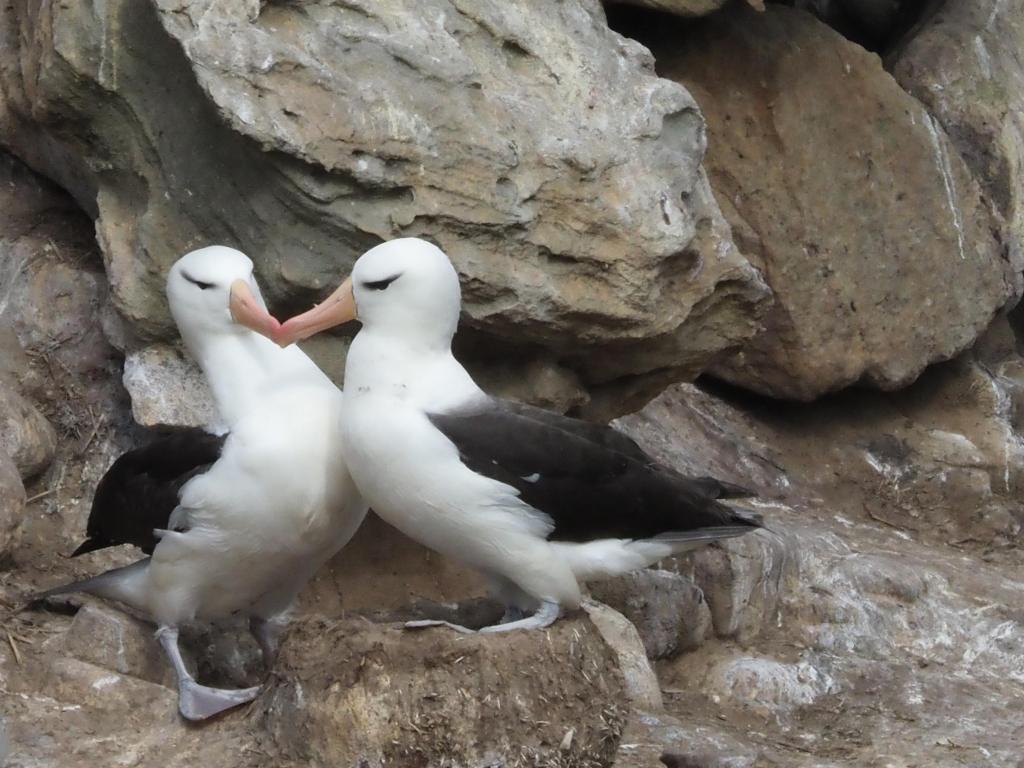
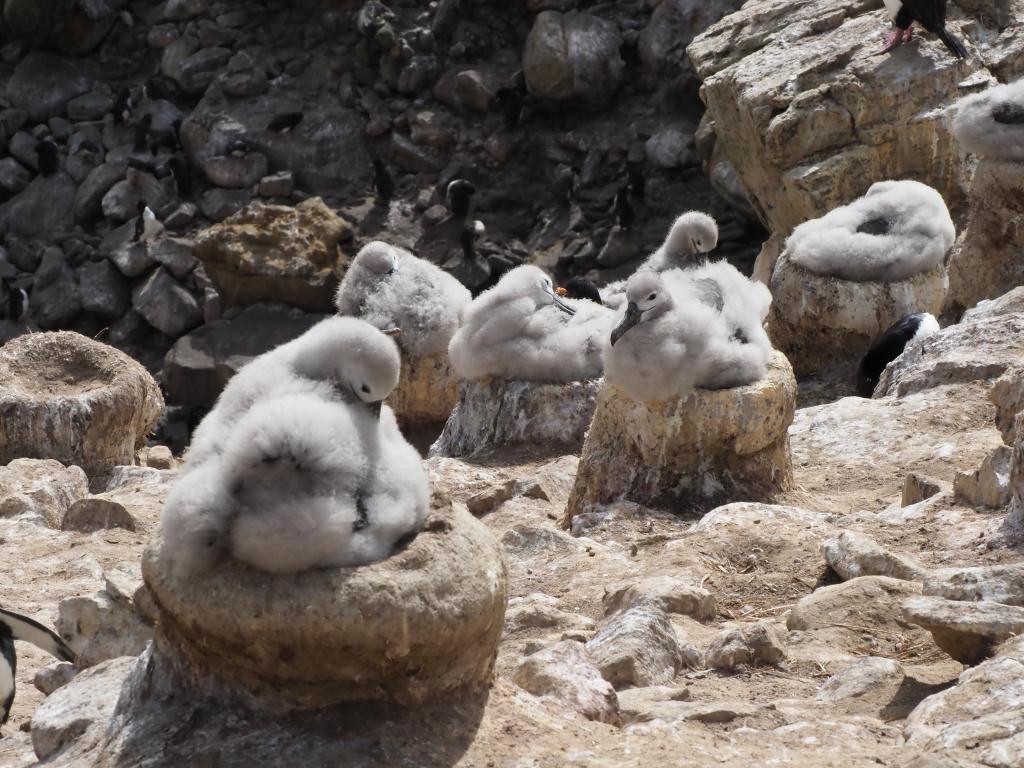
I got to the colony which is on a very large cleft in the cliff and slopes down to the sea. There are so many birds it took me a while to get my bearings. I found a good vantage point to watch from and to take it in. At this rookery there are large numbers of Imperial Cormorants (black and white) and Rockhoppers (black and white) and Black Browed Albatross. At first I couldn’t see the albatross and felt a bit disappointed. Then I started to see them – their characteristic nests built at the highest points of the rookery on the other side of the cleft. I think this is so that the adult birds can take off more easily and use updrafts to get into the air. I sat and watched adults feeding pretty big chicks – one per nest – and chicks preening and sleeping.
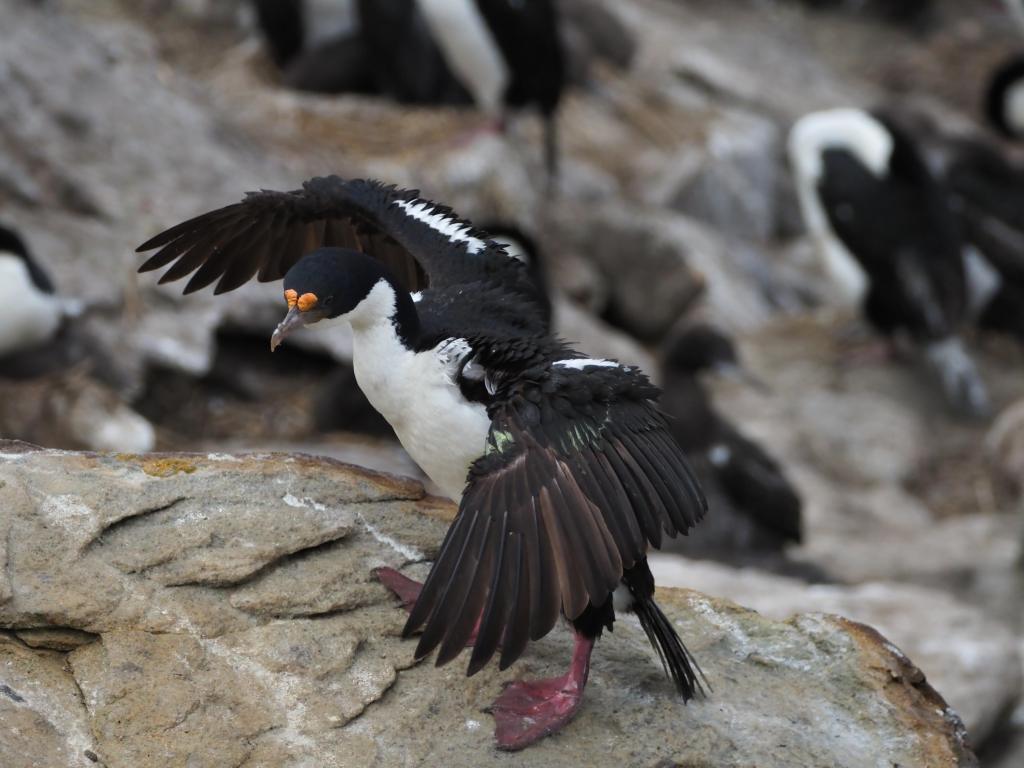
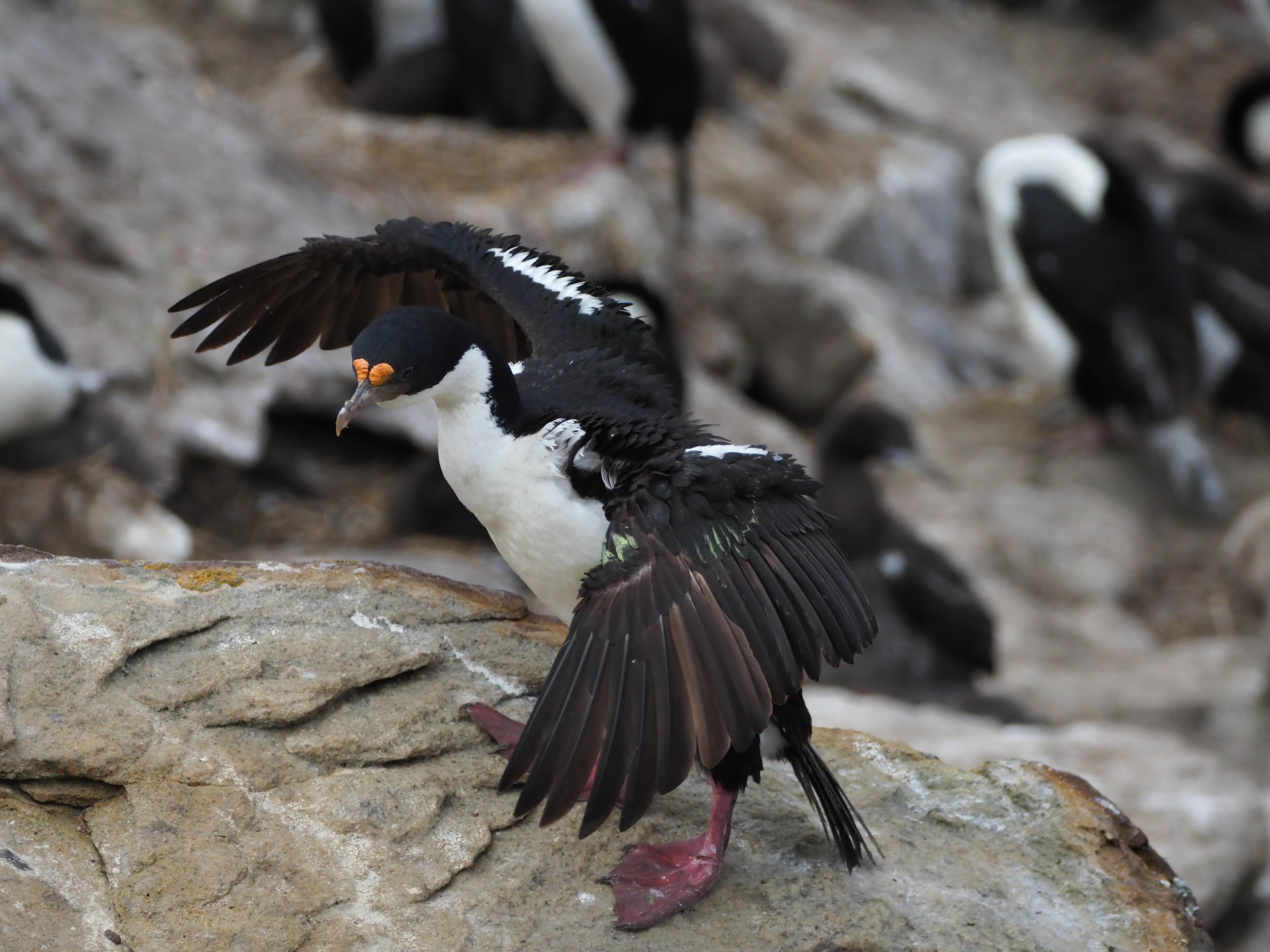
Imperial Shag wing stretching I could see lots of Imperial Shag activity – adults coming and going, chicks of lots of different sizes, some pretty big and ready to go. Then I started to notice that there was a steady trickle of them moving to just below my vantage point to take off. Presumably because it’s a good place to start, lots of chances of updrafts to make flying out easier, particularly useful if a bird is just learning about flying. I watched a pair near me, testing their wings, hopping up and down rocks and then, one was off. I spent ages watching the second one, thinking that any moment when it was ready to take its leap into the air I might get the perfect pictures of it taking off – but it fiddled about for ages and eventually wandered back to some other cormorants. Not quite ready yet.
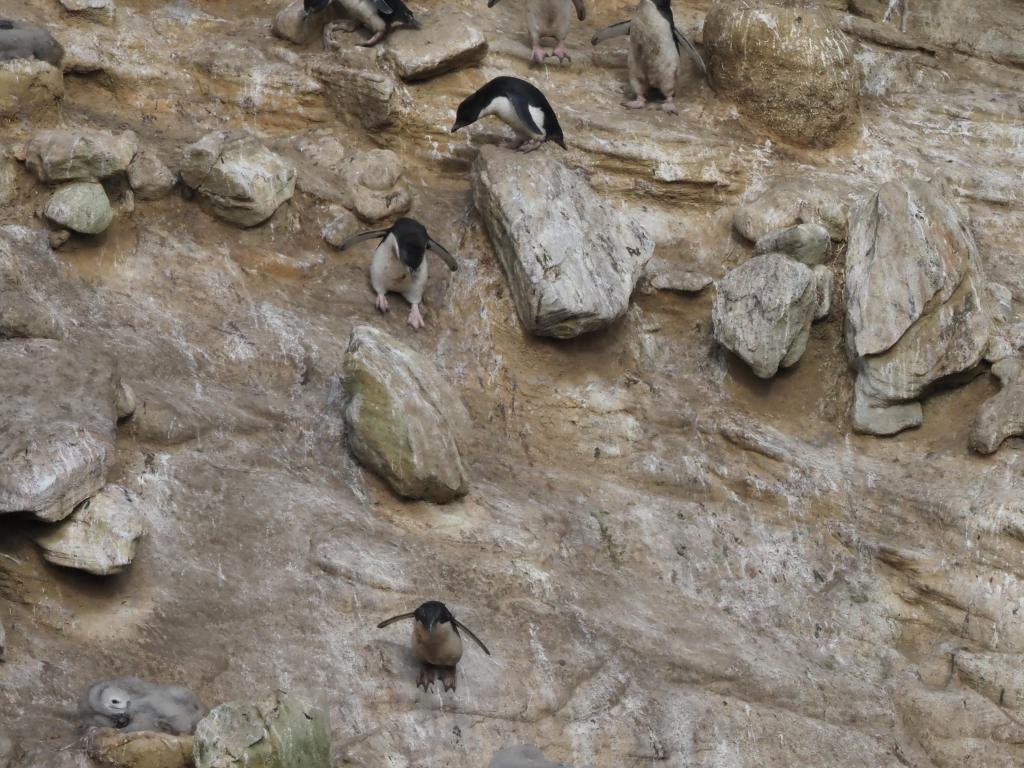
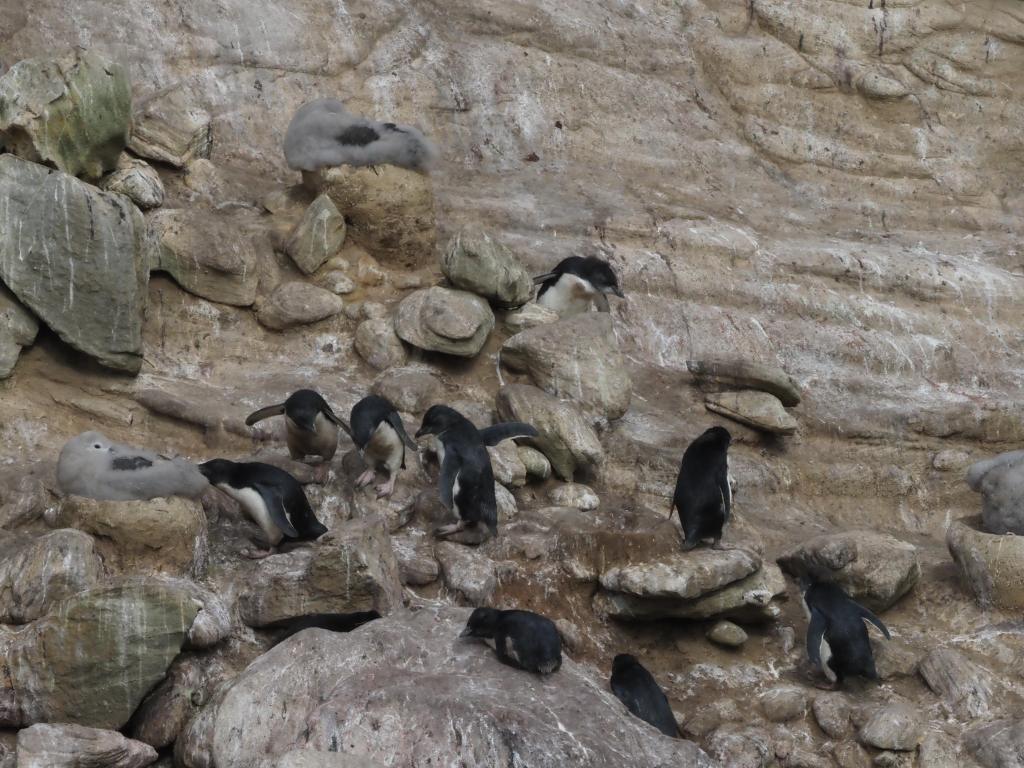
There was lots of Rockhopper activity, as ever with some death defying feats, Rockhoppers definitely don’t get vertigo. Particularly some younger ones who were going up and down sheer cliffs, it seemed just for the practice, as at one point they did a whole loop up and dow around some albatross nests. Of all the penguins that live in the Falklands, I do feel that Rockhoppers make their lives particularly difficult. It does make me wonder about evolution – why on earth would any creature think that hopping up sheer cliff faces was the best way to survive and evolve to specialise in it?
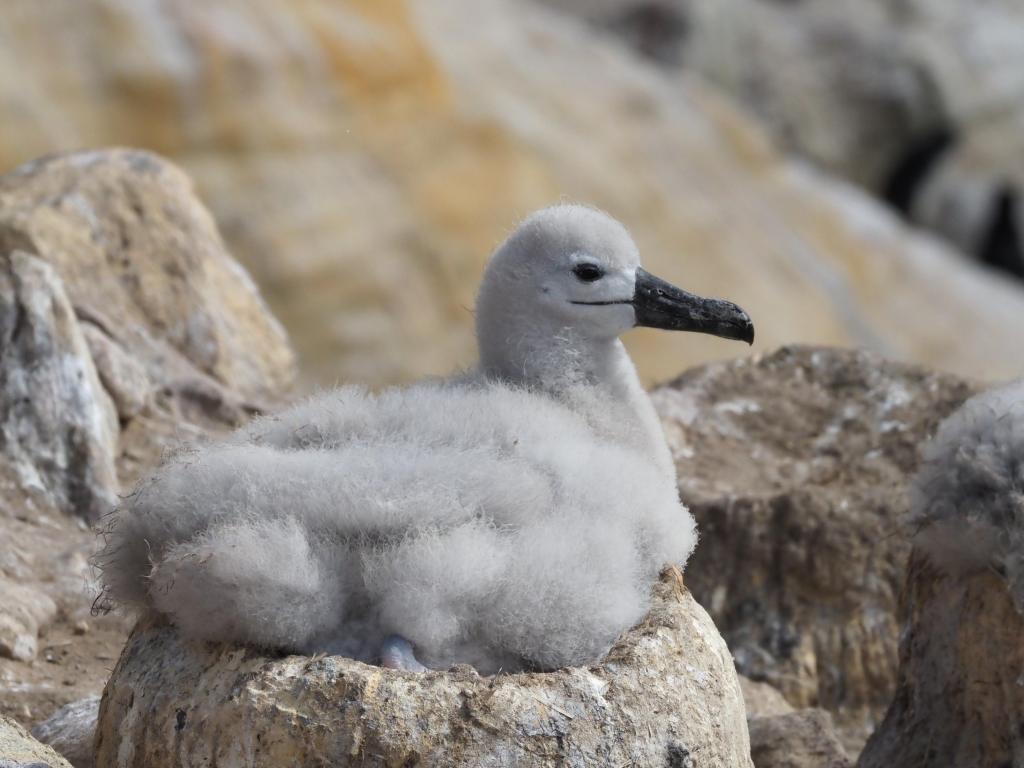
I then walked around the top of the cliffs to the other side of the rookery, staying the right side of the cruise ship rope and came to a section by a large number of Black Browed Albatross nests. It was really amazing to see these young birds, which are pretty big at this point, although they won’t leave their nests until April. They were large, with lots grey fluff and juvenile eyeliner around their eyes. The grey fluff all has to go and be replaced with proper feathers before they leave to face the world and feed themselves. I realised that I was under one of the incoming flight paths – when I observantly noticed that the “whompf” of an Imperial Shag going over my head, as it sped into its landing, made me duck! It was magical watching these birds and I went home happy and content.
Day 3 dawned, with the weather exactly as forecast – well I knew before I got out of bed, because I could hear the old house groaning and moving in the wind. If you use the weather app Windy, you’ll know that the colour purple is not a good colour – it means very strong winds. It was a day with gale force winds and stronger gusts. It would be a Red Warning for wind in the UK – here it’s just a very strong wind day and therefore a reading day and a gazing out the window day and a short afternoon walk day to get some air. During which I was stalked by a pair of caracara (of course I was) who weren’t going to try flying but stalked me on foot, wanting me to know they were there. On my way back I couldn’t see them for a while, that’s because they were sheltering from the wind behind some clumps of tall grasses, exactly like horses in the lee of a hedge. A very sensible approach in the circumstances and they are very intelligent birds.
So I didn’t get to see the fur seals on this trip, and there’s lots more of the island to explore, because it really is a very large place and you need to come for more time than I had to see it all. Only one solution – I’ll have to come back!
-
A “Swiss Cheese” Island
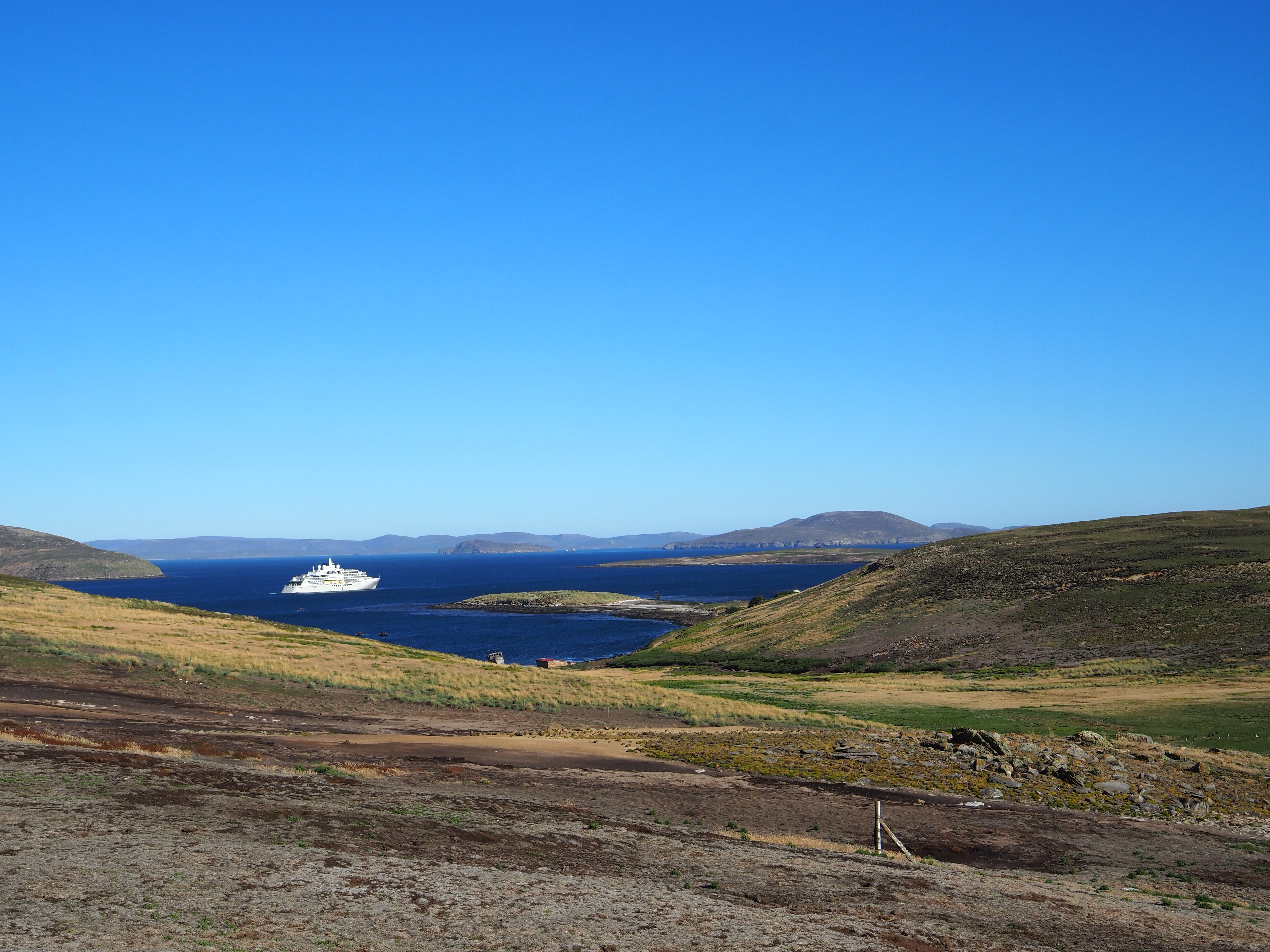
I was very pleased to be at New Island – I arrived towards the middle of the afternoon and by the time we’d waited for the second plane to arrive and bumped over the track to the settlement for 40 minutes, it was getting on.
It was about 5pm when I set out and as there was a cruise ship visiting, I was advised not to go to the nearby settlement rookery but go further afield perhaps to the fur seals, using one of two routes – round by the vehicle track or over the hill. I was also given instructions for how to find the right place to walk down to see the fur seals and not frighten them. Apparently they’re easily spooked by people and if frightened will rush off into the water, leaving their pups – which no one wants.
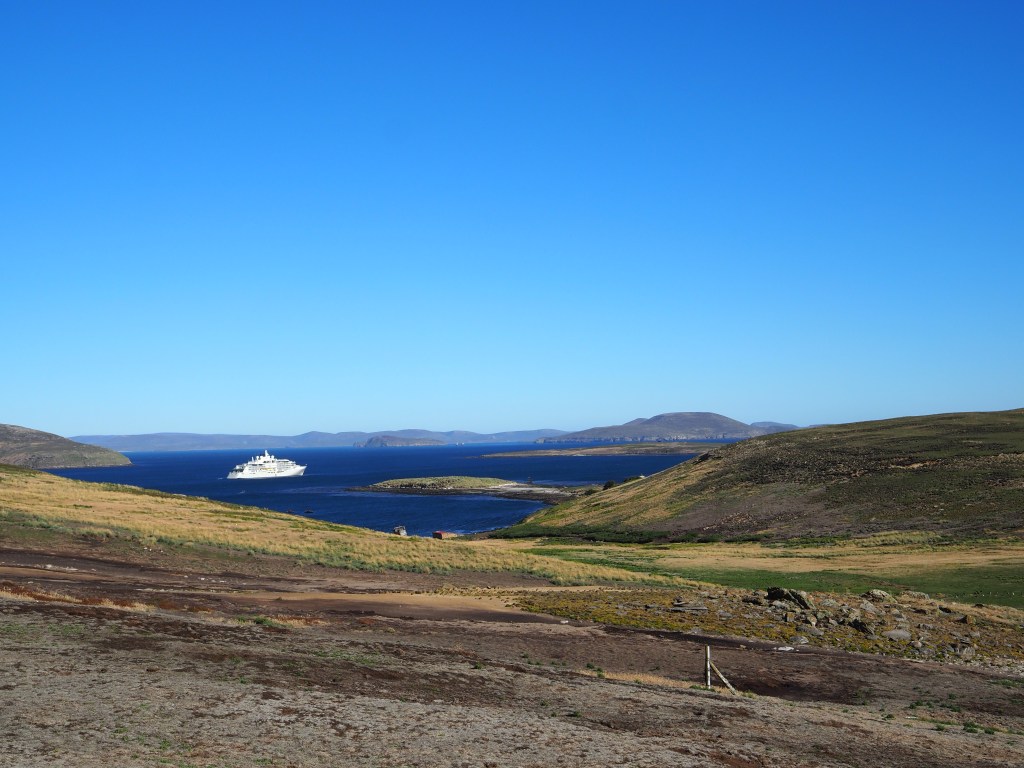
An expedition ship anchored off New Island I set off, secure in the knowledge that it doesn’t really get dark until after 9pm or later at the moment – but I hadn’t really asked how long it would take to get to the fur seals and obviously I wanted to arrive, have a while watching them and then walk back. If the wardens thought it was doable, I should be fine…
I set off up over the hill as I thought it would be a shorter distance. I hadn’t factored in how much time it would take to avoid prion burrows. Prions live in huge numbers on New Island and they nest in burrows not far from the surface. If you’re not careful you can put your foot through a prion burrow – bad for you and worse for a prion chick, as it’s now exposed to the air and the attention of the caracas, who will swoop in and get it. If you do inadvertently put your foot through, you should check and see if there is a bird in there and find a stone to cover the hole. I was careful to try and avoid them, but this is almost impossible as the island is a bit like a swiss cheese, filled with holes that are prion burrows. I found that when you notice one, you suddenly find you are in an area filled with them and you have to pick your way out very carefully.
I got to the top of the slope – having walked up a fairly regular slope and assumed that I’d be walking down something similar on the other side to the point where the valley to the fur seals was. Not so – it was undulating…. or perhaps I should have gone higher and it would have been a ridge all the way round, but who knows I didn’t go that way. I also was a bit unclear on where the turn off to the valley to the furs seals would be – but I could see the rover track wending its way gently round the valley floor. Ah the ease of the road not taken – too late now. I persevered and admired the range of flora that existed on this side of the slope – lots and lots of diddle dee and lots of plants I couldn’t name!
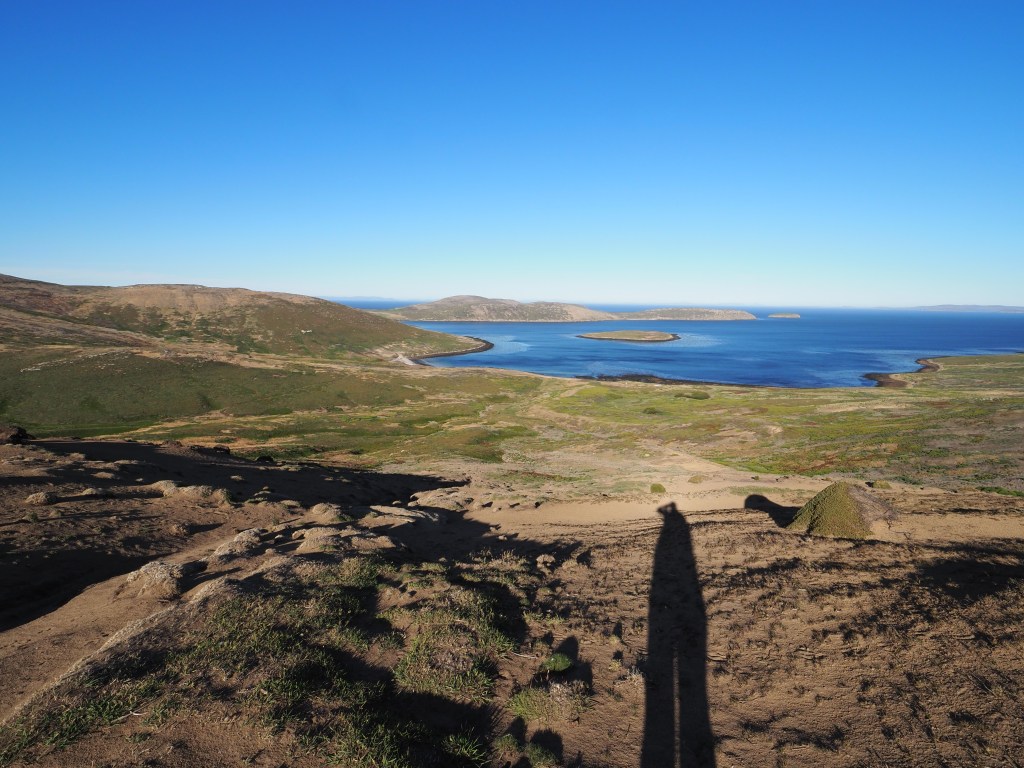
Giants appear in the shadows of evening light Eventually I made it to the track – having been eyed up by some caracara on the way. I hope I wasn’t have a drink in a particularly desperate way inviting them to think that I might soon be food, more likely I was close to a nest that I couldn’t see or just in their territory. I moved on, they left me alone.
I found a stick in a cairn on the rover track, which I thought probably signified the turn off to the valley towards the fur seals. Off I went following some old fence posts down – was this right? I remembered that I should see some blue stones – there weren’t any. I went further down and got buzzed by another pair of caracara – still no stones. Should I have gone further along past the cairn to another one? There were two on the map but I’d only seen one. I went back up the hill, more caracara buzzing, back to the cairn. I walked past it for a bit – no more cairns, no more valleys. It was 7pm. How long would it take me to walk back?
I decided sadly that I’d run out of time to see the fur seals that evening. I walked back along the rover track – it was further, but it relatively level and I didn’t have to do any prion nest dodging. It was peak Magellanic penguin evening shoutout time and the air was thick with their braying. It is a sound that I have really come to love, along with the way they watch you from the edge of their burrows, fixing you with a beady eye while they decide whether it’s safe to stay out on guard, or whether they need to duck back inside for safety.
And so back to the house for the night – I got home just after 8:30pm, so the rover track was definitely the right choice and might have been on the way out! I still didn’t know if I’d been in the right place or not. I’d had a lovely and somewhat eventful walk despite being rubbish at finding the fur seals!
-
New Island or bust

New Island is one of the outer islands in the Falklands and it is more than usually difficult to get to. It’s long and thin with high cliffs on its western coastline, inland hills and gentle slopes to the eastern shore. There is very little flat land, which means that the only airstrip is short and FIGAS’s sturdy Islanders can only land or take off in quite a restricted wind range. Just like Goldilock’s porridge the wind has to be just right for landing and take off. Oh yes and there can only be 3 passengers at a time, instead of the plane’s normal capacity of 7.
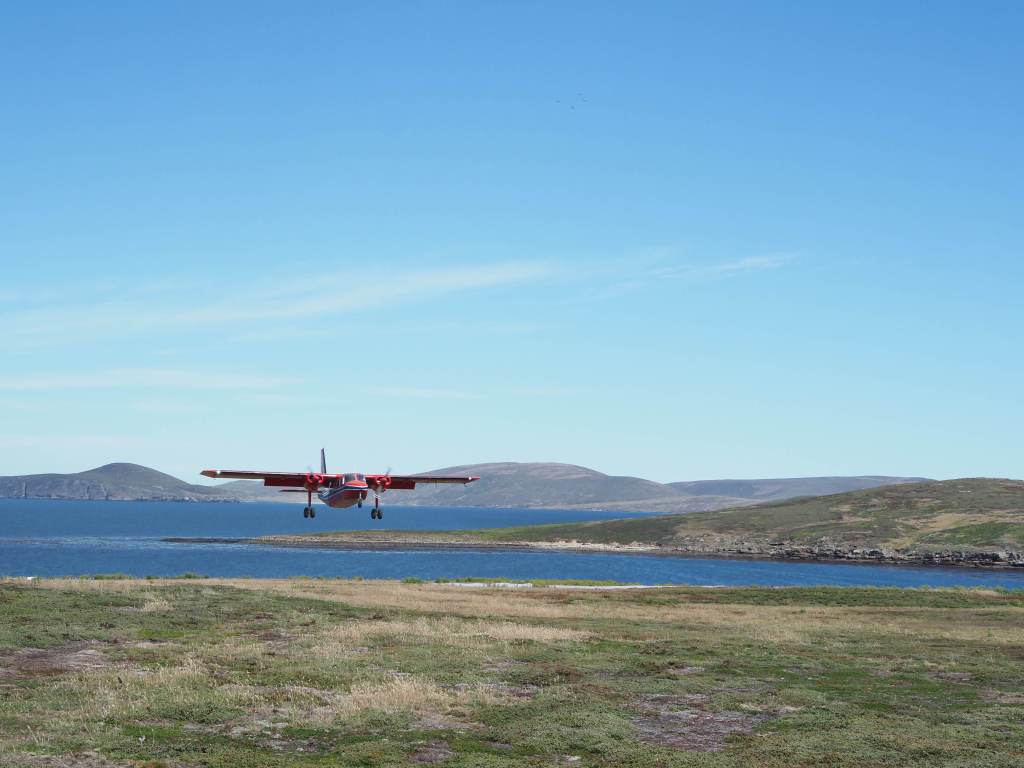
Coming in to land at New Island As a result of the wind restrictions the advice to anyone who wants to visit is – be prepared to be delayed and be prepared to be stuck! Don’t have anything critical planned – like an international flight – for 5 days after you’re supposed to leave.
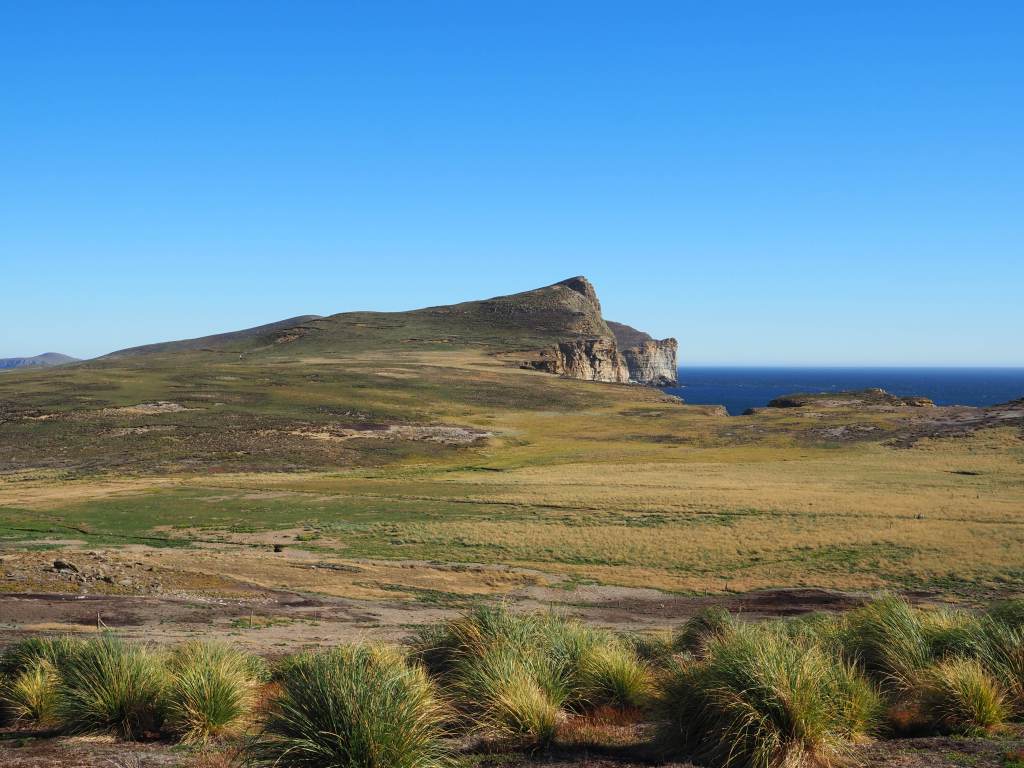
Despite the difficulty factor of arriving and leaving, New Island is generally agreed to be a great place to visit. It’s very beautiful, the walking is excellent and wildlife is abundant, some of the island has been managed for nature since 1972 and the whole island became a nature reserve in 2006 and it is now run by Falklands Conservation. It has an international designation as an Important Bird Area with large populations of breeding Black-Browed Albatross, Prions and Rockhoppers – and lots of other bird life such as Gentoos, Magellanics and Imperial Cormorants. There are also Southern Sealions and Falklands Fur Seals.

New Island settlement So a plan was hatched before Christmas, to visit with 2 friends. A booking was made for a 3 night stay in February – arriving on a Friday and leaving on the Monday – in theory. As the date got closer we started watching the weather, it became clear that we wouldn’t be going on Friday, but we might go on Saturday or Sunday – and that the return flight might be Tuesday or Wednesday. Unfortunately, despite keeping the week clear of important commitments, one of us found that important meetings had just been set up and had to be attended – so then there were two.
Nevermind, the weather looked fair for a Saturday flight. I packed as lightly as I could on Friday night (the weight limit is 14kg, which is a challenge with an increasing amount of camera kit) and went out. I returned to a message from my second friend saying that to her horror and disappointment she had caught a sickness bug off her children and wouldn’t be able to come after all. So then there was one.
I got up bright and early on Saturday morning and pitched up at FIGAS for 9am checkin, only to find that the times had changed during the evening, and checkin was now scheduled for 11am. Nevermind! I went home (it only takes 10 minutes) made some coffee and had a very relaxed couple of hours.
Back to FIGAS. Checked in and waited. We waited quite a long time – it transpired that there was not enough wind currently at New Island but it was forecast to increase. It was just like waiting to go sailing on days when there is too much wind or not enough. Hours spent waiting on the pontoons wondering whether we’d get to go out at all or in this case fly.
I met a couple of scientists who were travelling to New Island to work (the birds living near the settlement have been the subject of ongoing research for many years). I also met a family group travelling to Fox Bay on West Falkland to see Till Cove. During the 40th anniversary year names of the British forces who died in the 1982 war were given to unnamed places across the Falklands. This family were coming to see Till Cove, named after their father and husband who had died on HMS Sheffield. The mother and one of the daughters had been to the Falklands several times and I had met them in November 2022, when they visited as part of that anniversary year’s veterans trip. It was lovely to see them and we chatted as we waited. FIGAS were using two planes to fly to Fox Bay and then on to New Island – to split the passengers, the luggage and the freight.
Then I had a chat with the lady running checkin. She told me she loved visiting New Island but she hated it in terms of organising flights – particularly because people don’t really appreciate just how quickly conditions can change. Recently there was a training flight for one of the newer pilots. They got out to New Island, all was well, the wind was just right as they entered the harbour – but it died by the time they got to the airstrip (100s of meters later?) and they just had to turn around and fly the hour back to Stanley.
The next update was that there was now felt to be enough wind to go … but they’d just had a call from the hospital and might need to use one of the planes to do a medical flight, so they were calling up a third pilot.
And then I was off – hurray – but still slightly concerned about the story of last minute wind changes thwarting plans at the final moment. I need not have worried. We arrived at Fox Bay, dropped off half of the family group and took off again for New Island, a further 25 minutes away. It was a beautiful, sunny day and the colours of the sea and the clarity of the shallow water was amazing. Soon we could see New Island and then we were there, touched down and got out. I had arrived.
-
A photography learning curve
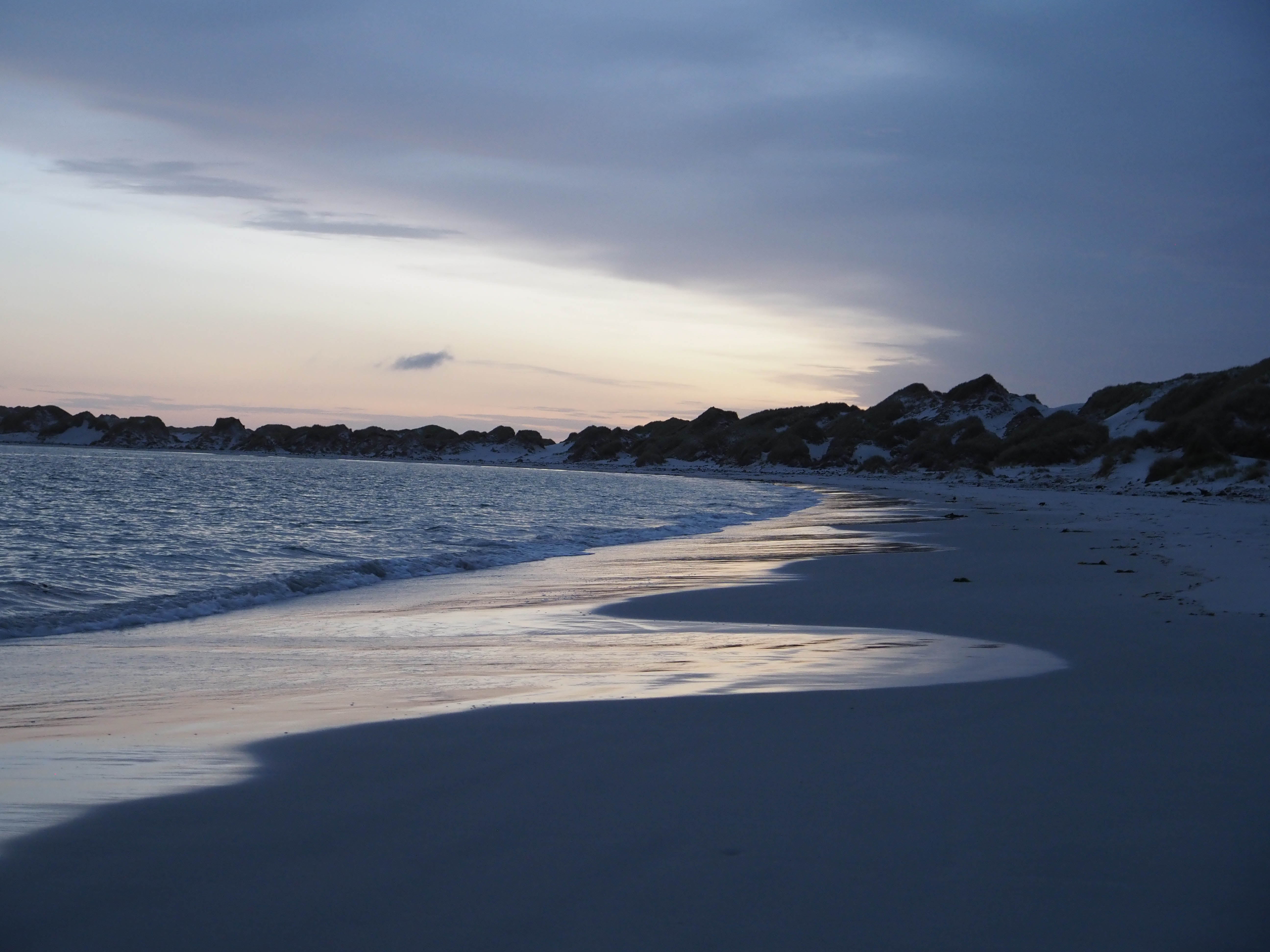
I’ve always taken photos when I’ve travelled, but they have tended to be of the point and click variety, taken as memories for me. Coming to the Falklands I knew that I would want to try and capture the incredible richness of the marine wildlife and the vastness of the landscape. Once I’d been here for 6 months I took the plunge and bought a mirrorless DSLR camera (Olympus) and a big zoom lens for it, and this Christmas I invested in a wide angle lens. It’s still very much a work in progress, but I feel like I’m starting to get there.
What I’ve learnt so far is:
- Go out as often as possible in the summer, to local beachs as well as to wildlife hotspots
- Always take all my lens – I’m sure to want the one I left behind
- Take lots and lots and lots of photos
- Going out at dawn and or sunset is best as the birds and animals are most active then and the light quality is at its best – but dawn at the moment is very early so it takes some doing!
- Be brave and come off automatic settings, although that does lead to some terrible fails, but I am learning by doing it
- Edit my photos as soon as I can – preferably the same day – otherwise they sit on the camera for too long and I do nothing with them
- Use the amazing resources online to study what other people are doing and try out new ideas
- Repeat!
I do feel like there are signs of progress though and I am very happy with the images I took at Yorke Bay recently, when I did get there before sunrise (5:15am) and the birdlife was in fine form.
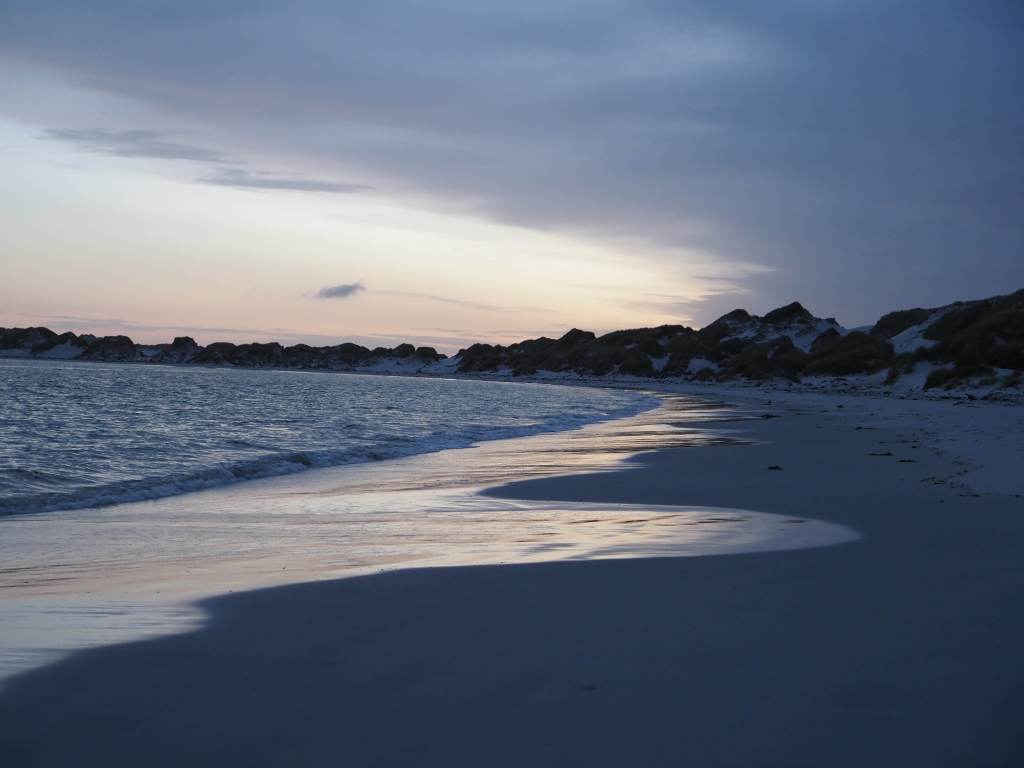
Dawn Yorke Bay 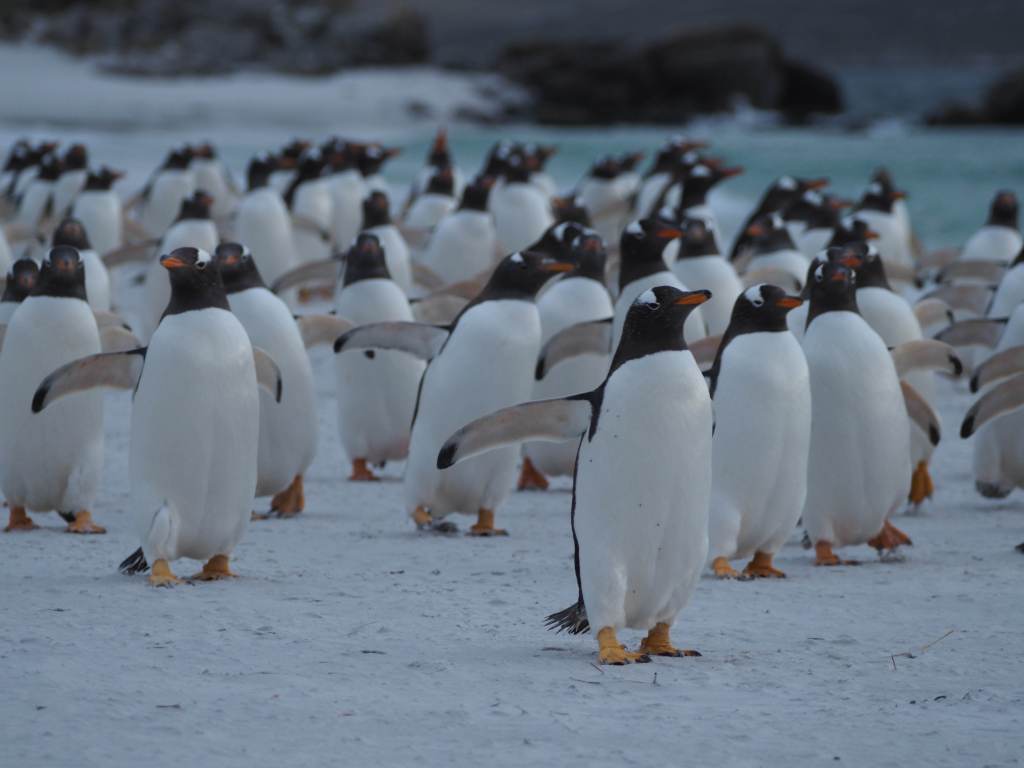
OLYMPUS DIGITAL CAMERA 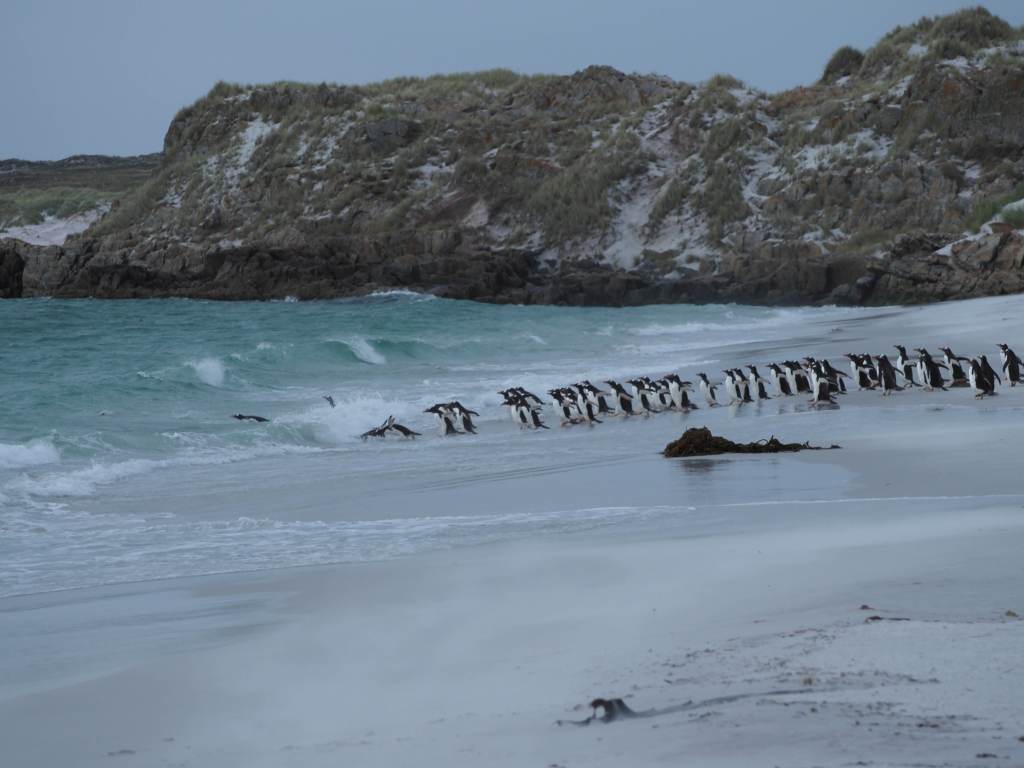
OLYMPUS DIGITAL CAMERA 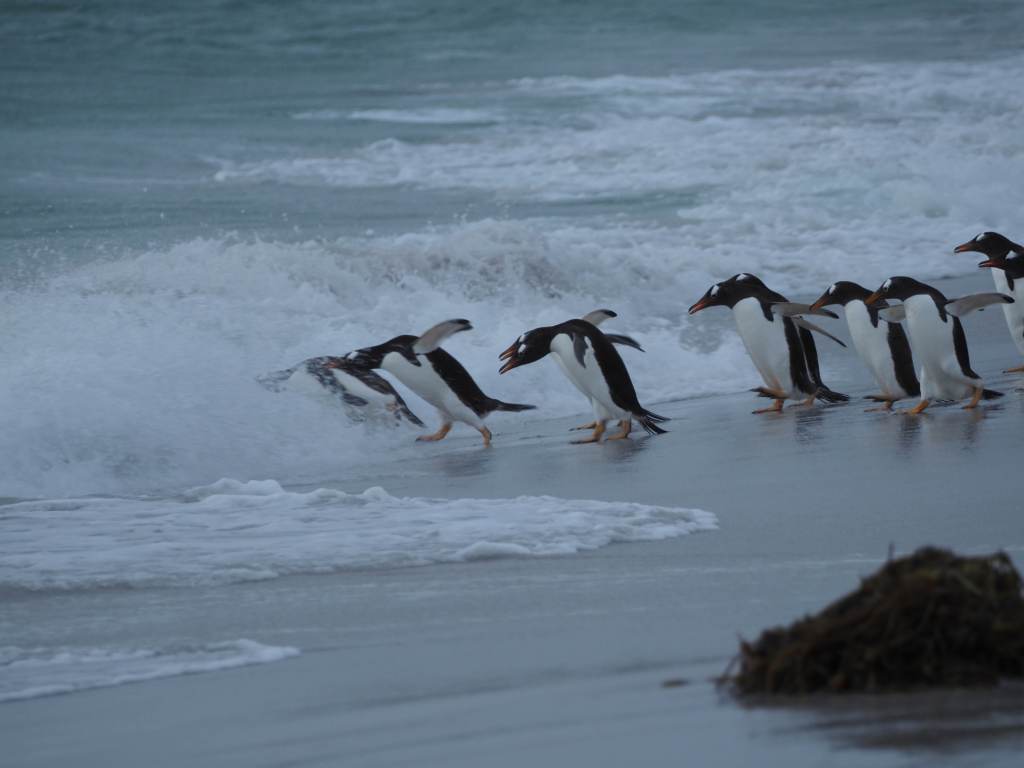
OLYMPUS DIGITAL CAMERA 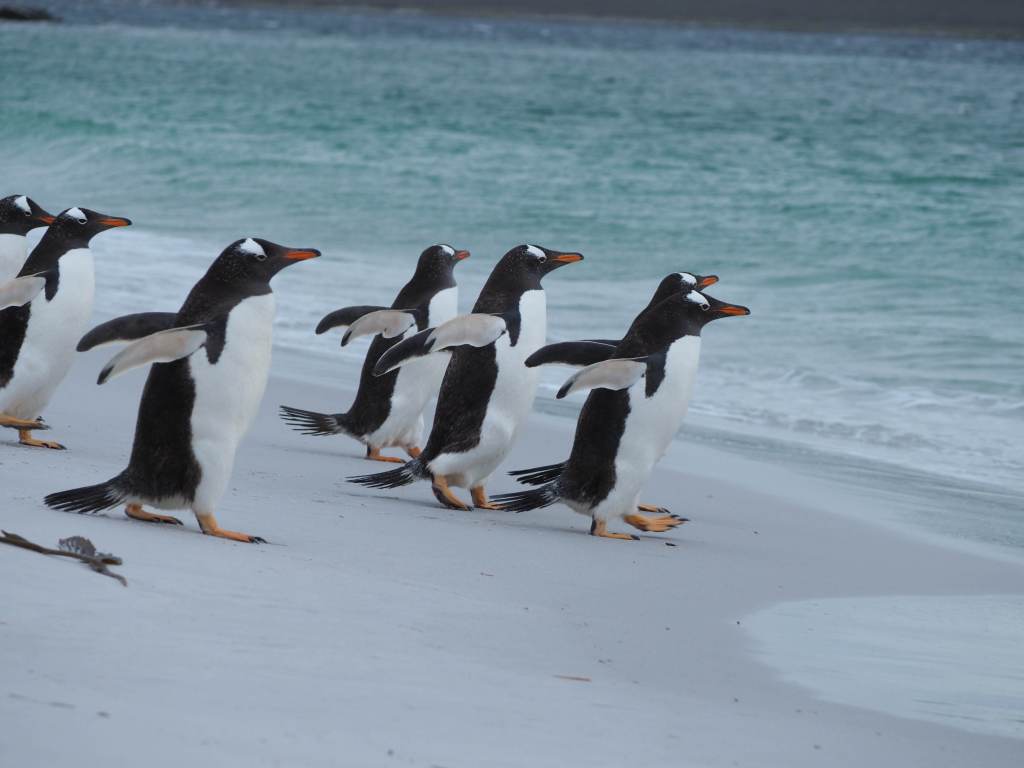
OLYMPUS DIGITAL CAMERA 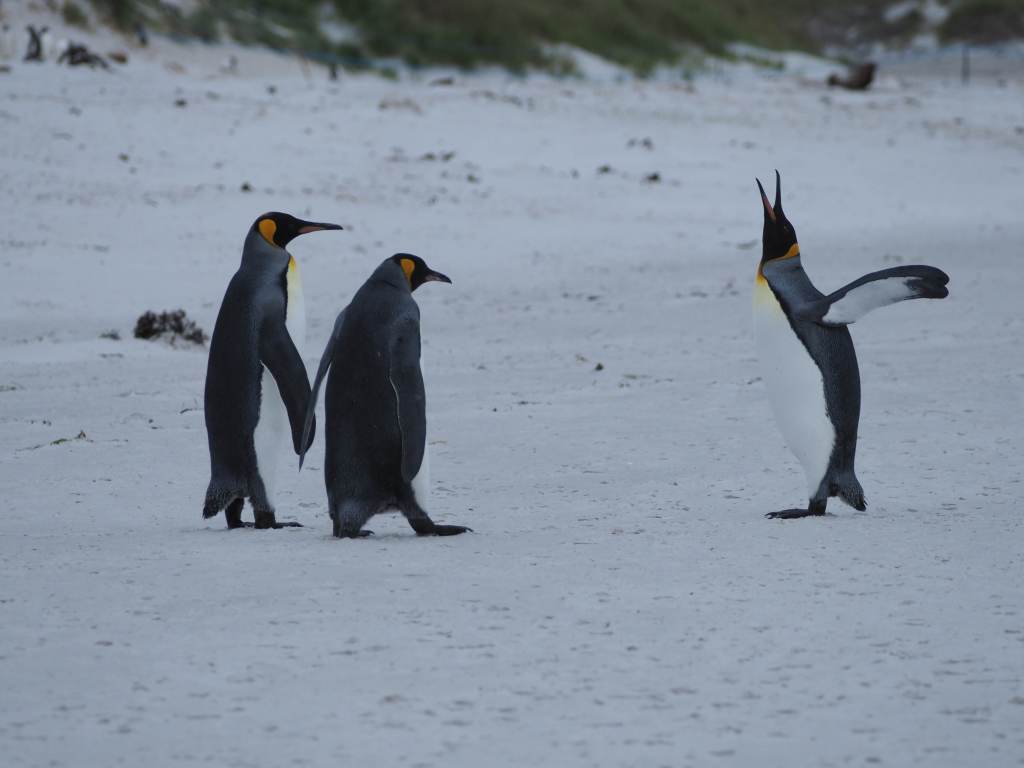
OLYMPUS DIGITAL CAMERA 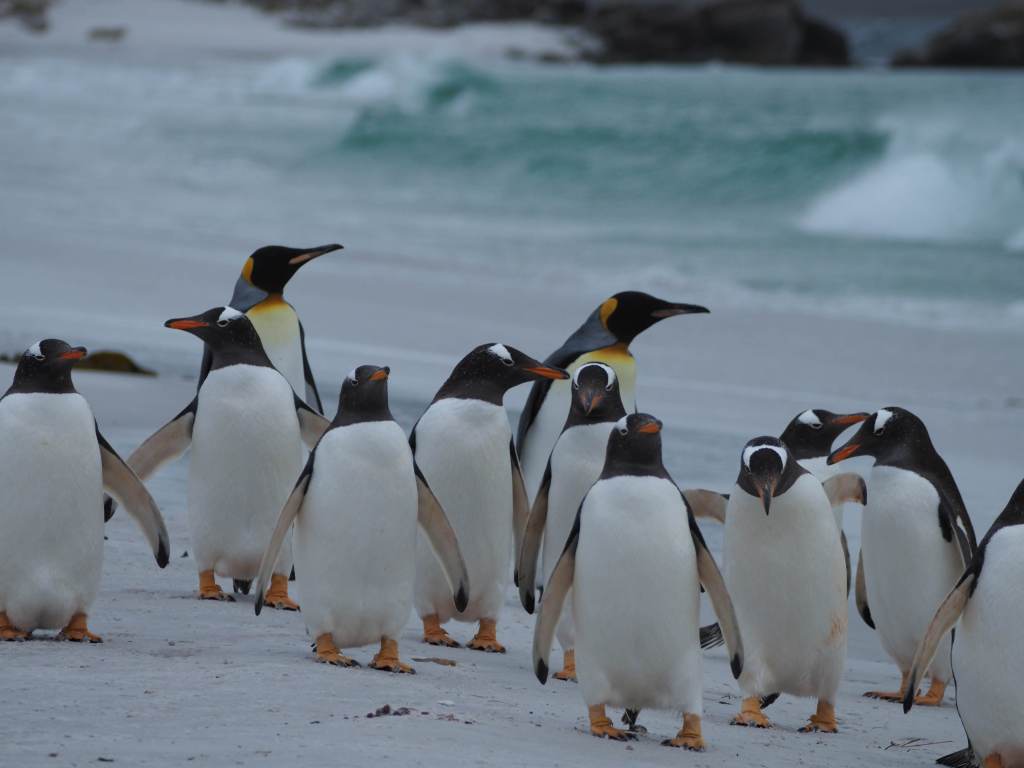
OLYMPUS DIGITAL CAMERA 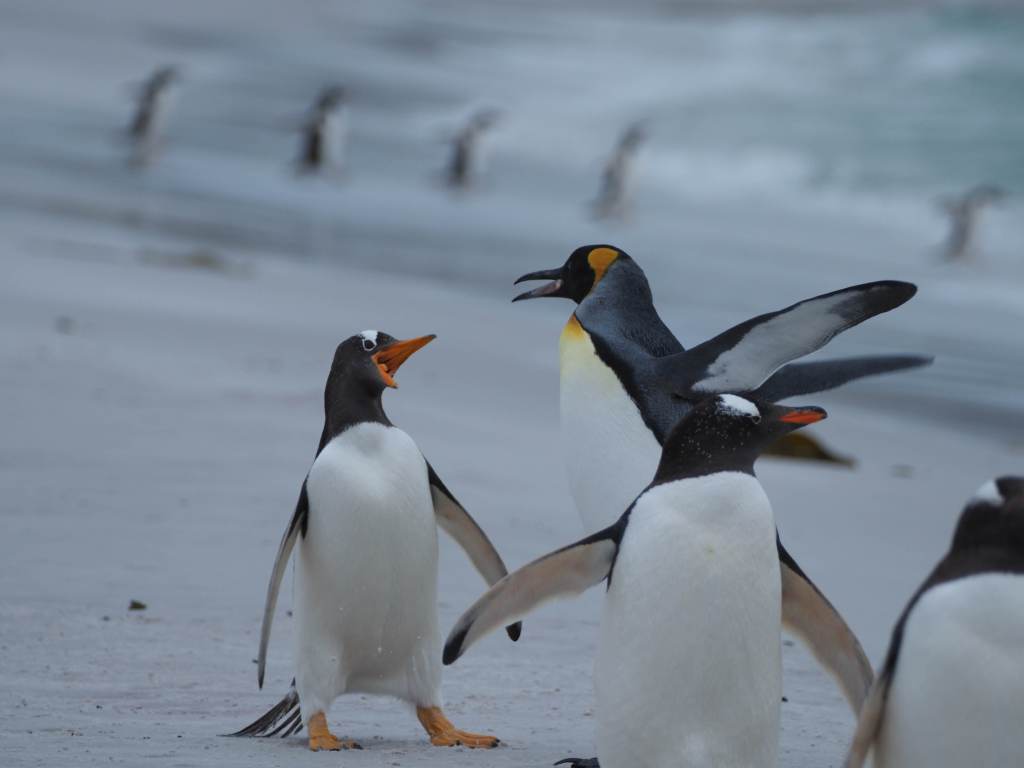
OLYMPUS DIGITAL CAMERA 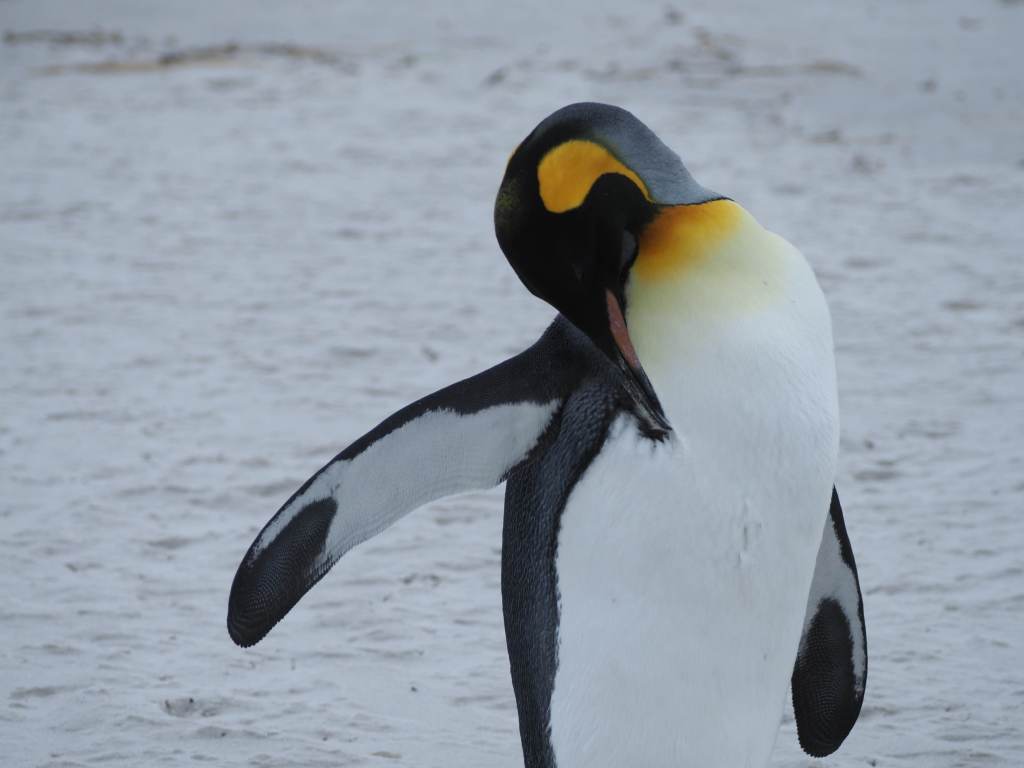
OLYMPUS DIGITAL CAMERA 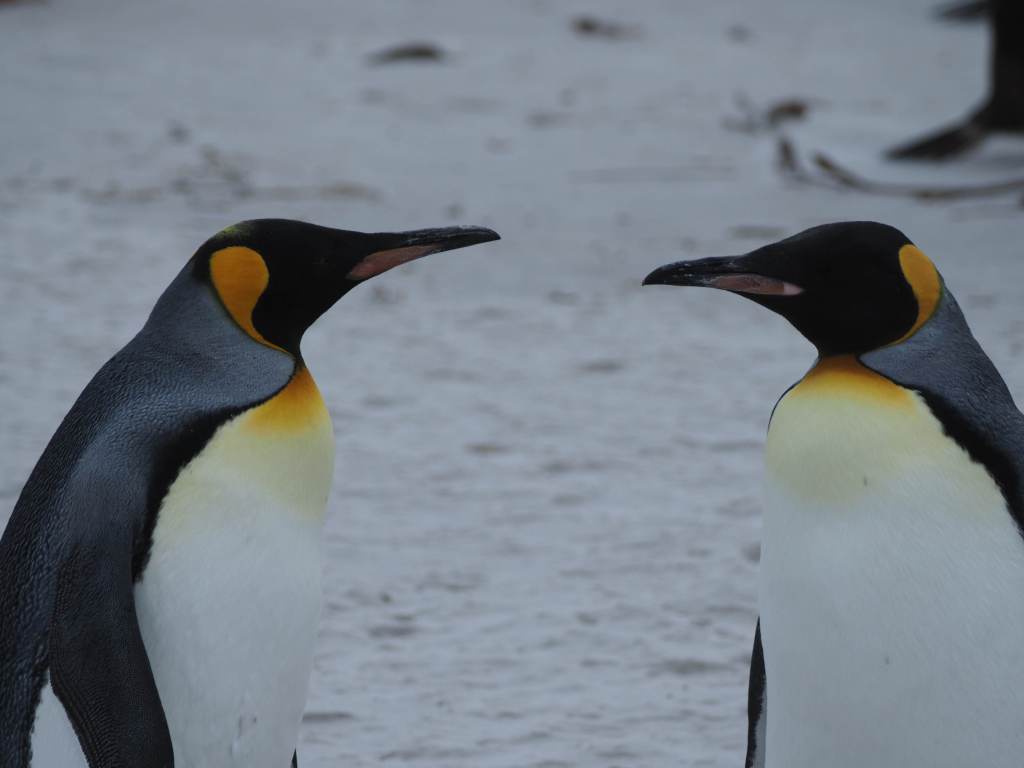
OLYMPUS DIGITAL CAMERA 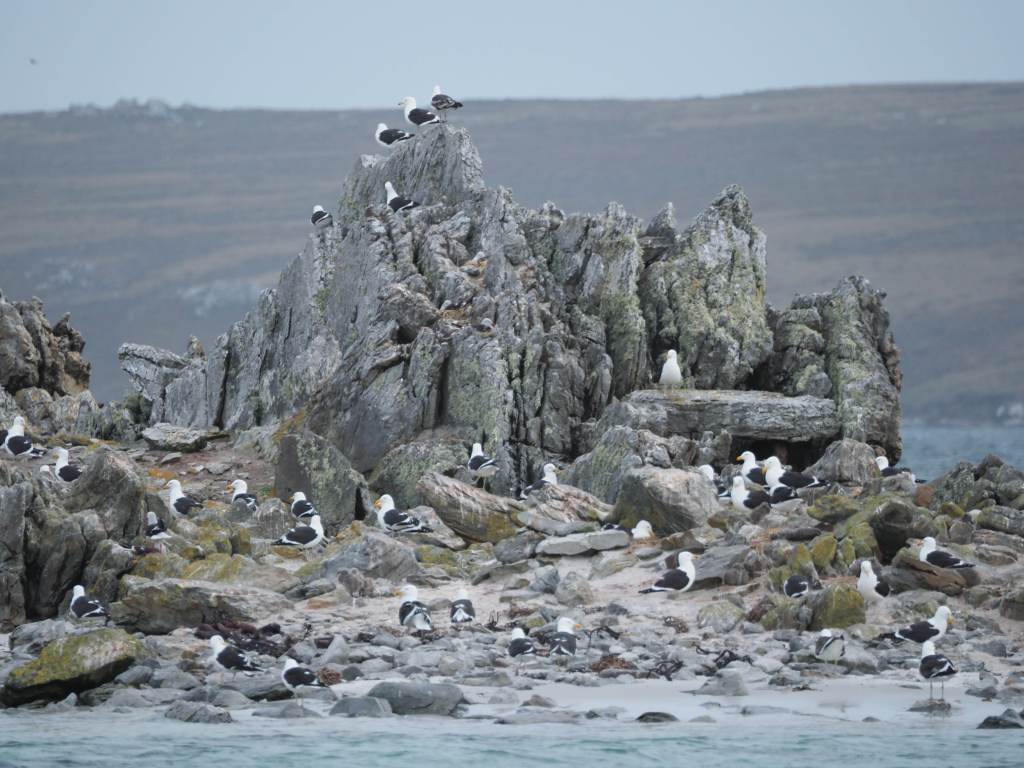
OLYMPUS DIGITAL CAMERA 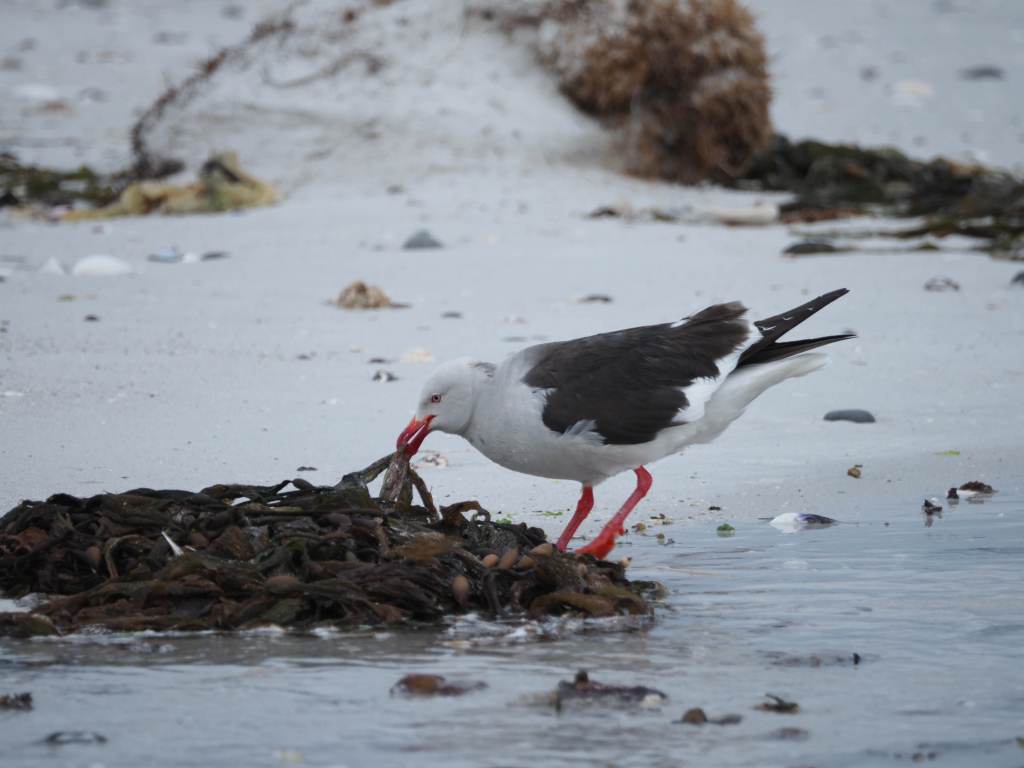
OLYMPUS DIGITAL CAMERA 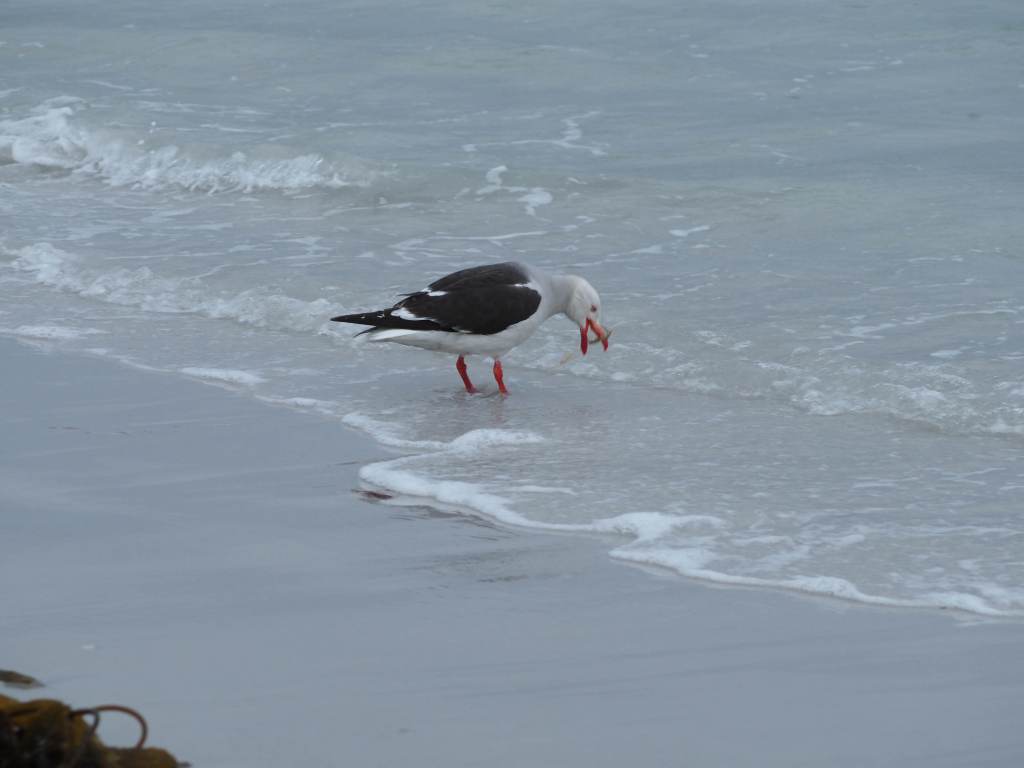
OLYMPUS DIGITAL CAMERA 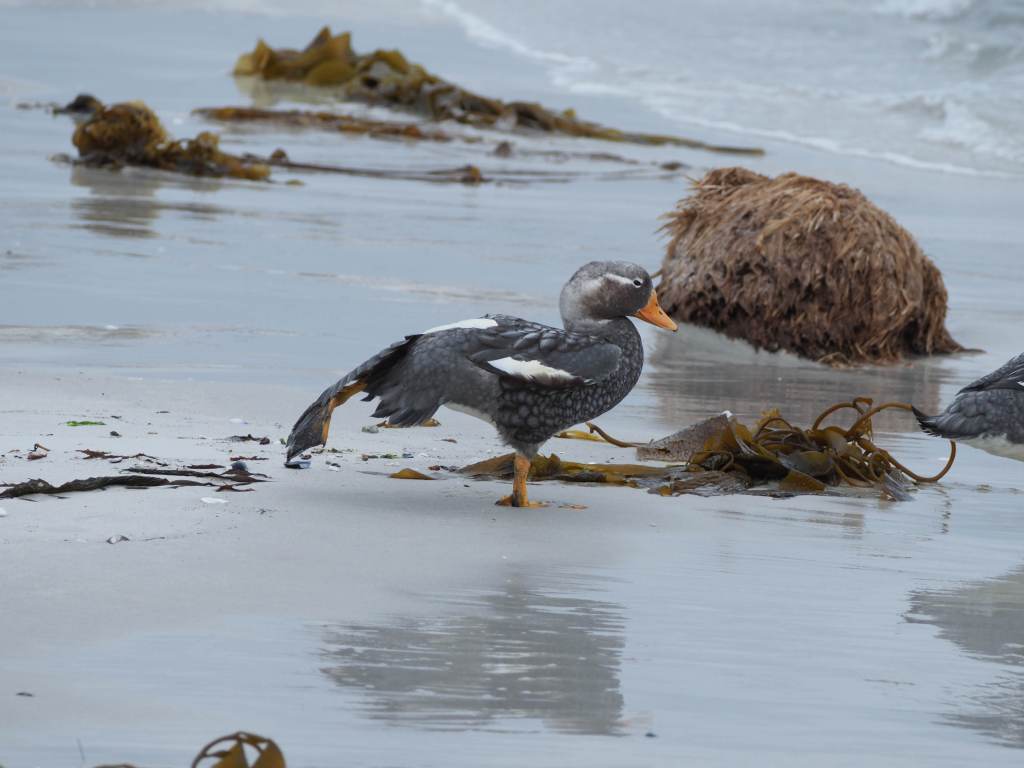
OLYMPUS DIGITAL CAMERA 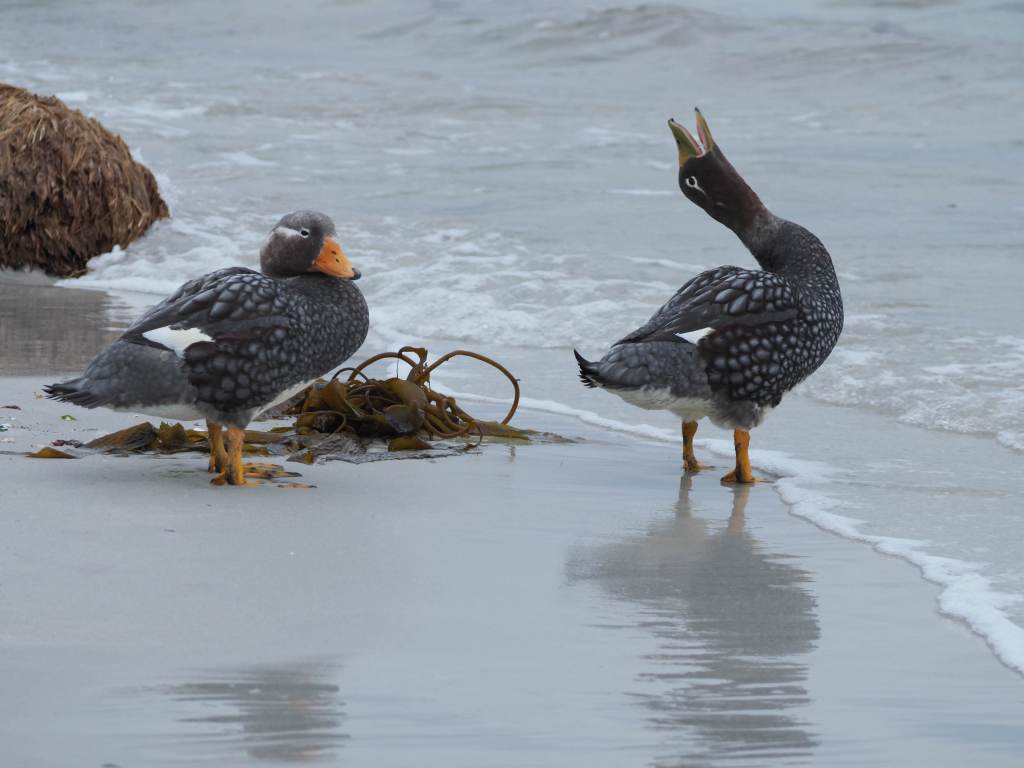
OLYMPUS DIGITAL CAMERA 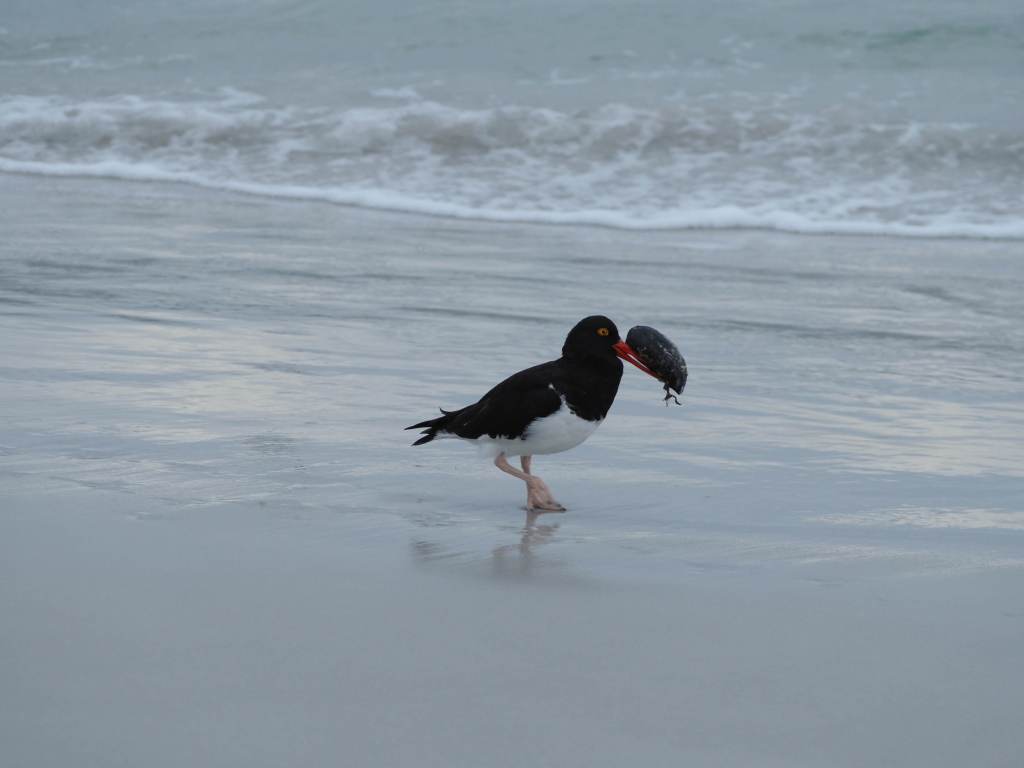
OLYMPUS DIGITAL CAMERA 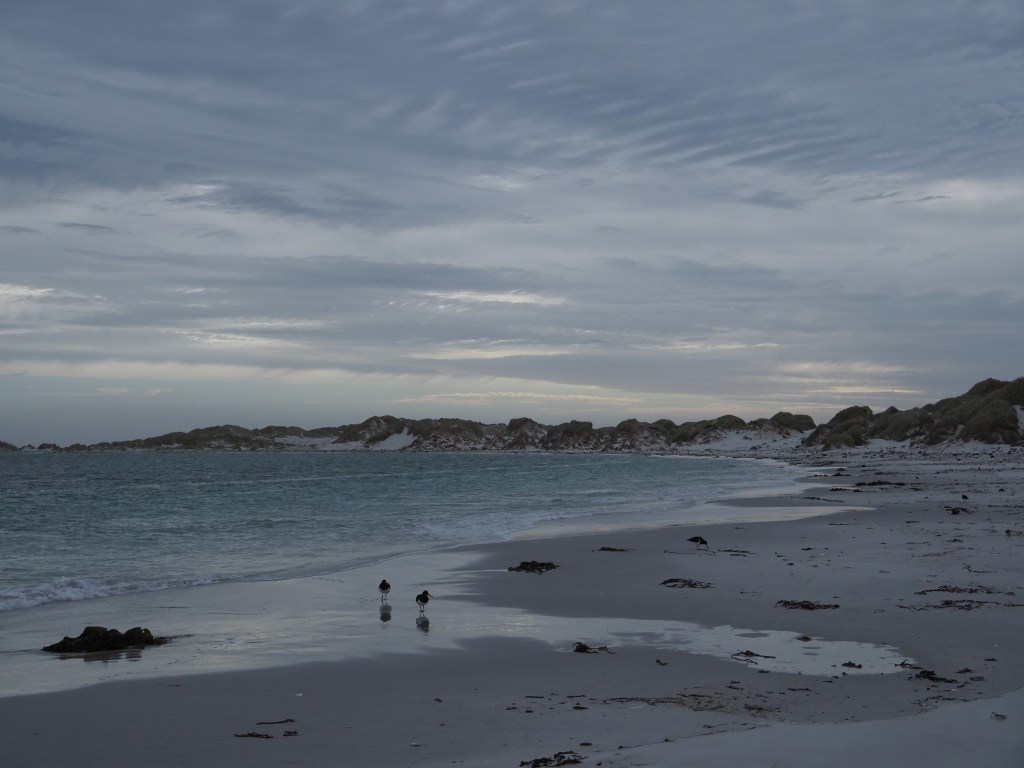
OLYMPUS DIGITAL CAMERA
In sequence – the birds are gentoo penguins, king penguins, 11 are kelp gulls, 12 is a dolphin gull, 14 and 15 are of steamer ducks, 16 is a magellanic oystercatcher.
-
The long journey south
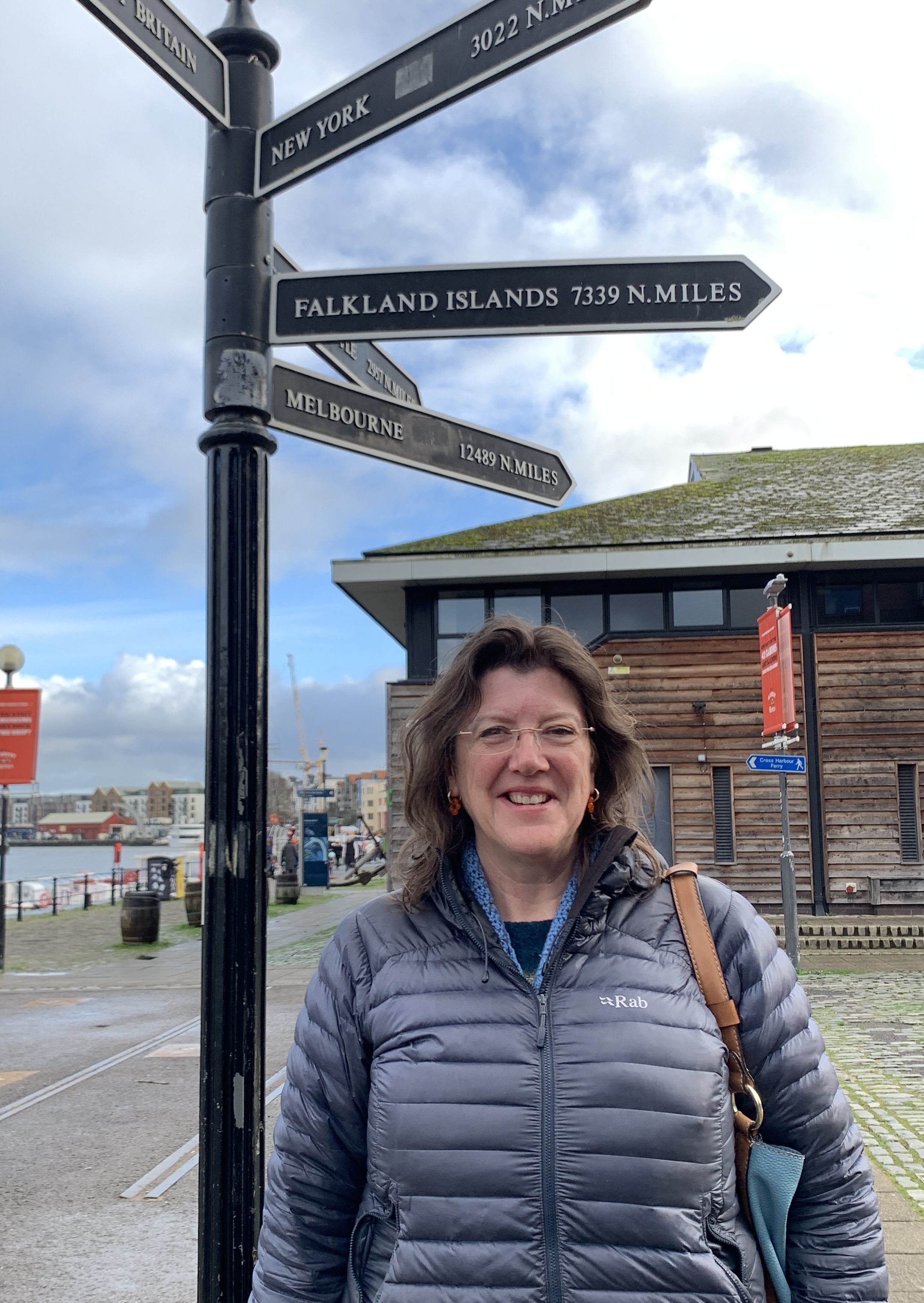
I went back to the UK over Christmas and flew North on the Airbridge, which I’ve written about previously (https://whereissarah.blog/2023/05/20/the-airbridge-experience/). This time I flew back via South America.
It was a memorable journey.
The first thing that you know before you set off, is that it is going to take much, much more time. The Airbridge takes 18 hours from take-off from Brize Norton to arrival at Mount Pleasant Airport (MPA). This was going to take closer to 2 days. The route, rather than straight down the Atlantic, was to Brazil, then Santiago in Chile, then to the Falklands on the weekly Saturday flight.
The journey started well – the car hire staff at Enterprise Heathrow were delightful when I dropped my hire car off and within minutes I was in a minibus being taken to the terminal by Cleveland; he absolutely would not let me put my own suitcases on the bus, insisted on getting me a trolley for my large bags and wouldn’t take a tip, but only a handshake. Slightly different to Brize Norton, where you definitely have to haul your own bags in and out of the transport from the main gate to the the terminal. So unusually I arrived at check in a positive frame of mind!
At check in the Latam staff were also lovely, although the complications of our route made Felipe work really hard. The major challenge was to try and persuade the computer to print out a bag tag, that went as far as Santigo, where I could retrieve my bags for an overnight stay. He tried 4 different ways and couldn’t make it work! I could have my bags back in Sao Paulo (which I didn’t want) or at Mount Pleasant Airport in the Falklands, but the computer said no to Santiago. We agreed it was better to tag them for MPA and I could try and get Latam in Santiago to retrieve them.
My route was to leave Heathrow late Thursday and fly to Sao Paulo in Brazil (12 hours), and then after a 3 hour period in transit fly to Santiago (3.5 hours), arriving midday on Friday. Then a long wait in Santiago and an overnight in an airport hotel. This all went well and being in Sao Paulo airport gave me an opportunity to learn which animals Brazil sees as its national emblems – the soft toys and tshirts on display were clear that they are the Jaguar, Toucan and Macaw, but the 4th was a bit more contested between sloths and anteaters.
On to Santiago, where you remember I could pick up my bags or not. I found a member of staff in the baggage reclaim area who very firmly told me I must pick up my bags, as I was entering the country. She directed me to the baggage desk. Where the nice lady in charge said I didn’t have to if the bags were tagged through to Mount Pleasant. I chose to believe her, as I didn’t need my bags and I didn’t want to haul them over to the hotel just for the evening… but I was very tired and not thinking very clearly. Some hours later, when I found everyone else had collected their bags, I wasn’t sure which member of staff I should have believed. Only time would tell.
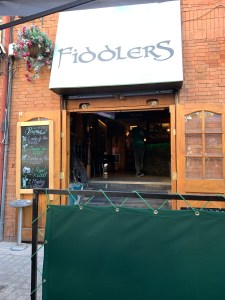
Off to the hotel for a bit of a nap and a shower and then into Santiago itself for an evening drink to meet up with others on their way back – at an Irish bar, obviously. It was a lovely temperature, as the sun slowly set. A proper, brief, summer moment with a cold beer and good company.
All too soon my alarm was going off at 3:30am, as we went to check in for the last leg. Once I’d woken up a bit, it was nice to see familiar faces and easy to spot who had spent Christmas in the UK (pale faces) and those who’d been somewhere warmer (healthy tans).
Nearly there you think, only 4.5 hours flying time to the Falklands. However there’s the small matter of it being a domestic flight as far as Punta Arenas (in the far south of Chile), where we all get off and go through international departures (a booth in the lounge) and get back on the flight, which is now international to the Falklands. So that adds an hour or so. Oh yes, and this is the monthly stopping service that goes to Rio Gallegos in Argentina and collects passengers, which means a 20 minute flight from Punta to RG and then 1.5 hours on the ground, before finally taking off again and landing at Mount Pleasant. Astonishingly, against my expectations, my bags appeared on the carousel and so my journey was complete (but I am always going to collect them at Santiago in future!).
Having done both routes this year, last week I was really clear that the Airbridge is better – because it’s quicker. However events just a week later are making me reconsider! The current Airbridge flight is experiencing all the downsides – passengers checked in at Brize Norton yesterday, only to be sent away to find accommodation in the middle of the night because the storm going across the UK unsurprisingly closed Brize Norton as well as Heathrow, Bristol and Birmingham. Then to add insult to injury, some poor souls checked in on time this afternoon, only to find there is a several hour delay and they could have arrived much later. This time because the weather at the Falklands end is delaying arrival. Fingers crossed after all that, they actually get here!
I think the real point of these travel tales is that the reality is that the Falkland Islands are very remote and difficult to get to. Modern communication means that the distance doesn’t feel great when you’re chatting over Whats App to friends and family, but as soon as you start to travel and the weather starts to act up, it is not a simple place to get to.
Good thing then, that it’s worth all the trouble to get here.
-
Subscribe
Subscribed
Already have a WordPress.com account? Log in now.
 Where is Sarah?