-
FIGAS
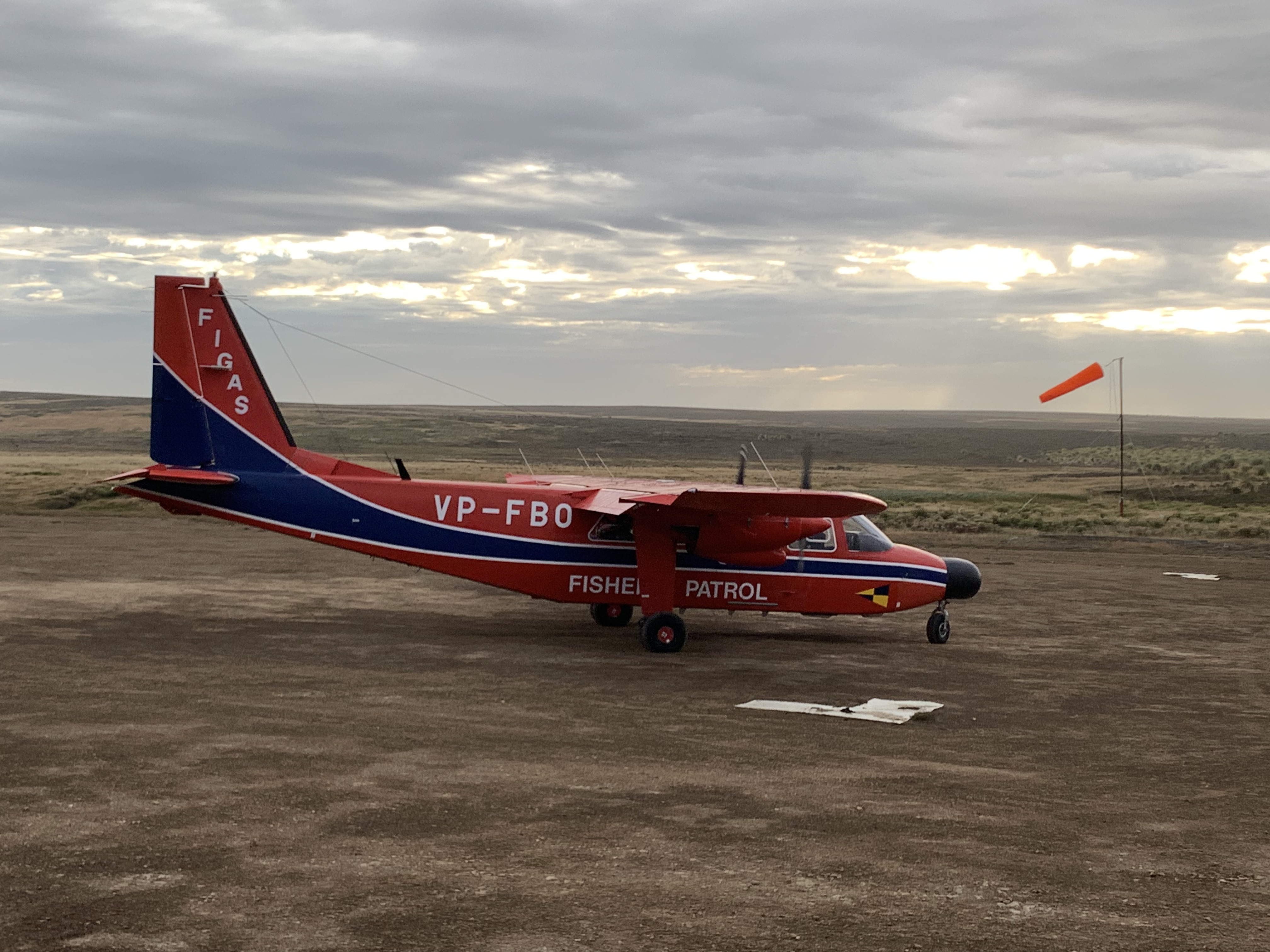
The Falkland Islands doesn’t really do public transport – not on land anyway. However, in the air we benefit from the rather fabulous FIGAS – or Falkland Islands Government Air Service, which will celebrate its 75th birthday later this year.
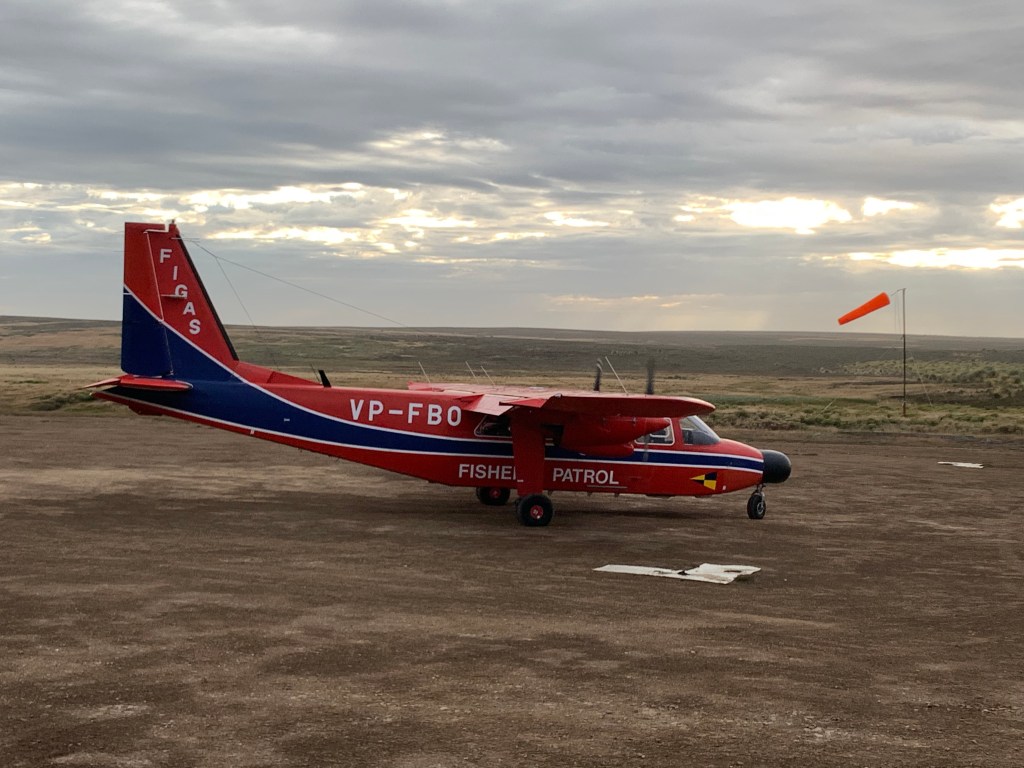
FIGAS flies to anywhere in the Islands with an air strip and they do it in Britten-Norman Islander planes, manufactured in the Solent. These are small, rugged, propeller aircraft that can land on grass airstrips and beaches as required and don’t need a lot of room for take-off or landing. FIGAS has 5 (1 also does fishery patrol surveillance over the fishing fleets) and they take up to 8 people and freight each.
The service takes a little bit of getting used to – there’s no schedule. You contact FIGAS and say where you want to go on which day. They then take all the requests and work out a schedule that makes sense – so a trip that looks like it could be 30 minutes, might take an hour, if there are stops on the way. They also tell you what time you’ll be flying, you definitely don’t get to choose and you need to learn to be flexible, because the day doesn’t always go the way they expect and your flight time can change.
The service is a lifeline for settlements and critical to the development of land tourism, particularly for the Outer Islands who are visited by the supply ship just once a month. FIGAS is the way for many in Camp to reach Stanley for doctor’s appointments, to go shopping or to meet up with friends. Children at secondary school, who board in Stanley, are picked up and taken home by FIGAS at the start and end of each half-term and sometimes will go home for a long weekend or special event.
For me, the great thing about flying with FIGAS is that you really know you are flying, there’s no endless waiting in white, glossy air terminals and then being loaded into a vast plane to be bored for hours on end.
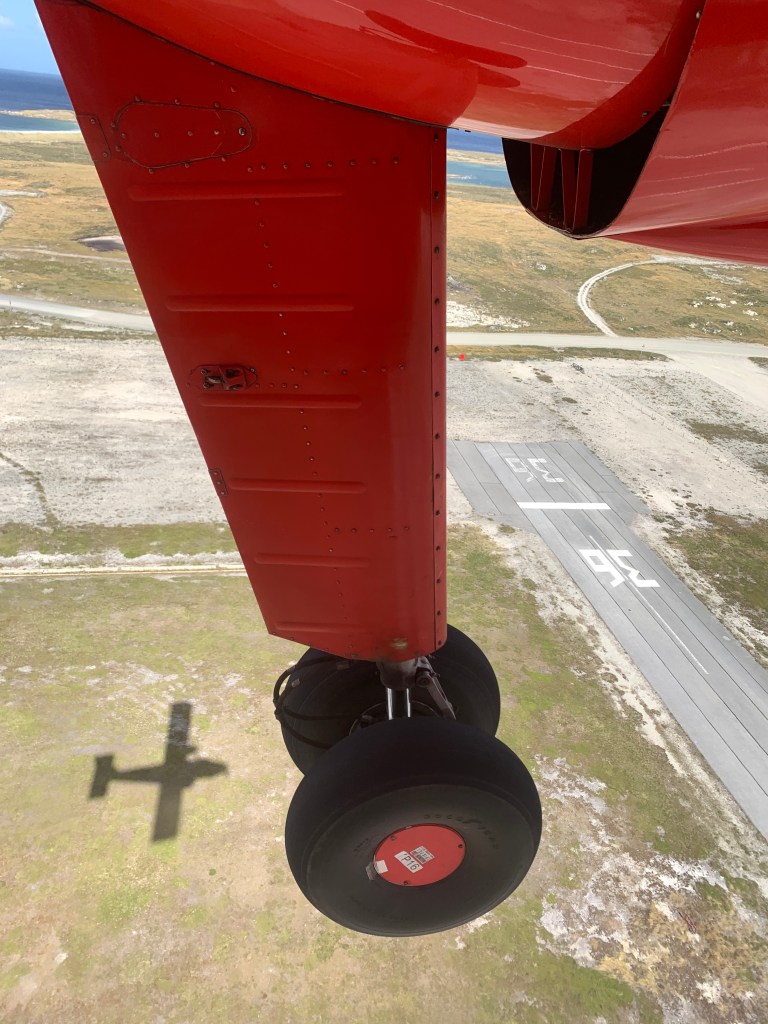
With FIGAS you turn up at the airport in Stanley, are weighed (yes you, as well as your luggage) and then walk across the tarmac to climb up into the plane and strap yourself in. The pilot checks everyone is properly in, starts the enginges and the propellers whirl round. The plane lifts off really quickly and you get a great view of Stanley beneath you as you set off on another adventure. I highly recommend it!
-
A magical, musical mystery
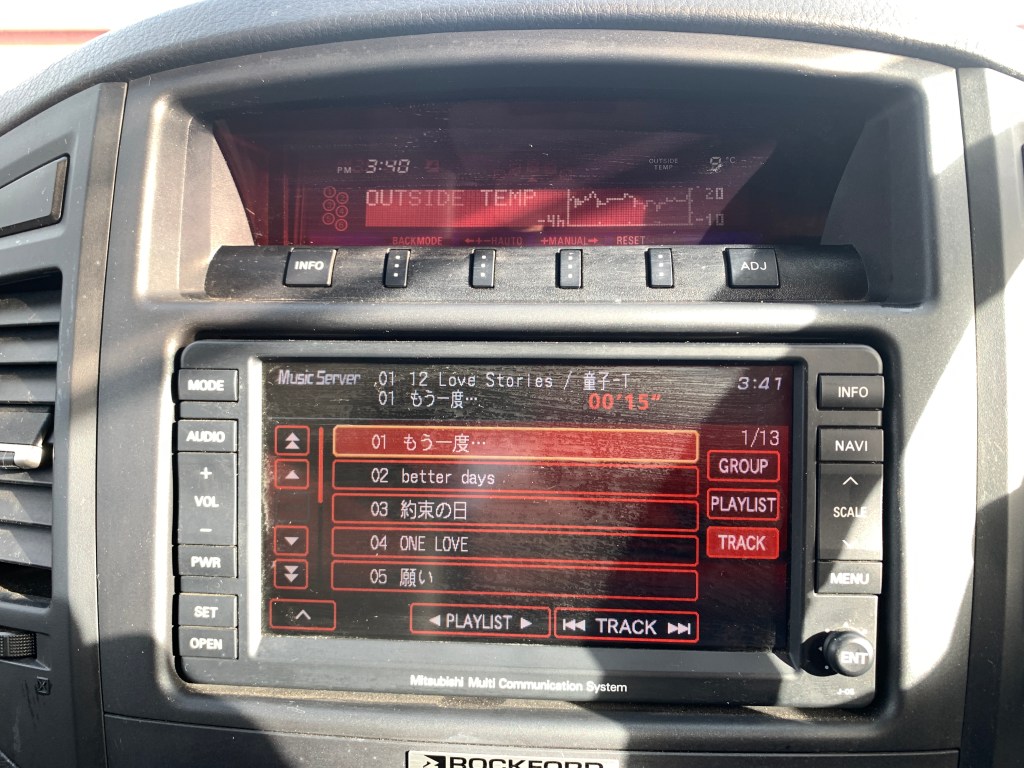
It’s now 5 months since I became the owner of a second-hand Mitsubishi Pajero, a car that to be honest I bought as a “sensible” choice, but not one that makes me smile and appreciate its looks when I walk past one in the street. I spent a couple of months thinking about buying a Rover instead and selling the Pajero; or even buying a Rover as well and having two cars.
However, the Rovers that occasionally came up for sale were not quite right – too cheap or too expensive and so I carried on with the sensible, vast, unprepossessing Pajero.
Then we went West for a long weekend and I drove it, because being able to take it almost anywhere was one of the reasons I’d bought it. I’d been to the West two weeks before in an old government Rover which shook and bounced on the untarmaced roads and refused to go into low ratio when we needed it to, it wasn’t an endearing car. In comparison the Pajero was a star – comfortable, fuel efficient and quick. It ate up the distance with no trouble and I didn’t even need to have it in 4WD. It went up in my estimation and I decided that it was definitely a good thing to keep it through the winter and see how it does on snow and ice.
And then this weekend, it revealed a previously hidden secret to me.
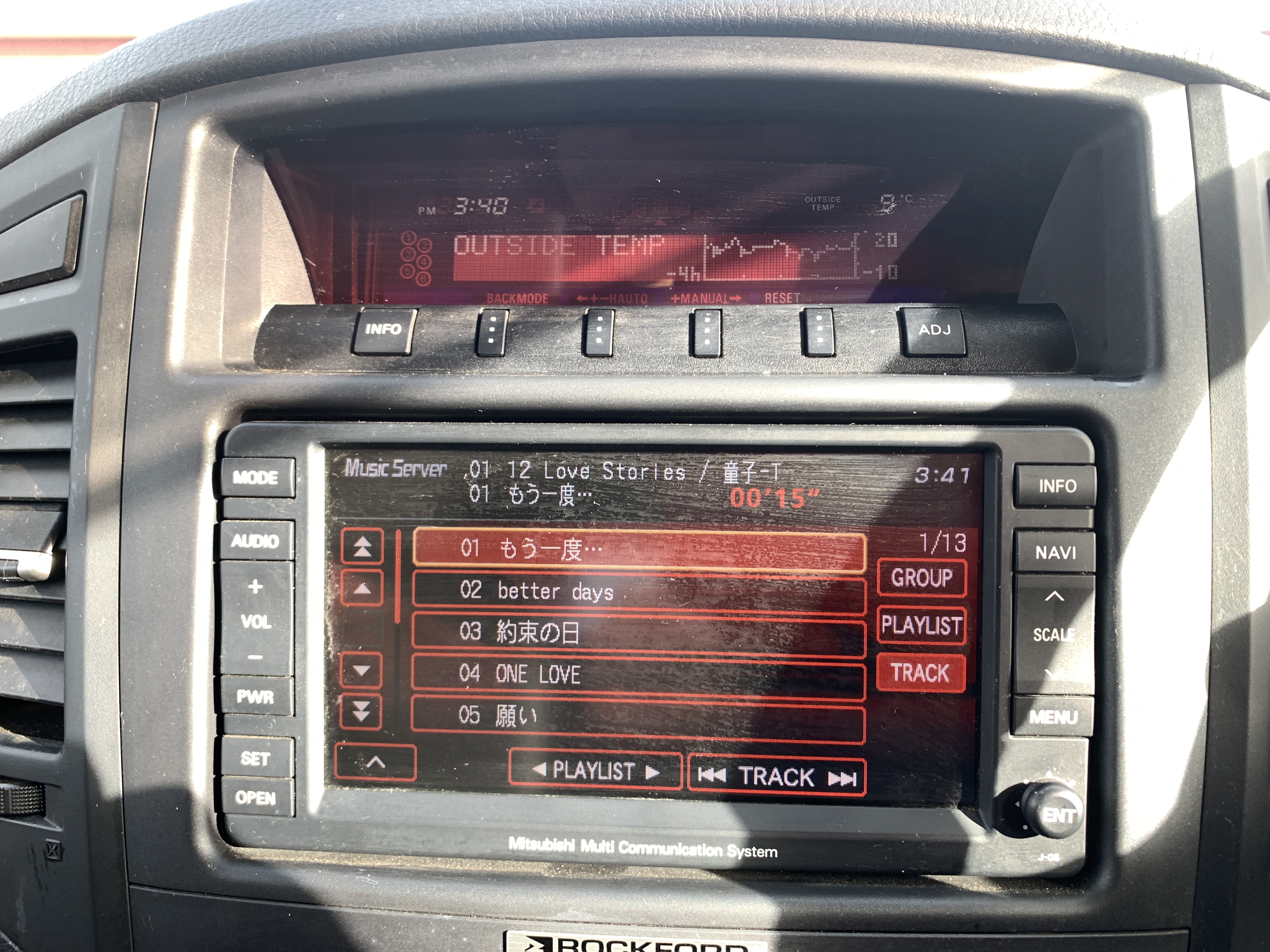
I was in the car, waiting for a friend, randomly pressing buttons on the steering wheel to see what they do. I pressed Mode and it started changing through Audio modes – FM1, FM2, AM and then something called Music System.
A pause and then the sound of melodious Japanese pop filled the car…. I burst out laughing at the unexpected, ridiculousness of it and spent the rest of the weekend demonstrating the car’s party trick to anyone who got in it. So far we have tried a playlist called Love Stories and I’ve found something that appears to be a Christmas playlist and some Beatles!
I need to go back to Google to find out what on earth is going on – but I rather love the fact that my awkward looking, brick of a car has brought a bit of Japanese culture into my life with the ethereal, whimsical sound of J-pop. I’m not sure any Rover can top this…
-
Winter is coming ….
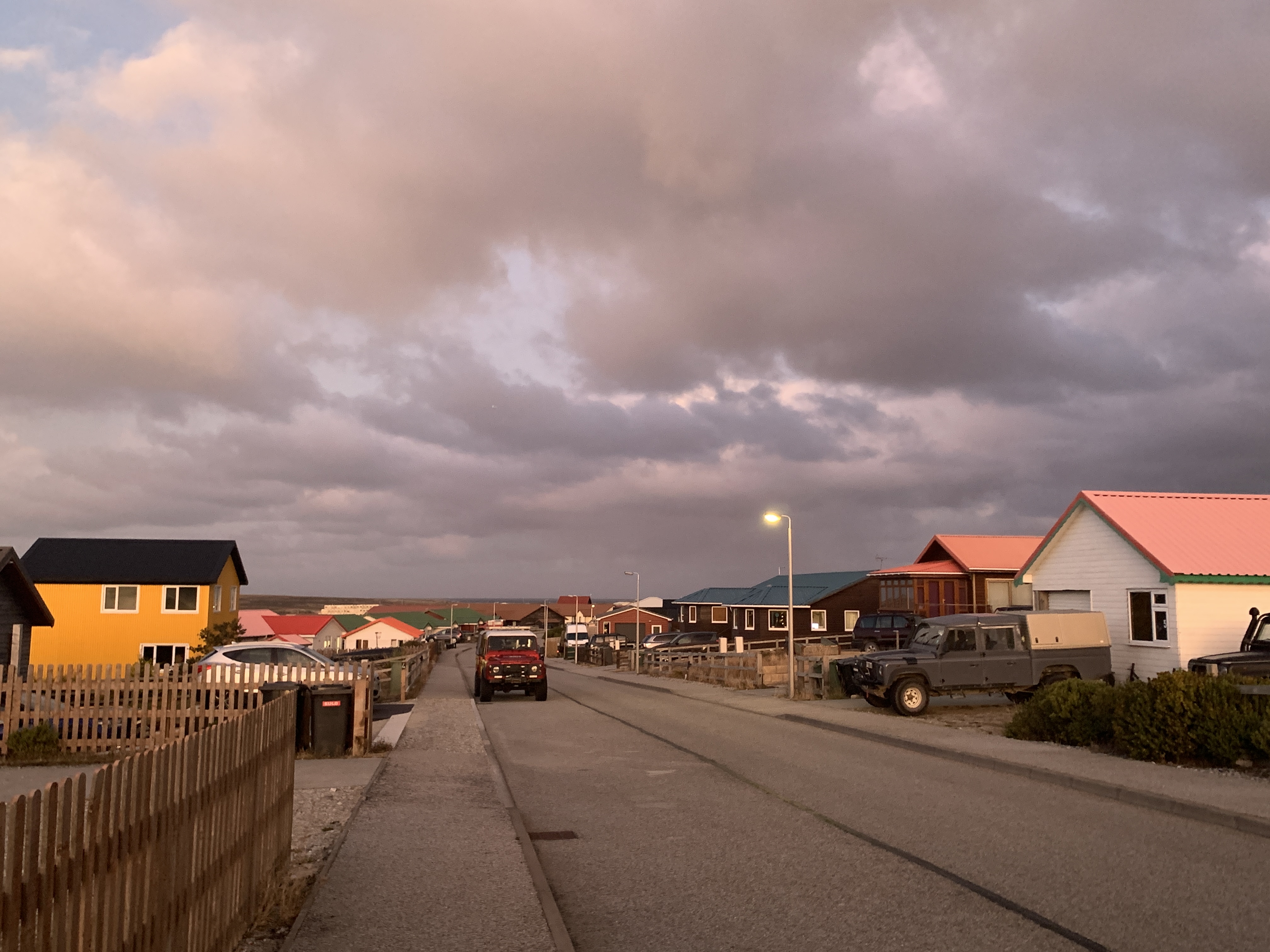
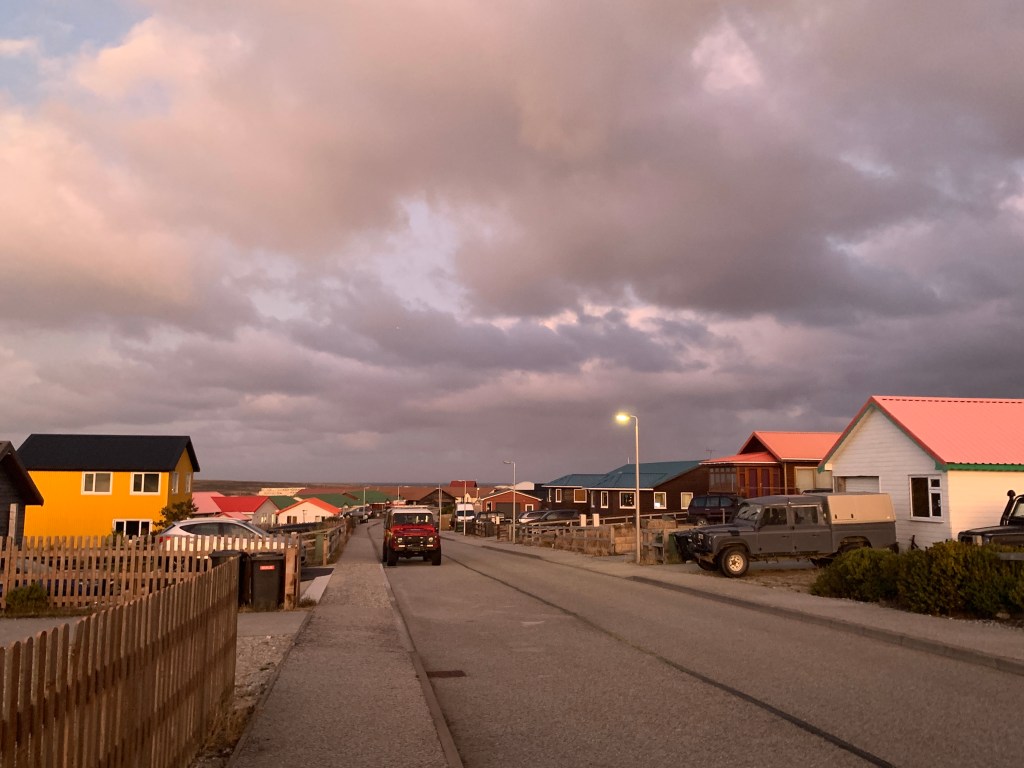
Not winter yet – but ominous times Well actually it’s not yet – it’s March, which is effectively autumn in the Southern Hemisphere, however, ever since I arrived here I have heard the following phrases:
- Wait until you’ve done a winter here, it’s really hard
- It’s so dark in winter, it’s dreadful
- It’s very cold
- You need to find things to do in the long evenings, to get through the winter
And ever since the solstice on 21st December people have been saying… the nights are drawing in.
Now, not to get too optimistic about my view of all this:
a) THE DARK – I’m from a country which is the same latitude north, as the Falklands are south – and I’ve looked up sunset and sunrise times here and for Oxford (same latitude as Stanley more or less) and the summer days are similarly long and the winter days are similarly short.
I’ve even spent some time learning about twilight and why it’s light longer after the sun has set in the summer, than it is in the winter. But that happens in both hemispheres as well.
So really I’m expecting it to be very similar to the way it gets dark in the UK, which I understand is distressing if you’re from Australia or St Helena or other places without the same level of change in daylight, but I do not think it is going to be like Finland or Iceland.
Remind me of this bold statement if I start to moan about the dark.
b) THE COLD – it isn’t going to be that cold. It is going to be colder than the city centre of Southampton and there may be more snow around than I’m used to and certainly more than my warmer weather friends are used to, but I think it’s going to be a bit like northern Scotland and Shetland. It is not going to be like continental winter in the USA or Canada or Europe – no one is going to find their eyes frozen shut because their eyes watered and their eyelashes got stuck together, which is an American friend’s yardstick for cold.
c) Will I need more things to do in the evening to occupy the hours of darkness? I don’t know – but I do know that I struggle to fit everything in at the moment and I have hundreds of photos to sort out, so I feel like I shouldn’t get bored. And I’m used to going to work in the dark and coming home in the dark, so I think it will be ok.
On the plus side:
I’m looking forward to finding out how much less windy it is in the winter – apparently it is, everyone says so, so it must be true (but then they also talk about the cold and the dark….)
I’m also looking forward to finding out which wildlife stays around and what leaves – I think King Penguins and Gentoos stay and I know the beaches look really good against dark, moody skies – so more photo opportunities perhaps!
And I’m looking forward to easier night sky viewing – because it will be dark early. A benefit of the Southern Hemisphere is that we look directly into the centre of the Milky Way (I heard Professor Brian Cox say that, so I really believe it to be true) and on a clear night it is really astonishing and gorgeous to look up into a carpet of stars – more of that will be very good.
So now, having belittled all the dread predictions about winter in the Falklands, I just have to wait and see and next September when spring arrives, I need to revisit this post and tell you what really happened.
-
Christmas comes but once a year
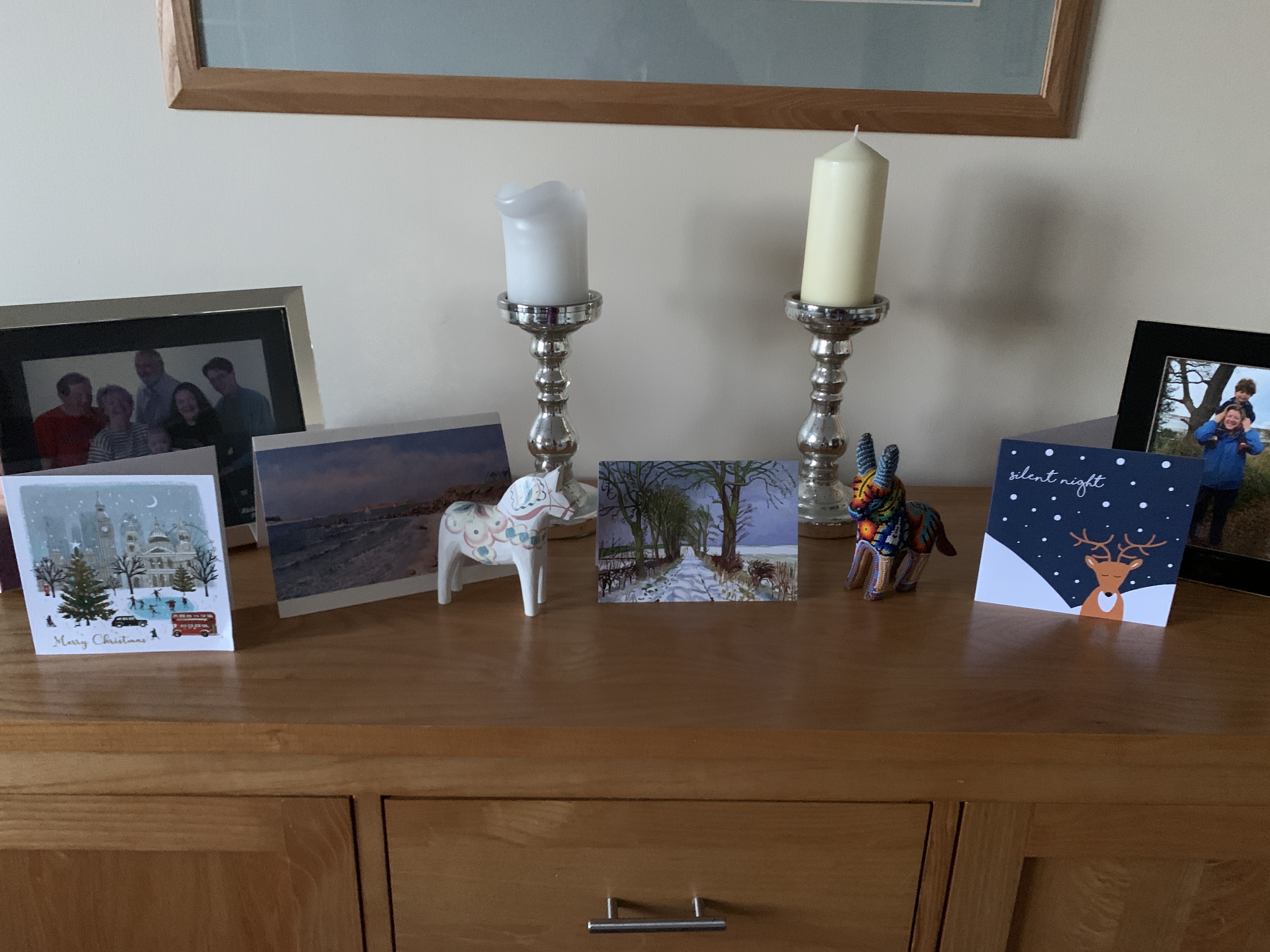
Or apparently more often in the Falklands! This year has been quite odd – firstly it was because of strikes in the UK, which meant that many many Christmas parcels were delayed.
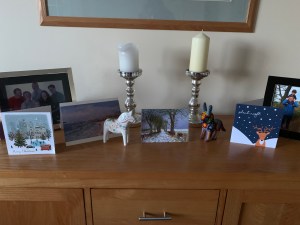
For me this meant that most of my presents arrived post Christmas but at the start of January. Then Royal Mail were hit by a ransomware attack, which meant that for weeks and weeks we got absolutely no airmail at all. Every time a plane arrived, there’d be a sad little message on Facebook from the Post Office to say that there was no airmail on the plane again. Reactions went from cross, to sad, to jokes, to forgetting about it.
And then the glorious day came when airmail started to arrive again and Christmas reappeared! I got my final Christmas parcel from my parents this week and various things that I’d ordered have been turning up over the last two weeks – the dates posted range from late November to end of January. The date posted in the UK seems to have little relevance to the order they’ve arrived in!
And today more cards arrived in the post. So it may be March, but the cry of “Merry Christmas” is ringing round the Falklands once again. I wonder how long it will last? Perhaps until FIXmas, but that’s a post for another day.
-
Say Hello
As a city dweller for some considerable time, I have definitely perfected the behaviour of politely passing strangers in the street unacknowledged.
However, in the Falklands I am learning new customs (or relearning, because as a country child I knew how to do this). To begin with, walking down the street I was prone to startle when someone I didn’t know said hello or good morning/afternoon. 5 months in, I’ve changed and happily reply in kind.
Interestingly, saying hello when passing is not confined to walkers – it extends to cars. When I first arrived, I thought that the people giving me lifts knew an extraordinary number of people, as they waved away at passing vehicles – but I quickly learnt, it’s the custom to acknowledge any passing car.
There are a variety of techniques – firstly you need to wave far enough away that the other person can see it. If you wait for them to wave before responding, it’s generally too late and you’ve gone past them and look rude.
Once you’ve got the hang of when to wave, you have a number of choices about how to do it.
- There’s the madly enthusiastic – take your hand off the wheel completely and wave as if you’ve just seen your best friend;
- The moderate – lift your hand just of the wheel momentarily and down again
- Minimalist – one finger extended forward from the wheel in a barely discernible gesture.
I’m not brilliant at this – I’m often a bit late but I’m learning and I think by the end of my first year I’ll be a pro.
-
Lawnmowing
How on earth could anyone want to write or to read a post about lawnmowing, I hear you ask.
Has she lost her mind?
Surely she hasn’t developed an interest in perfect, green, stripey lawns?
No I haven’t and although I have a garden, it would be better to call it a piece of land rather than a garden.
The downside to a very serviceable government house, is that no one lives in one for long enough to put much effort into their garden. Mine is mostly growing an excellent crop of dandelions which are outcompeting any grass very effectively.
There are some lovely gardens in Stanley, that people put a huge amount of effort and creativity in to – particularly in combating the terrible effects of wind, however today is about lawnmowing not flowers and vegetables.
I don’t have a fenced-in garden, so my only real choice for lawnmowing was a mechnical solution – in this case a very nice man who brought his strimmer round and brought everything under control.
However, if you have a fenced-in garden, you have more options and so I present to you, some of the choices for this season.
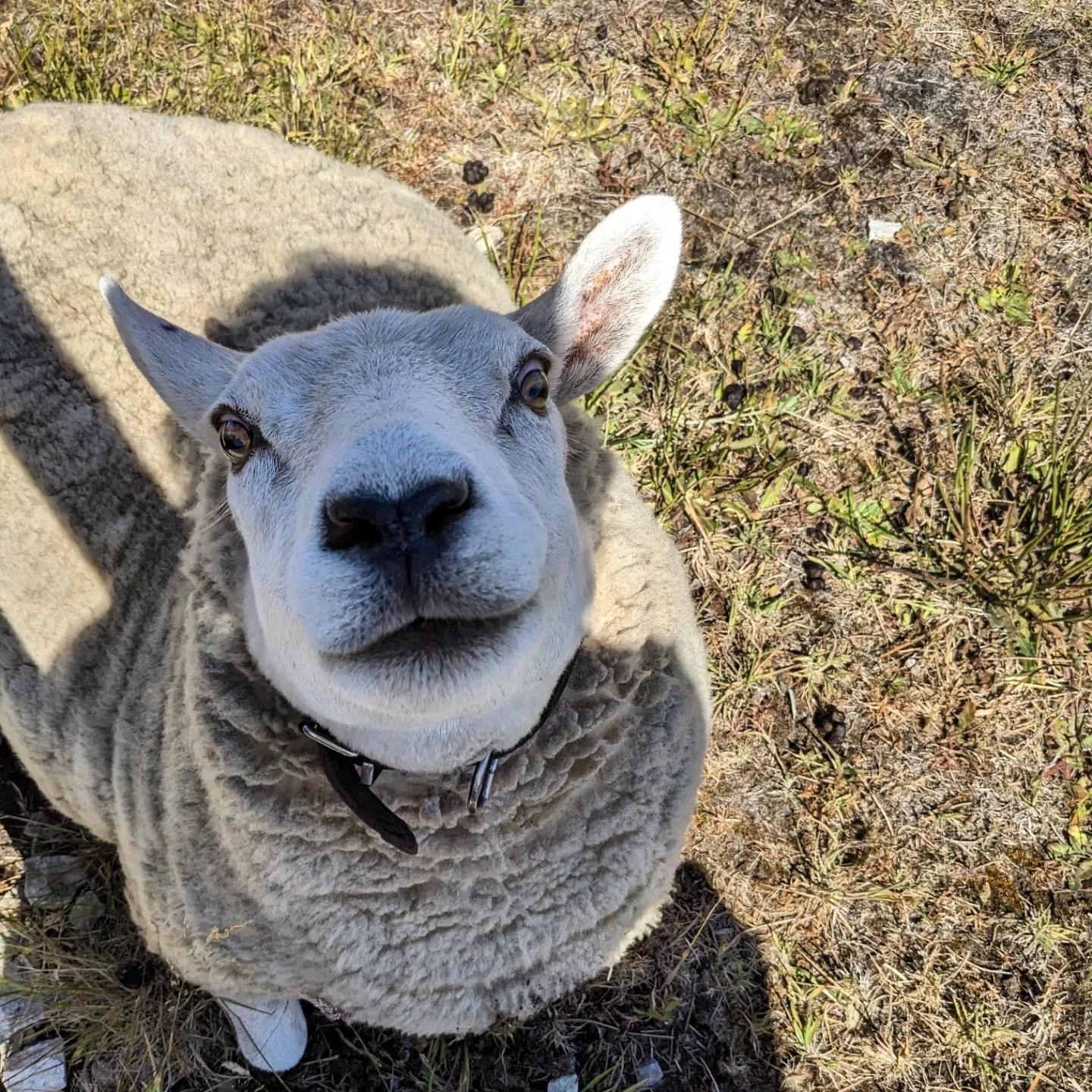
First up – Barbara – recently employed in Sapper’s Hill. Docile, friendly and didn’t try to escape (thanks to Becky for the photo)
Or you could choose to employ tiny horses, as Amanda did, (this is her photo). They’re pretty to look at but can be demanding, are always in search of apples and other treats and are liable to try and come into the house

Or as my neighbours did, for a day – have full sized horses in your small garden, which could have stepped over the fence but for some reason stayed placidly inside and didn’t strangle themselves on the washing line. Falklands horses seem to have a lot of common sense!

-
Out West
Recently I went to West Falkland to visit our settlement school at Fox Bay Village and the farm schoolrooms and more importantly to meet the children in those schools, the parents and teachers.
A short aside – the Falkland Islands is made up of over 700 islands from very small to large. The two largest are East Falkland (Stanley is in East Falkland) and West Falkland. Interestingly, unlike the Orkneys and the Shetland Islands, who both call their biggest island “Mainland”, there is no such place here, every inhabited island is referred to by its name.
I’d been told that West Falkland is really beautiful and I listened politely, but didn’t really believe it could be that different to East Falkand. After all it has more or less the same flora, hills, rocks – how could it be that different? Reader, I was wrong. It’s spectacular and I loved it.
First to reach it – we took the ferry on the way over – it runs from Newhaven to Port Howard on the Concordia Bay, which doubles as supply ship to farms and outer islands, so there isn’t a ferry every day, you definitely have to pay attention to the schedule, because missing it could mean a very long wait.
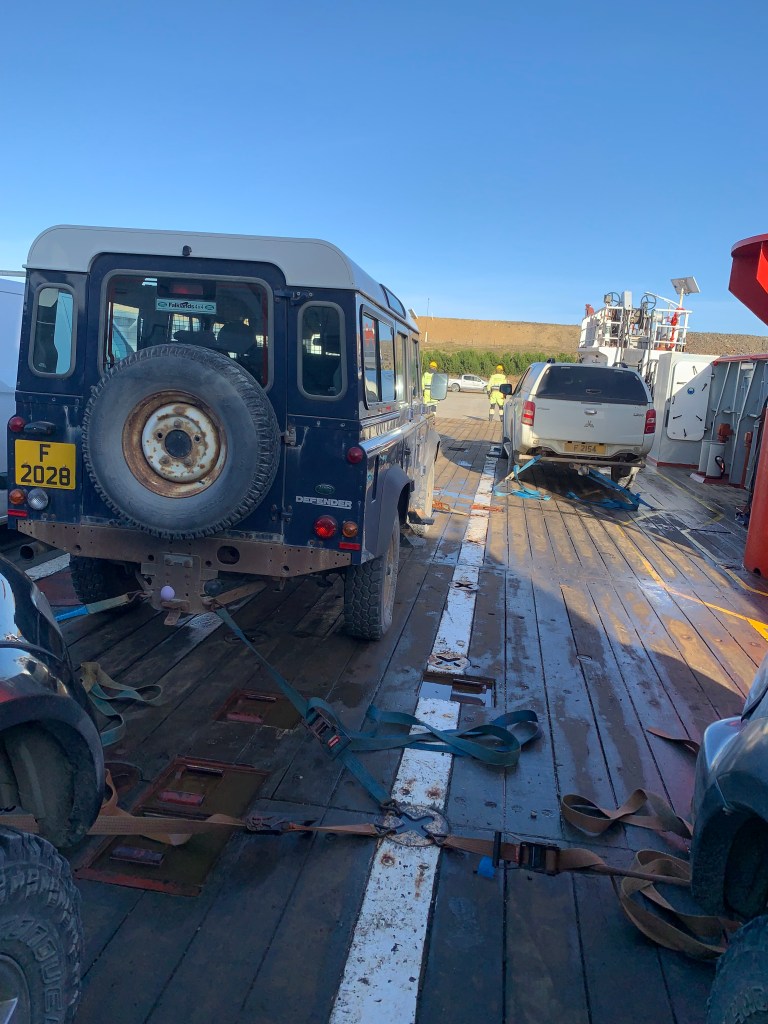
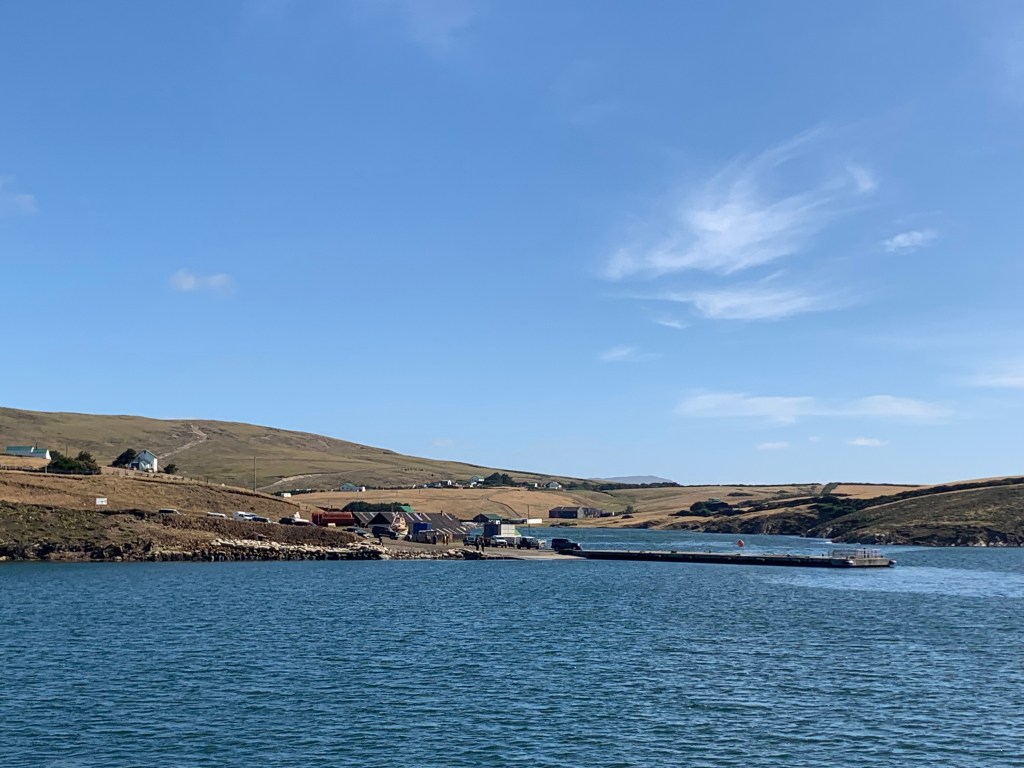
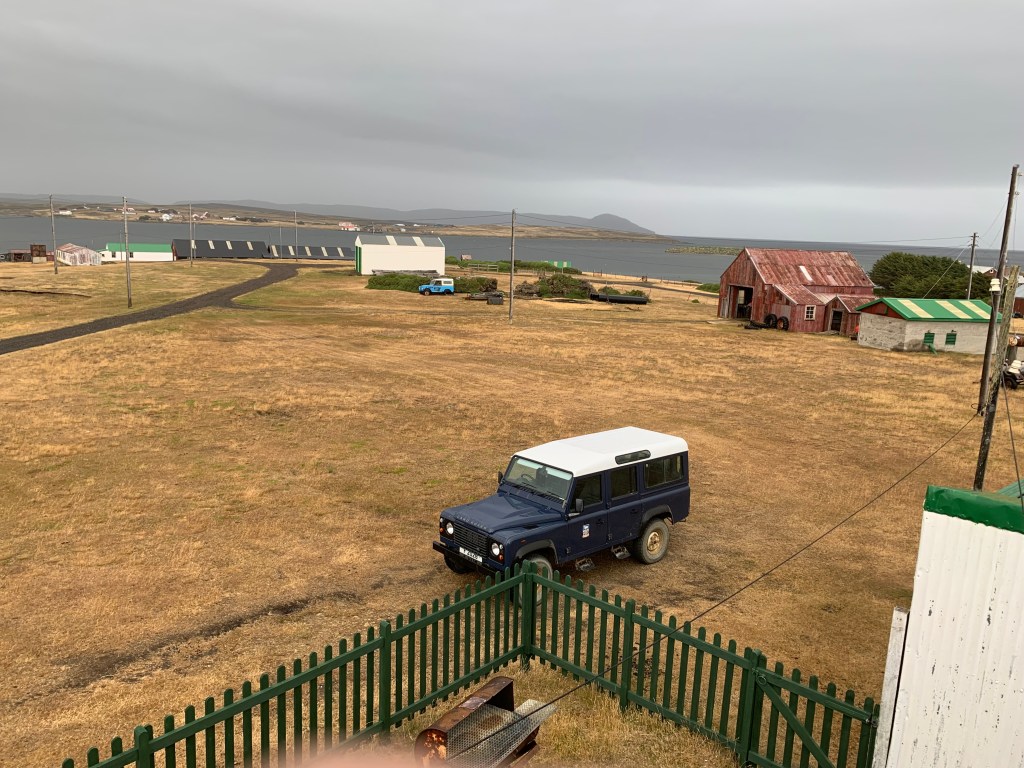
We were driving the Landrover pictured above – not the most up together vehicle (we couldn’t persuade it to engage low ratio when we wanted it, on the day it poured with rain) but it did the job. The white pick-up on the right is the vehicle of one the travelling teachers. They need capable vehicles that will cope with gravel/clay roads all year round and that they can transport key resources from one farm to another.
We drove down from Port Howard to Fox Bay Village – West Falkland is 80 miles long in total and 45 miles wide at some points, but the west coast is full of inlets and bays, so it often doesn’t feel very wide and certainly in the south there are points where you can see sea on both horizons.
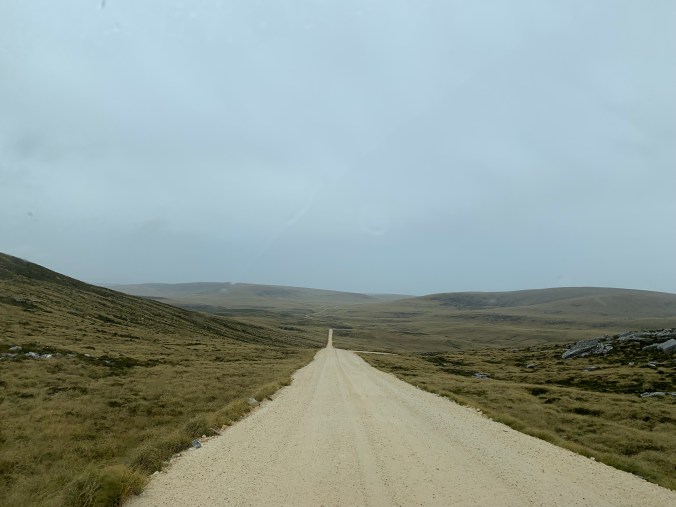
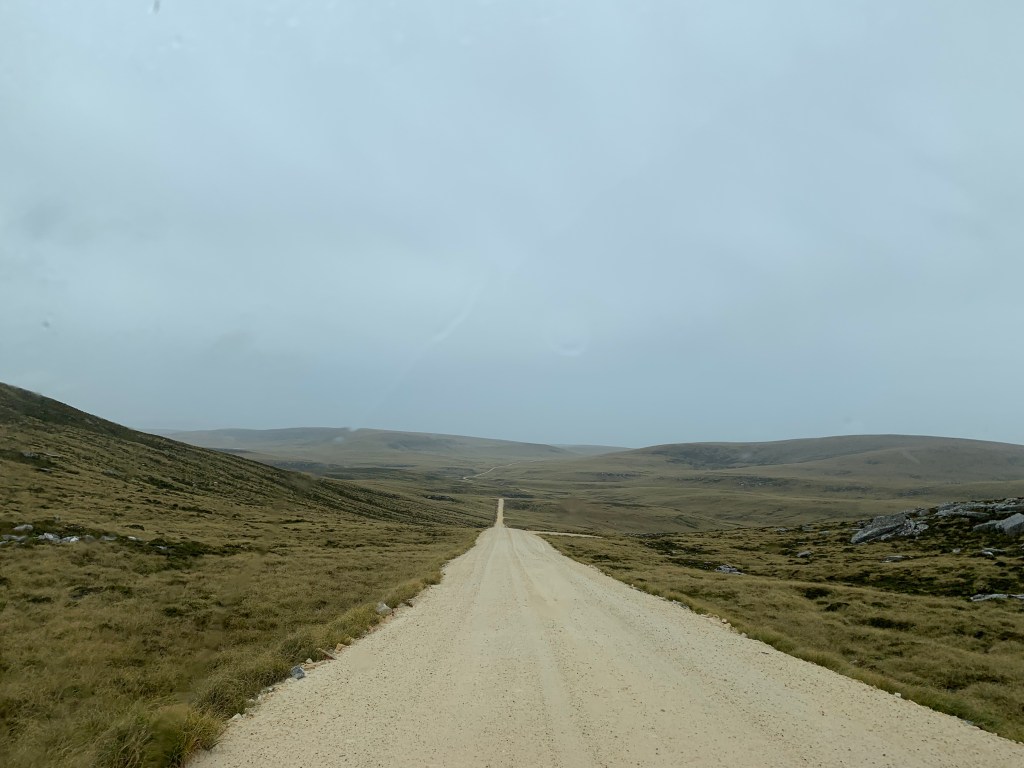
80 miles doesn’t sound long on paper – but the distance is deceptive. The road is single track, gravel/clay and goes up and down – in some places like a rollercoaster of bumps and in others with steep hills and curves. So even in dry, summer conditions it is quite slow going. Bizarrely it seemed to take us about an hour and a half each journey:
- Port Howard to Fox Bay – an hour and a half
- Fox Bay to Albermarle – an hour and a half
- Fox Bay to Port North – an hour and a half
- Hill Cove to Port Howard – you’ve guessed it, an hour and a half
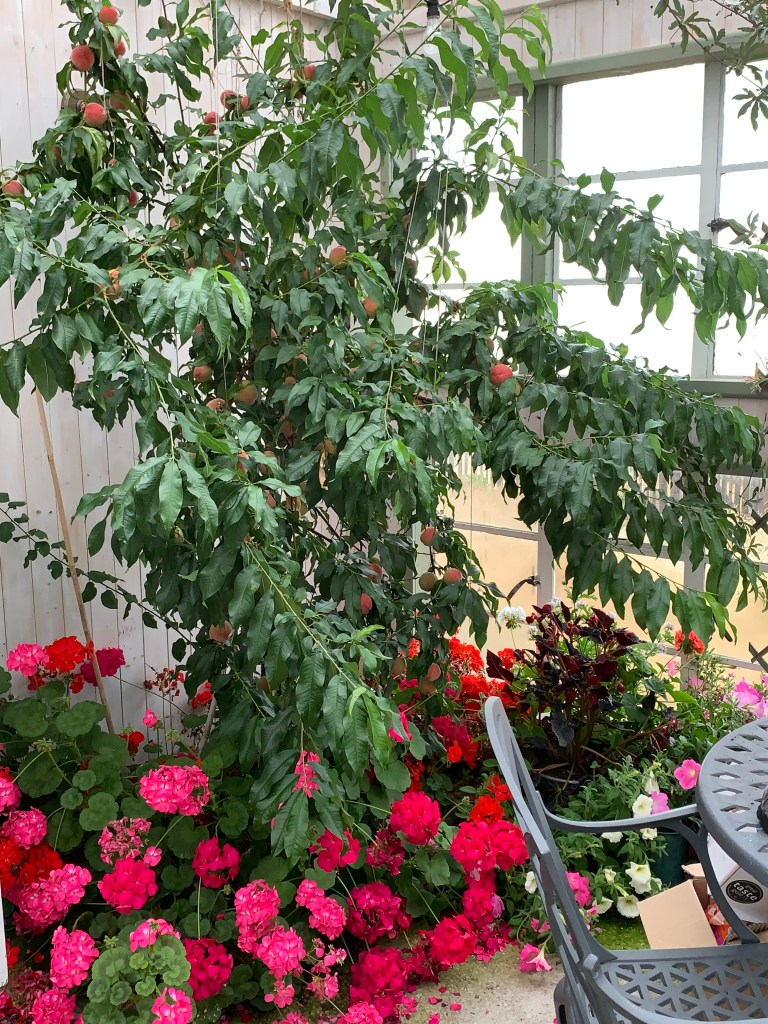
We stayed for two nights at Fox Bay Village and were invited in and made welcome – I developed a severe case of view envy, as each house seemed to be built looking out over spectacular views. I was also interested to see people’s walk in pantries/store rooms. Practical as cool storage but also essential in terms of keeping enough of your own stores, that you don’t suddenly run out of essentials. I coveted a lovely, Victorian style conservatory built on the end of one house, which meant that they had fabulous summer flowers and fruit trees – the peaches were small but delicious and we were given some to take away for lunch the next day.
After three days on West Falkland, it was back home from Port Howard. There was no ferry though, as it had gone off to be a supply ship, so it was home by plane, having found someone to put the Landrover on the next possible ferry – to be collected from Newhaven.
For anyone visiting the Falklands as a landbased tourist, I’d thoroughly recommend some time on West Falkland and indeed I’m going back to Hill Cove in a couple of weeks, so standby for more scenic views!
-
The Lunch Hour
Life in the Falkland Islands and particularly working life has many habits and customs that are very familiar to me. However, there is one custom that stands out as being totally different to the UK and that is the Lunch Hour.
In the Falklands, the lunch hour is midday to 1pm and this seems to hold true across almost all employers and locations. Not only is it at a set time it is also strictly observed, people do not work through lunch, they do not eat lunch at their desks – they go home or at the very least go out to eat their lunch. No one ever organises a meeting in the lunch hour, people just won’t come and I have yet to encounter anyone trying to organise a working lunch, it doesn’t seem to exist.
How has this happened? No one is really sure, but it does seem to revolve around the fact that children go home from school for lunch. Indeed the schools do not have kitchens or any catering facilities, as at the time they were built the expectation was that all children would go home for lunch.
Although I have not adapted to the extent that I go home for lunch, I do appreciate the space that the lunch hour gives you. On a nice day I will eat my lunch outside and go for a walk. I have quickly learnt to appreciate the fact that there is an hour in the working day when you can stop and no one will send you an email or expect you to answer the phone.
It’s a practice I think the UK would do well to consider adopting!
-
A post about Post…
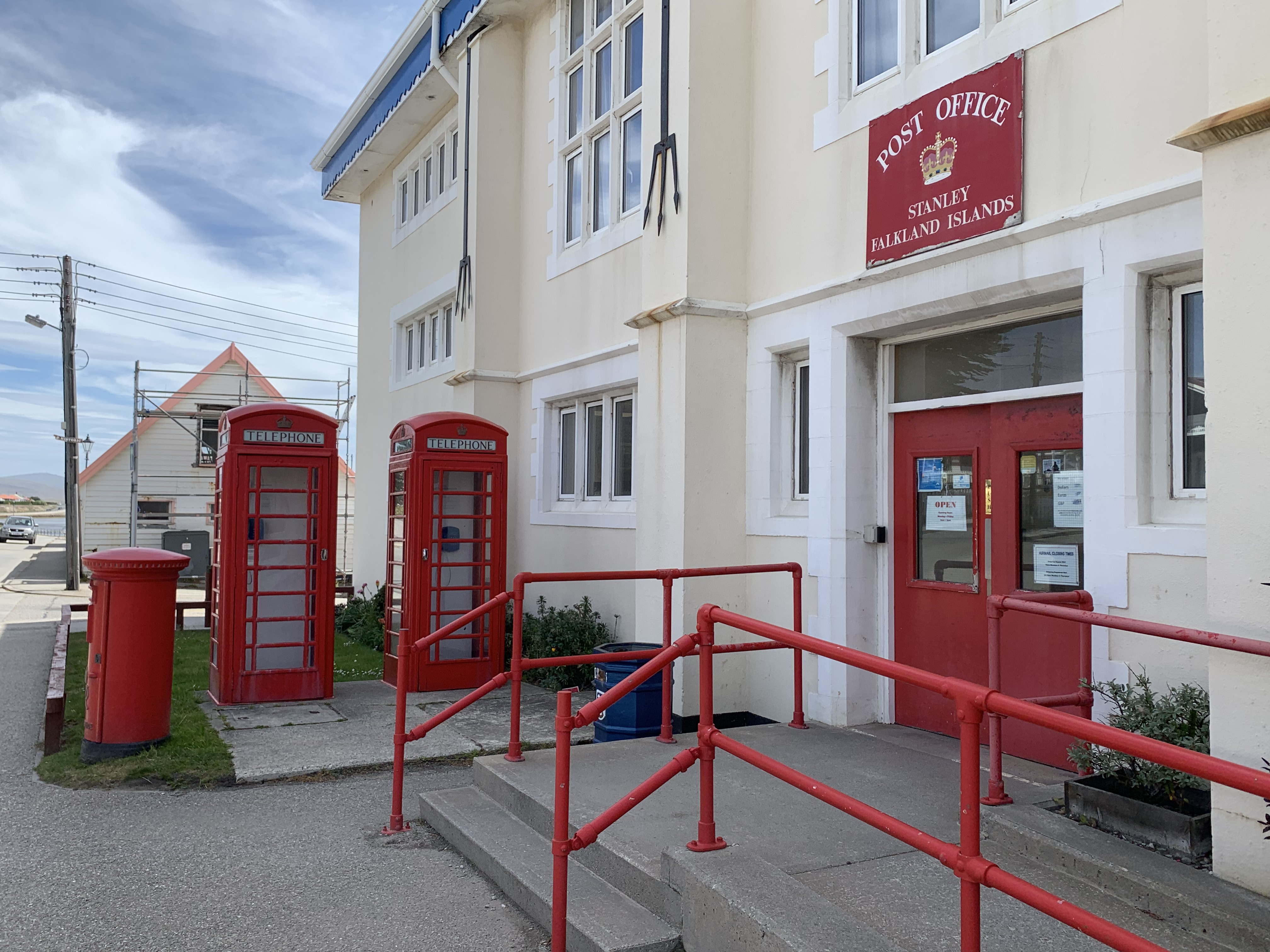
In our increasingly connected world, physical post has become much less used and less important but there are still times of year when we all like to receive physical post – especially birthdays and Christmas. And when one is away from home, post becomes even more important (as anyone who boarded at school, travelled for months or lived away from family and friends for years will already know). There’s something about the effort taken to write a physical letter or card and send it, which is better than an email or message, and of course you can display an actual card or postcard and enjoy it for a considerable time.
So having established that physical post is a good thing, how does it get to the Falklands? I have to own up and say I’m pretty sure about what happens from the UK, but am less sure about the rest of the world. UK post comes with the RAF – in theory there are two flights a week and in theory they can all carry mail. In practice not every scheduled flight flies, mainly due to the dreaded rotor winds (I’ll explain another time) or due to a forecast gale or due to RAF operational priorities. Even if the flight does come there’s probably a limit to how much mail it will bring on top of all the other supplies it is transporting.
When all goes well mail can make it in about 10 days to 2 weeks from the UK to the Falklands or vice versa, however Christmas is a pressure point with more mail than usual (and the last day for posting North to arrive for Christmas was 1st December, which I didn’t entirely meet…) and of course this year strikes in the UK have also slowed things down. Which is a long winded way of saying that very little Christmas post arrived in the Islands this year and that those of you to whom I sent Christmas cards might have to see them as Happy New Year cards!
Once the mail has arrived it does not get delivered to houses, since there is no postal service. It does go to the Post Office in the centre of town and is put into PO boxes.
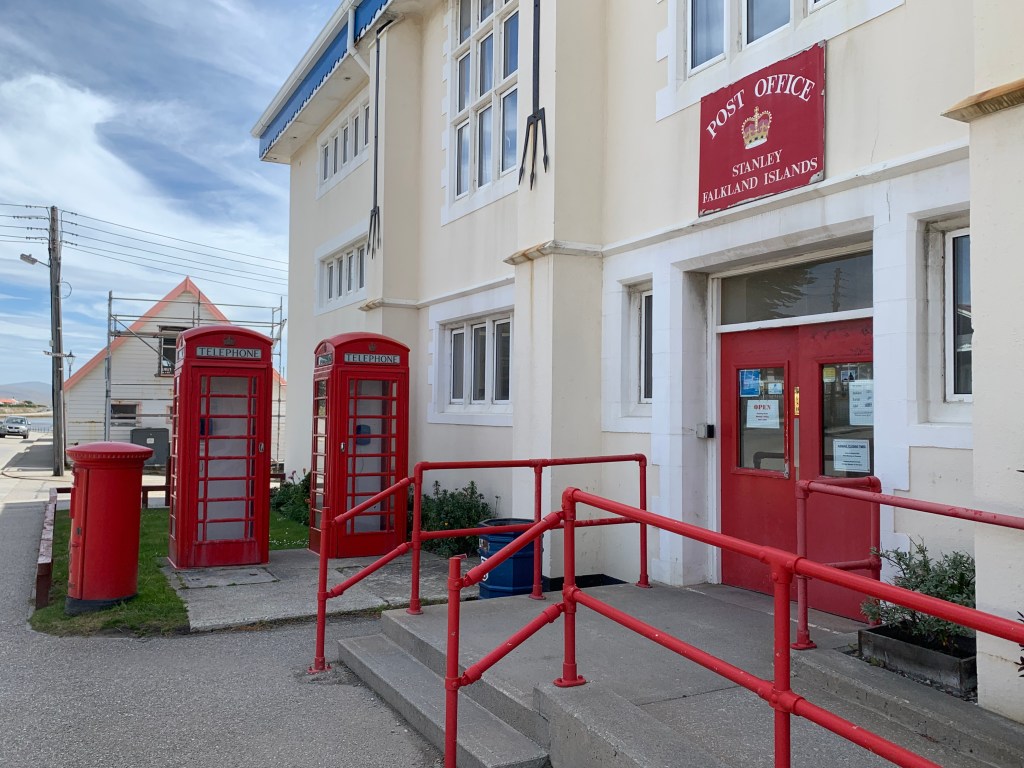
You can have an individual one but most people have theirs delivered to their workplace PO box. So it doesn’t matter if you address post to me at my house, or at the office, or Sarah Stannard, Falkland Islands – it all ends up in the same PO box, waiting for one of the office team to come and collect it one afternoon.
So, if you did send me something for Christmas, its arrival will make for a cheerful afternoon sometime in January (fingers crossed!)
-
A Falklands Christmas
As it’s my first year in the Falklands, I thought I should spend Christmas here and enjoy a southern hemisphere Christmas. It took me a while to feel Christmassy, as I was missing my usual cues – days were getting longer, not shorter; there were no endless Christmas songs in shops (until the final week or two); the shops didn’t convert to Christmas the instant Halloween was over but only became really Christmassy once the December supply ship arrived, with all the Christmas goodies.
I also had to be more organised than usual in buying Christmas cards and posting them to the UK, as the last date for airmail was 1st December. I slightly failed on that and certainly didn’t factor UK postal strikes into the mix, so some people will be receiving Happy New Year cards by the time they make it there. Lesson learnt for next year!
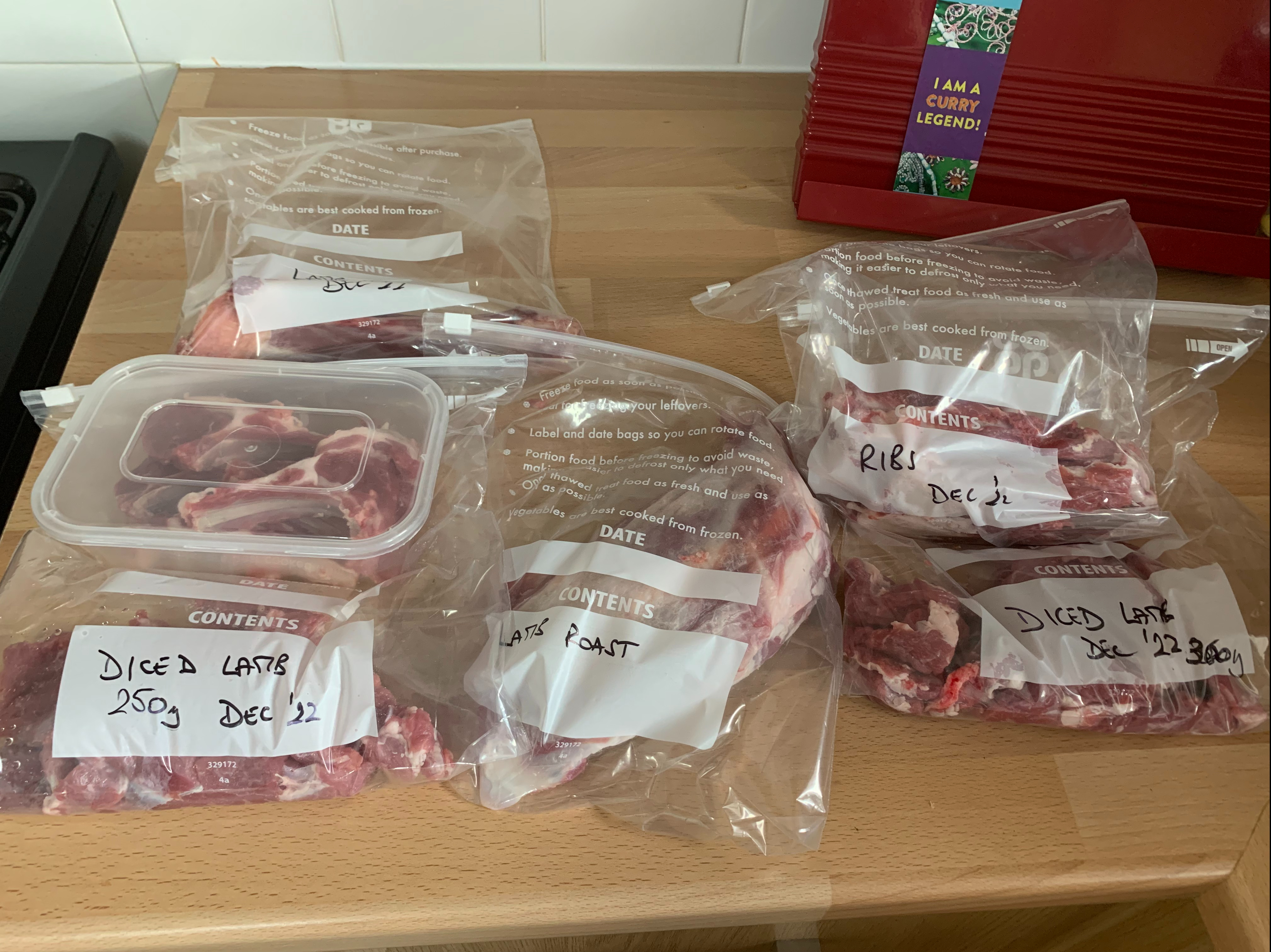
Work stopped at lunchtime on 23rd December. I made my first food shopping stop in one of the public car parks, to collect some lamb and carrots direct from the farmer and then tested out my butchery skills, with the aid of helpful Australian Youtube videos on how to butcher lamb! Needless to say I did not have the right tools for the job and it wasn’t always easy to see what the experts were doing but I did manage to produce some recognisable cuts of meat – not entirely sure I’ll be doing it again!
The other thing that happened on the 23rd was Christmas food shopping and it did look like Armageddon the way everyone was stocking up – but to be fair, here the shops were generally closing on 24th and not reopening for several days, so there was some excuse for the laden trollies.
Christmas Eve was notable for ear splitting sirens shattering the peace of a calm afternoon. It sounded like Stanley was burning down. I went to my front door and sniffed – could I smell smoke? I went to the back door to see if I could see anything. I met my neighbour who was similarly mystified.
And then round the corner, in the street below us, came Santa …. on his way to the Town Hall to meet local children and being taken there by the Fire Service, with all of their sirens and blue lights going full blast.

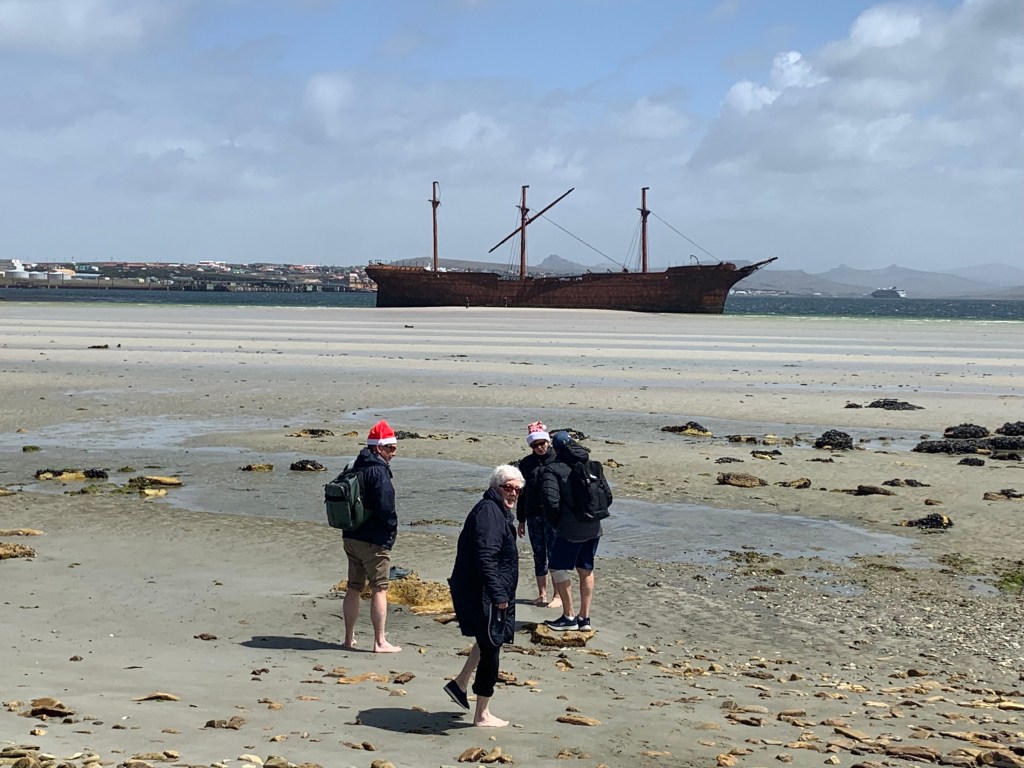
Christmas Eve carol singing at the Whalebone Arch And so to Christmas Day – it coincided with a very low spring tide and we were able to walk out to the wreck of the Lady Liz at the edge of Stanley Harbour – a real “Oh wow” moment, given that one is normally looking at lots of water between the shore and the wreck.
And then off to a lovely lunch, kindly hosted by Jo and Gaynor using both of their houses. We all brought a contribution, which at one point looked like we would only be eating puddings, however after some reorganisation we had a feast of several courses. Champagne and pumpernickel bread (Canadian) and crackers and dips (South African) outside in the sun and then turkey, ham, lots of roast vegetables and sometime later lovely puddings and cheese. Followed by a number of silly games, until eventually it was time to leave our hosts in peace and go home to bed. A memorable Christmas Day.

-
Subscribe
Subscribed
Already have a WordPress.com account? Log in now.
 Where is Sarah?